


Recliner Reupholstery Breakdown: How the Hardware Shapes the Fabric Work
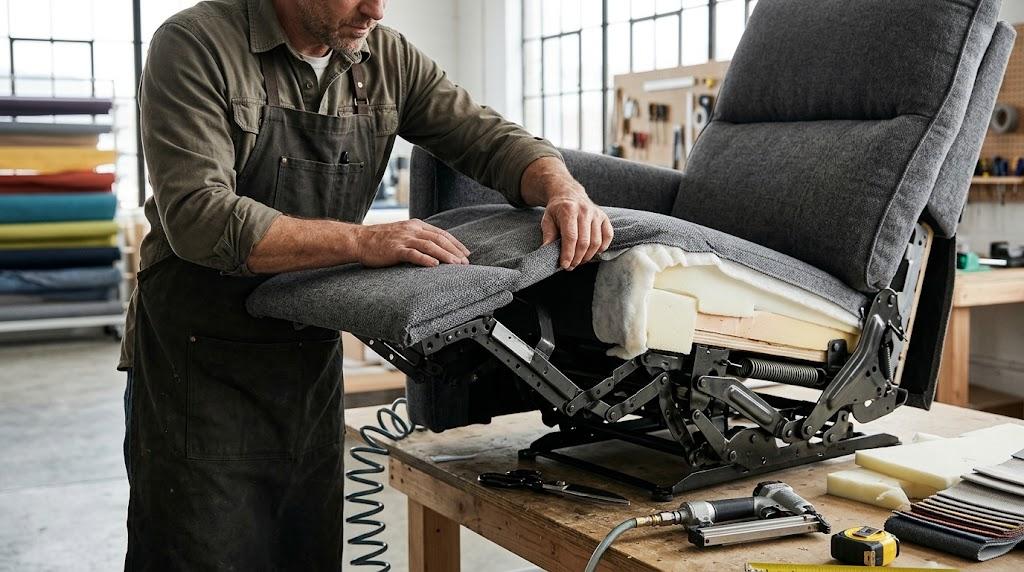
Think about a convertible car roof. The material needs to stretch over a folding frame, seal tightly when closed, and fold without tearing. Recliner sofas present a similar engineering problem. The fabric stretches across a pivoting structure that changes shape on command, and it has to look composed in every position the mechanism allows.
Success depends on understanding three things in order: how the mechanism operates, where the fabric takes the most punishment, and which textiles are built to handle that kind of punishment.
Inside the Mechanism
The skeleton of a recliner is a lattice of steel linkages, springs, and glide tracks. Every component moves within a defined arc, and all of those arcs overlap with the fabric surface in different places. An upholsterer's job is to give each of those intersections enough room to operate without binding.
The concept of "ease" — deliberate slack left in the fabric at joints and folds — is the primary tool for this. It is not an accident or a shortcut. It is a calculated allowance. Techniques like welt cord reinforcement and boxed-corner construction anchor the panels at the points of highest stress so the extra fabric does not simply collapse into wrinkled messes.
Disassembly comes before any cutting or sewing. Anyone who provides sofa upholstery services knows that a recliner must come apart at the frame level. Seat assemblies get unbolted. Release cables disconnect. Each panel is stripped, measured, and recovered as an independent piece on the workbench. Skipping this step and attempting to staple around an assembled mechanism almost always produces visible misalignment.
Powered models add electrical complexity to the mechanical picture. Motors, wiring harnesses, and control boards occupy the interior channels of the frame. The fabric path must thread between all of them without contact. A staple through a wire loom is an immediate failure. Even indirect pressure from a taut panel against the motor housing can cause overheating and premature burnout of the actuator.
The Four Points of Failure
Recliners break down in predictable places. This is not speculation — it is what decades of repair work consistently show. Knowing these locations in advance lets an upholsterer reinforce them before problems develop.
The footrest lip experiences grinding friction with every recline cycle. The leading edge drags across metal structure as the mechanism extends and retracts. Reinforcing this edge with a doubled fabric layer, double-stitched seams, and a hidden abrasion strip is standard practice in well-run shops.
The headrest area degrades through chemical and environmental exposure. Scalp oils penetrate fibers and break down dye molecules, creating a dark discoloration band that no cleaning product reverses. Sunlight adds UV damage that embrittles the fibers over months. When a recliner is positioned near a window, specifying a UV-stable fabric for the headrest zone prevents this predictable deterioration.
Armrests face mechanical stress from body leverage. When a person pushes themselves upright, their weight compresses the foam beneath the arm pad and stretches the surface material. This creates a permanent hollow that deepens over time. During sofa reupholstery inspections, technicians should always assess arm foam integrity. A fresh batting wrap restores mild compression, but foam that has lost its structural resilience needs complete replacement.
The seat-back seam — where the backrest meets the seat platform — flexes with every operation of the mechanism. Thread selection here determines whether the seam survives. Cotton thread degrades under sustained tension and humidity, snapping without warning. Bonded nylon thread holds its strength through thousands of cycles, making it the standard choice for structural seams in recliners.
Textile Selection for Moving Frames
Fabric on a recliner is under mechanical obligation. It resists abrasion, deforms repeatedly, and recovers its original shape between uses. Standardized abrasion testing provides objective guidance. The Martindale and Wyzenbeek tests count rub cycles until visible thinning appears. Recliners demand a minimum of 30,000 rubs for reliable performance.
Leather is frequently chosen for its durability and easy maintenance. The concern is rigidity. Stiff hides crack along fold lines where the mechanism bends, especially around the footrest and arm pivots. Bonded leather fails much faster — its laminated surface delaminates and flakes, often within one year. If leather is the selection, it must be soft and pliable, and the sewing process requires leather-specific needles to prevent perforation damage during assembly.
Performance synthetic fabrics handle cycling better than most natural fibers. Olefin and polyester blends have built-in elasticity, meaning the panels can follow the mechanism without transferring stress to the seams. Their stain resistance exceeds that of cotton or linen by a significant margin. They also maintain color under prolonged light exposure far better than plant-based alternatives.
Microfiber offers a compelling middle ground. Its tight weave gives pet claws a smooth surface with no loops to snag, keeping the fabric free of damage. The material has enough mechanical flex to accommodate both manual and motorized recliner mechanisms. It is also forgiving to sew — small measurement errors during cutting do not show in the finished piece.
Avoid heavyweight canvas, stiff linen, crushed velvet, and silk on a recliner. Canvas and linen have no stretch, so they pull against the staples when the footrest extends until the fabric tears. Velvet loses its surface nap on high-contact areas within months. Silk snags and splits at the first sign of mechanism movement, with no compensating durability to justify its use.
Foam, Springs, and What You Cannot See
The outer fabric is the visible layer, but internal components determine whether the finished piece actually feels restored. During sofa reupholstery, the teardown phase is the critical moment for evaluating what lies inside the frame.
Foam compression is the most common internal failure. Years of sitting compress polyurethane cells beyond recovery. Applying new fabric over degraded foam creates a piece that looks refreshed on the outside but still feels deflated to anyone who sits down. High-resilience foam resists compression far better than standard grades. A density of 2.5 to 3.0 pounds per cubic foot is the accepted specification for recliner applications.
Dacron polyester batting wrapped around the foam cushion serves a protective and aesthetic purpose. It smooths cushion edges for a more finished profile, and it keeps the fabric from rubbing directly against the foam's abrasive surface. That separation is essential — without it, foam particles slowly wear the fabric from the inside out, damage that accumulates invisibly before the surface finally shows signs of distress.
Sinuous springs and webbing under the seat platform carry structural loads that foam alone cannot sustain. A recliner that sags may have intact foam but stretched springs. Addressing this while the frame is already disassembled prevents a second round of work months later.
Choosing Between Home Projects and Professional Help
An experienced DIY enthusiast can reupholster a recliner, but the skill and equipment requirements exceed what most home shops offer. Heavy upholstery fabric in multiple layers needs a machine with significant punching power. Domestic sewing machines skip stitches and produce inconsistent seams under this kind of load.
Panel alignment is the step that determines success or failure. Each piece must sit correctly when the chair is upright and when it is fully reclined. Panels cut too short create resistance against the mechanism and can overheat the motor on powered models. Panels cut too long bunch and sag during normal use. Adjusting either condition after attachment is labor-intensive and imperfect.
Frame disassembly intimidates many first-time upholsterers. Hidden fasteners, spring clips, and cable routing channels must be separated in the correct order, often with specialized tools. A pneumatic staple gun is another practical necessity — hand-stapling a hardwood recliner frame for a full day is physically punishing and produces inconsistent fastener seating.
For these reasons, many recliner owners engage professional sofa upholstery services rather than tackle the project in a home workshop. A trained technician knows precisely how much slack each panel needs and operates industrial sewing equipment that handles thick, layered seams without difficulty. When weighing the cost of a new recliner against professional sofa reupholstery, the latter is often the more practical decision — particularly when the frame and mechanism remain in good condition.
Selecting a qualified tradesperson requires asking informed questions. Confirm that the person has worked on recliners specifically, not just sofas and dining chairs. Ask about their approach to footrest reinforcement, their thread specification for structural seams, and their method for verifying mechanical clearance before final assembly.
Closing Perspective
Recliners occupy a unique position in furniture — part upholstery project, part mechanical assembly. The fabric must cooperate with moving components, absorb friction at known stress points, and maintain its appearance through thousands of cycles. The foam, springs, and webbing inside the frame are just as important as the material on the outside. Whether the work happens in a home shop or on a professional bench, the fundamentals are consistent: disassemble thoroughly before cutting, reinforce the four known wear zones, select fabric rated for mechanical cycling, specify thread that handles sustained tension, and test the mechanism completely before the cushions return. Patience in each of these steps produces a recliner that performs well long after the reupholstery is complete.

 English
 Arabic
 French
 Spanish
 Portuguese
 Turkish
 Dutch
Dutch
 Italiano
 Russian
 Romaian
 Portuguese (Brazil)
 Greek
Greek
