


Complete Guide to Solar Inverter Certification in India
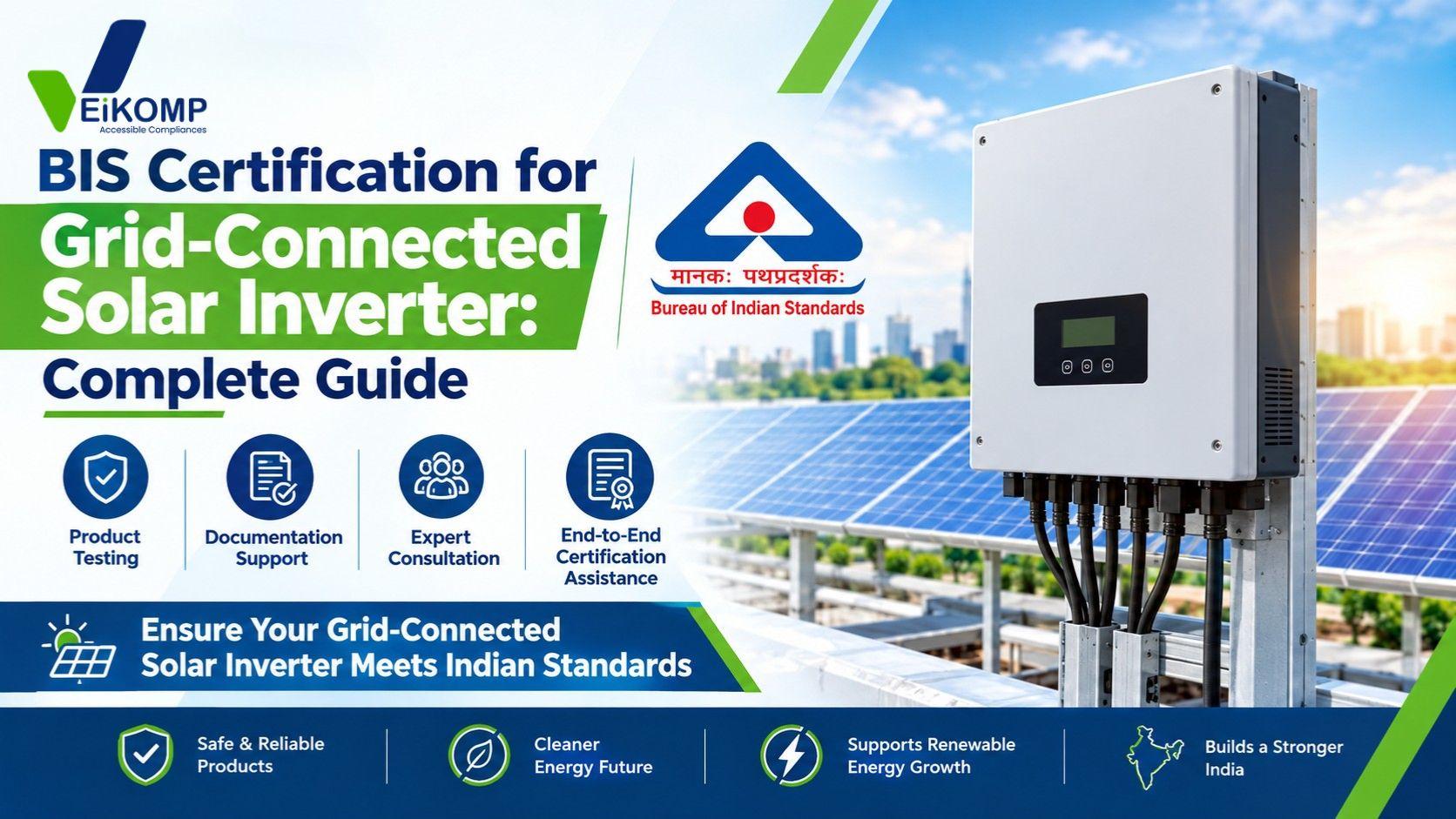
India's renewable energy sector is expanding rapidly, and grid-connected solar systems are becoming increasingly popular among residential, commercial, and industrial users. A grid-connected solar inverter plays a crucial role in these systems by converting the direct current (DC) generated by solar panels into alternating current (AC) that can be used by electrical appliances or supplied to the electricity grid.
For manufacturers and suppliers planning to enter the Indian market, understanding product quality and regulatory compliance is essential. BIS Certification for Grid-Connected Solar Inverter is an important compliance consideration because applicable Indian Standards and government notifications may require specific products to undergo testing and certification before they can be sold in India.
What Is BIS Certification?
The Bureau of Indian Standards (BIS) is India's national standards body, responsible for developing Indian Standards and administering product certification schemes. These standards help establish requirements relating to product safety, quality, reliability, and performance.
For solar inverter manufacturers, the applicable certification requirements depend on the product category, technical specifications, relevant Indian Standard, and current government regulations. Not every inverter necessarily follows the same certification procedure, so businesses should verify the applicable requirements before beginning the application process.
Compliance can help manufacturers demonstrate that their products meet the prescribed standards and provide greater confidence to distributors, solar installers, project developers, and customers.
BIS Registration Requirements for Solar Inverters
Before applying for approval, manufacturers should identify the exact classification of their grid-connected inverter. Factors such as rated power, electrical configuration, intended application, and product design may influence the applicable standard and regulatory route.
BIS Registration for Grid-Connected Solar Inverter should begin with verification of the latest BIS requirements and relevant Quality Control Orders (QCOs). Businesses must establish whether their product falls under the Compulsory Registration Scheme (CRS), another BIS certification scheme, or a separate regulatory framework.
This verification is important because selecting an incorrect scheme can result in unnecessary testing expenses, application delays, and documentation problems.
Manufacturers should also confirm whether the relevant requirements apply to their particular model and whether additional approvals are necessary under other applicable regulations.
Understanding BIS CRS Registration
The BIS Compulsory Registration Scheme is a product registration framework applicable to specified categories of electronic and IT products and other notified products, according to the relevant government orders.
BIS CRS Registration for Grid-Connected Solar Inverter should not be assumed to be mandatory for every inverter without checking the current product list, applicable Indian Standard, and relevant notifications.
Where CRS applies, the manufacturer generally needs to arrange testing through the prescribed laboratory, prepare the required technical documents, and submit an application through the applicable BIS process. Registration is granted only after the necessary requirements have been fulfilled and the application has been accepted.
For products covered by a different certification scheme, manufacturers must follow that scheme's specific testing, inspection, and approval procedures.
Documents Required for the Application
Preparing accurate documentation is an important part of the compliance process. Although the exact list varies by scheme, manufacturers may need the following documents:
-
Company registration documents and manufacturing unit details.
-
Address proof for the manufacturing facility.
-
Product datasheets and technical specifications.
-
Model numbers, product photographs, and labels.
-
Circuit diagrams and relevant technical drawings.
-
Details of critical components and the bill of materials.
-
Prescribed laboratory test reports.
-
Trademark authorization documents, where applicable.
-
Authorization letters and declarations required under the relevant scheme.
All documents should contain consistent information about the manufacturer, product model, brand, and technical specifications. Incomplete or inconsistent records may lead to clarification requests and delays.
Step-by-Step Certification Process
The procedure for obtaining approval typically involves several stages, depending on the applicable regulatory framework.
Step 1: Identify the applicable standard. Check the product category, relevant Indian Standard, and current government notifications.
Step 2: Confirm the certification scheme. Establish whether the product requires CRS registration or another form of BIS approval.
Step 3: Prepare the product and documentation. Verify that product specifications, model details, and technical records are complete and accurate.
Step 4: Arrange laboratory testing. Submit representative samples for testing through the laboratory and process prescribed under the applicable scheme.
Step 5: Submit the application. Provide the necessary forms, supporting documents, and test reports through the appropriate procedure.
Step 6: Address queries. Respond to any technical or documentation issues raised during assessment.
Step 7: Maintain compliance. After approval, follow applicable marking requirements, surveillance procedures, renewals, and other ongoing obligations.
Processing time and expenses depend on the applicable scheme, laboratory workload, product complexity, and whether additional information or testing is required.
Role of a BIS CRS Consultant
Manufacturers unfamiliar with Indian compliance procedures may benefit from professional assistance. A BIS CRS Consultant for Grid-Connected Solar Inverter can help businesses understand applicable requirements and organize the registration process.
A consultant may assist with product classification, standard identification, document preparation, laboratory coordination, application submission, and responses to regulatory queries. Professional guidance can also help identify missing documents or inconsistencies before submission.
However, consultants cannot guarantee certification or replace official testing and assessment. Approval remains subject to the relevant requirements and the decision of the competent authority.
When selecting a consultant, manufacturers should look for relevant experience, transparent service charges, a clear explanation of the applicable scheme, and an understanding of current regulatory requirements.
Common Challenges and Compliance Tips
Some manufacturers face delays because they select the wrong certification route, submit incomplete documents, provide unsuitable test reports, or overlook differences between product models.
To avoid these problems, verify regulatory requirements before investing in testing, maintain accurate technical records, and ensure that submitted samples match the declared product specifications.
Manufacturers should also confirm whether changes to components, design, manufacturing location, or branding require additional action under the applicable scheme. An approval for one product should not automatically be considered valid for every model or variant.
Conclusion
BIS compliance is an important consideration for manufacturers seeking to supply grid-connected solar inverters in India. Understanding the applicable Indian Standard, certification scheme, testing requirements, and documentation can help businesses prepare an effective application and reduce avoidable delays.
Before proceeding with registration, manufacturers should verify whether their products fall under CRS or another regulatory framework. Working with an experienced compliance consultant can simplify documentation and coordination while helping businesses follow the correct procedure.

 English
 Arabic
 French
 Spanish
 Portuguese
 Deutsch
 Turkish
 Dutch
Dutch
 Russian
 Romaian
 Portuguese (Brazil)
 Greek
Greek
