


Most Demanding Skills in the Future: Top Skills to Learn for 2030 and Beyond
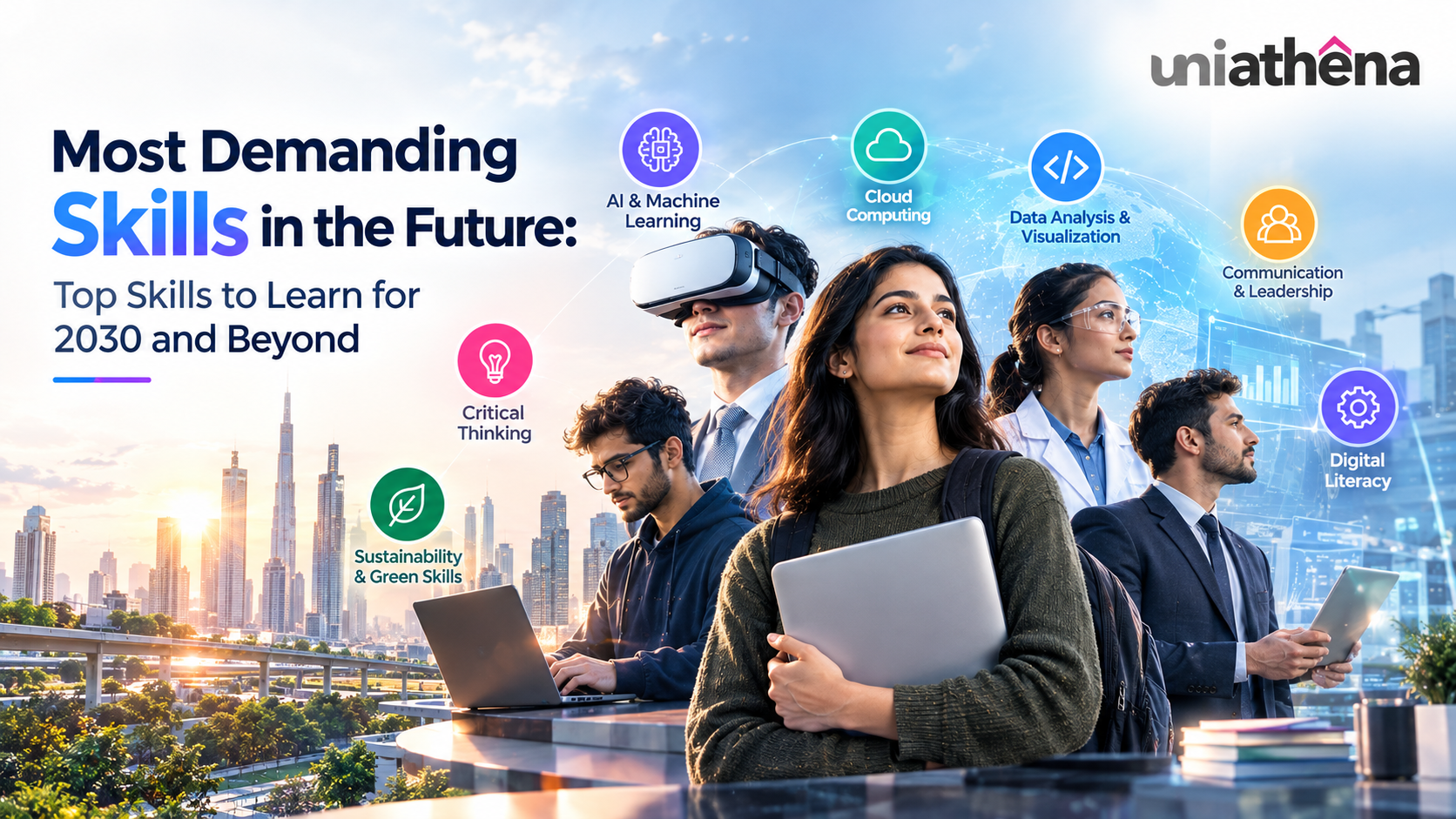
Table of Contents
-
Introduction
-
Key Takeaways
-
Why the Future of Work Demands New Skills
-
What Future-Ready Skills Mean for Your Career
-
Most Demanding Skills in the Future
-
How to Choose the Right Skills for Your Career
-
Your Action Plan for Building Future-Ready Skills
-
Skills in Demand in the United States
-
Conclusion
-
Frequently Asked Questions
Introduction
The world of work is changing faster than ever. Artificial intelligence (AI), automation, data-driven decision-making, and sustainability are transforming industries and creating new career opportunities. As businesses adapt to these changes, professionals must develop the right capabilities to remain competitive.
Understanding the Most Demanding Skills in Future is no longer optional for anyone who wants to build a successful, long-term career. Whether you are a student preparing for your first job, a working professional planning a career change, or an experienced manager looking to grow, learning relevant skills can help you prepare for emerging opportunities.
The future workplace will require more than academic qualifications. Employers will increasingly value professionals who can solve complex problems, understand technology, communicate effectively, and adapt to changing business needs.
So, which skills should you focus on? From artificial intelligence and data analytics to cybersecurity, digital marketing, and leadership, several fields offer promising opportunities for the coming decade.
With flexible online learning opportunities from UniAthena, learners can explore professional courses and diploma programs while balancing their existing commitments. The goal is simple: develop practical knowledge, apply it to real-world challenges, and build a skill set that grows with your career.
Key Takeaways
-
Artificial intelligence, data analytics, cybersecurity, and automation are among the important technical skills for the future.
-
Critical thinking, communication, adaptability, and leadership remain essential across industries.
-
Green technology and sustainability are creating opportunities for professionals with specialized environmental knowledge.
-
Combining technical expertise with human-centered skills can help you stand out in a competitive job market.
-
UniAthena offers online courses and diploma programs in areas such as data science, artificial intelligence, digital marketing, and product management.
-
Continuous learning and practical experience can help professionals stay relevant as job requirements evolve.
Why the Future of Work Demands New Skills
The traditional career path of learning one profession and following it for decades is becoming less predictable. Today, technological advances, changing customer expectations, and evolving business models are influencing the skills employers need.
According to the World Economic Forum's Future of Jobs Report 2025, approximately 39% of workers' existing skill sets are expected to be transformed or become outdated between 2025 and 2030. The report also identifies AI and big data, networks and cybersecurity, and technological literacy among the fastest-growing skill areas.
These changes highlight an important point: career development is no longer a one-time activity. Professionals must continually update their knowledge to keep pace with their industries.
Technology Is Reshaping Job Roles
AI-powered applications are helping businesses automate repetitive tasks, analyze large datasets, and improve productivity. However, these developments also increase the need for professionals who can manage technology responsibly, interpret results, and make informed decisions.
For example, a marketing professional who understands AI-assisted analytics may be better equipped to evaluate campaign performance. Similarly, a business analyst who can work with data visualization tools may help an organization identify opportunities more efficiently.
Employers Value Skills Alongside Qualifications
A degree can provide a strong foundation, but employers also want evidence that candidates can apply what they know. Practical projects, professional certifications, specialized training, and relevant experience can strengthen a candidate's profile.
This is why developing High Demanding Skills should involve both learning and application. Understanding a concept is important, but using it to solve a real problem makes that knowledge more valuable.
Human Skills Still Matter
Technology cannot replace every aspect of human judgment. Communication, empathy, creativity, negotiation, and leadership remain essential when working with customers, managing teams, and solving unfamiliar problems.
Professionals who combine digital expertise with strong interpersonal abilities can prepare themselves for a wider range of responsibilities.
What Future-Ready Skills Mean for Your Career
Future-ready skills are capabilities that help professionals respond to changing technologies, workplace expectations, and industry requirements. They include technical expertise, analytical thinking, communication, and the ability to learn continuously.
The most effective approach is to build a combination of specialized knowledge and transferable skills.
Consider these examples:
-
A finance professional can strengthen their career prospects by learning data analytics and financial technology tools.
-
A digital marketer can combine content strategy with search engine optimization, customer analytics, and AI-assisted workflows.
-
A project manager can improve their effectiveness through digital collaboration tools, risk management, and leadership training.
-
An aspiring technology professional can explore programming, cloud computing, cybersecurity, or machine learning.
UniAthena supports this kind of flexible learning through online courses and diploma programs that allow learners to explore different professional areas. Programs such as Basics of Data Science, Diploma in Artificial Intelligence, and Diploma in Digital Marketing can help learners develop knowledge relevant to technology-driven workplaces.
The right choice depends on your interests, existing experience, career goals, and the requirements of your target industry.
Most Demanding Skills in the Future
Which capabilities are likely to remain valuable as we approach 2030 and beyond? Although no single skill guarantees employment, the following areas offer useful starting points for career planning.
1. Artificial Intelligence and Machine Learning
AI is influencing industries ranging from healthcare and finance to retail, manufacturing, and education. Businesses use AI to automate workflows, analyze information, personalize customer experiences, and support decision-making.
Professionals who understand AI concepts and their practical applications can explore opportunities in AI implementation, business analysis, product development, and technology management.
Skills to develop: AI fundamentals, machine learning concepts, prompt design, responsible AI use, and data interpretation.
Related UniAthena course: Diploma in Artificial Intelligence.
2. Data Analytics and Data Science
Organizations collect large amounts of information, but data becomes valuable only when professionals can interpret it and translate findings into action.
Data analytics helps businesses understand customer behavior, measure performance, identify inefficiencies, and make evidence-based decisions. These capabilities are useful in marketing, finance, operations, healthcare, and management.
Skills to develop: Excel, SQL, data visualization, statistical reasoning, and analytical problem-solving.
Related UniAthena courses: Basics of Data Science and Diploma in Data Analytics.
3. Cybersecurity and Digital Risk Management
As organizations rely more heavily on digital systems, protecting sensitive information and preventing cyberattacks has become a significant business priority.
Cybersecurity professionals help identify vulnerabilities, monitor threats, strengthen security practices, and support incident response. Knowledge of privacy regulations and cyber laws can also be valuable in compliance and risk management roles.
Skills to develop: Network security, security awareness, risk assessment, incident response, and data protection principles.
Related UniAthena course: Executive Diploma in Cyber Laws.
4. Automation and Digital Technology
Automation is changing how businesses manage repetitive processes, inventory, customer support, reporting, and administrative work.
Professionals who understand digital workflows can help organizations improve efficiency while reducing unnecessary manual effort. You do not always need advanced programming skills to begin; understanding process improvement and automation tools can be a useful first step.
Skills to develop: Workflow mapping, automation fundamentals, digital literacy, process optimization, and basic programming.
Potential career areas include business process improvement, operations, automation support, and digital transformation.
5. Digital Marketing and Search Engine Optimization
Businesses need professionals who can reach the right audiences, understand customer behavior, and build effective digital campaigns.
Digital marketing continues to evolve through search engines, social media, online advertising, email marketing, and AI-assisted content tools. Professionals must understand both the creative and analytical sides of marketing.
Skills to develop: SEO, content strategy, social media marketing, campaign analytics, conversion optimization, and audience research.
Related UniAthena course: Diploma in Digital Marketing.
6. Critical Thinking and Problem-Solving
Critical thinking helps professionals evaluate information, recognize assumptions, compare alternatives, and make sound decisions.
As AI tools make information easier to access, the ability to verify results and identify meaningful insights becomes increasingly important. Employers need people who can determine whether a recommendation makes sense in a particular business context.
Skills to develop: Logical reasoning, research, decision-making, root-cause analysis, and structured problem-solving.
These abilities are relevant across almost every industry and career level.
7. Communication, Leadership, and Collaboration
Strong communication helps professionals explain ideas, manage expectations, resolve disagreements, and build productive relationships.
Leadership is equally important, even for employees who do not hold formal management positions. Taking responsibility, supporting colleagues, and coordinating projects can demonstrate leadership potential.
Skills to develop: Business writing, presentation, negotiation, emotional intelligence, team coordination, and conflict resolution.
For professionals interested in management, UniAthena's MBA Essentials with Innovation Management can provide an opportunity to explore business strategy, leadership, and innovation concepts.
8. Sustainability and Green Skills
Organizations are increasingly examining energy use, resource efficiency, environmental impact, and sustainability reporting. This creates opportunities for professionals who understand environmental practices and sustainable business operations.
Green skills can be relevant in energy, manufacturing, construction, supply chain management, consulting, and corporate sustainability.
Skills to develop: Sustainability fundamentals, environmental management, energy efficiency, ESG concepts, and sustainability reporting.
The best learning pathway will depend on whether you want to work in environmental science, business strategy, operations, or sustainable technology.
9. Product Management and Innovation
Product managers connect customer needs, business goals, design, and technology. They help teams determine what to build, prioritize features, evaluate feedback, and measure product performance.
As businesses develop new digital services and AI-powered products, professionals who can coordinate different teams and translate customer needs into workable solutions may find opportunities in this field.
Skills to develop: Product discovery, market research, stakeholder management, roadmap planning, and performance measurement.
Related UniAthena course: Mastering Product Management and Core Market Strategy.
10. UI/UX Design and User Experience
A successful digital product must do more than function correctly. It should also be easy to understand, accessible, and enjoyable to use.
UI/UX professionals study user behavior, identify usability challenges, create prototypes, and improve digital experiences. Their work can support websites, mobile applications, software platforms, and online services.
Skills to develop: User research, wireframing, prototyping, usability testing, accessibility, and design thinking.
Related UniAthena course: Diploma in UI/UX Design Process.
Quick Guide to Skills in Demand and Career Opportunities
Understanding the Skills in Demand can help you identify the right learning opportunities and plan your career more effectively. Here are some important skill areas, their benefits, and the career paths you can explore.
1. Artificial Intelligence and Machine Learning
AI helps businesses automate tasks, improve efficiency, and develop innovative solutions. Learning AI fundamentals can prepare you for roles such as AI specialist, machine learning engineer, or AI product analyst.
2. Data Analytics
Data analytics enables organizations to make informed decisions using data and measurable insights. Professionals with analytical skills can explore opportunities as data analysts, business analysts, or analytics specialists.
3. Cybersecurity
Cybersecurity focuses on protecting digital systems, networks, and sensitive information from potential threats. Relevant career paths include information security analyst, cybersecurity specialist, and risk management professional.
4. Digital Marketing
Digital marketing helps businesses increase online visibility, attract customers, and measure campaign performance. SEO, content marketing, and digital advertising skills can lead to roles such as SEO specialist, digital marketing executive, or content strategist.
5. Automation and Digital Technology
Automation improves productivity by reducing repetitive tasks and streamlining business operations. Professionals with these skills can explore opportunities in process optimization, workflow automation, and digital transformation.
6. Sustainability and Green Skills
Sustainability skills help organizations manage environmental responsibilities, improve resource efficiency, and support sustainable business practices. Potential career options include sustainability analyst, environmental consultant, and ESG specialist.
7. Leadership and Communication
Leadership, collaboration, and effective communication are essential for managing teams, solving problems, and achieving business goals. These skills are valuable for project managers, team leaders, business managers, and organizational development professionals.
8. UI/UX Design
UI/UX design focuses on creating accessible, intuitive, and user-friendly digital experiences. Learning user research, wireframing, and prototyping can prepare you for roles such as UX designer, UI designer, or product designer.
9. Product Management
Product management connects customer needs with business objectives and product development. Professionals in this field help teams prioritize features, coordinate projects, and improve products. Potential roles include product manager, product analyst, and associate product manager.
How Can You Get Started?
You do not need to learn every skill at once. Choose an area that matches your interests and career goals, then develop your knowledge through practical projects and structured learning.
How to Choose the Right Skills for Your Career
With so many options available, deciding what to learn first can feel overwhelming. Rather than following every new trend, focus on the capabilities that support your personal goals.
Identify Your Interests and Strengths
Start by asking yourself what kind of work you enjoy. Do you like analyzing information, designing digital experiences, solving technical problems, or leading teams?
Your interests can help narrow the options and make learning more sustainable.
Research Your Target Industry
Review job descriptions, employer requirements, and industry reports to understand which capabilities are frequently requested in your preferred field.
For example, someone interested in business analytics may benefit from learning SQL and data visualization, while an aspiring digital marketer may prioritize SEO and campaign measurement.
Combine Technical and Transferable Skills
A combination of technical knowledge and communication skills can make your expertise more useful. A data analyst who can explain findings clearly may be better positioned to influence business decisions than someone who struggles to communicate results.
Likewise, a project manager who understands digital tools and team dynamics can coordinate complex projects more effectively.
Choose Practical Learning Opportunities
Look for courses that match your current level and career goals. Check the curriculum, learning outcomes, assessment methods, and any prerequisites before enrolling.
UniAthena offers online learning options across areas such as data science, artificial intelligence, digital marketing, cybersecurity-related legal knowledge, and product management. These programs can help learners explore relevant topics while continuing other professional or personal responsibilities.
Build Evidence of Your Skills
Use projects, case studies, practical exercises, and professional portfolios to demonstrate what you can do. For example, you could analyze a sample dataset, create an SEO strategy for a fictional business, or develop a basic product roadmap.
Practical evidence can help employers understand how you approach real-world challenges.
Your Action Plan for Building Future-Ready Skills
You do not need to master every emerging technology at once. A focused learning plan can help you make consistent progress.
Step 1: Choose two priority skills. Select one technical skill and one transferable skill that support your career goals.
Step 2: Set a realistic learning schedule. Dedicate a manageable amount of time each week to lessons, practice, and revision.
Step 3: Select a suitable course. Compare available learning options, including UniAthena's courses and diploma programs, based on curriculum, time commitment, and relevance.
Step 4: Apply what you learn. Complete practical assignments or personal projects that demonstrate your understanding.
Step 5: Review your progress. Track completed modules, new capabilities, and areas that need improvement.
Step 6: Update your professional profile. Add relevant projects, newly acquired skills, and applicable certifications to your résumé or professional portfolio.
Step 7: Keep learning. Revisit your goals regularly and adapt your learning plan as technologies and employer expectations change.
Consistency is more important than trying to learn everything immediately. A clear plan, combined with practical application, can help you build confidence and improve your professional readiness.
Skills in Demand in the United States
The United States offers opportunities across technology, healthcare, finance, manufacturing, professional services, and renewable energy. However, demand varies by state, industry, employer, and experience level. Understanding these differences can help students and working professionals choose relevant skills.
According to the U.S. Bureau of Labor Statistics, employment of data scientists is projected to grow by 36% between 2023 and 2033, while information security analysts are projected to see 33% growth over the same period. These projections, published in the agency's 2023–2033 occupational outlook, illustrate the potential of data and cybersecurity careers. They are historical projections rather than guarantees of current hiring conditions.
Top Skills to Consider for the U.S. Job Market
1. Data Analytics and Artificial Intelligence
Businesses use data and AI to improve forecasting, customer experiences, operational efficiency, and decision-making. SQL, Python, statistics, data visualization, and AI literacy can be useful starting points.
Learners can explore UniAthena's Basics of Data Science, Diploma in Data Analytics, and Diploma in Artificial Intelligence to build foundational knowledge in these areas.
2. Cybersecurity and Information Protection
Organizations across the United States need to protect digital infrastructure, customer records, and business systems. Cybersecurity knowledge can support opportunities in security operations, risk management, and compliance.
UniAthena's Executive Diploma in Cyber Laws is relevant for learners interested in the legal and regulatory dimensions of digital security. Technical cybersecurity positions may also require dedicated hands-on security training and industry-recognized certifications.
3. Digital Marketing and E-Commerce
Companies need professionals who understand search visibility, online advertising, content performance, and customer acquisition. SEO, analytics, campaign optimization, and AI-assisted marketing can help professionals develop a practical digital skill set.
UniAthena's Diploma in Digital Marketing offers a learning pathway for those interested in this field.
4. Project Management and Business Leadership
Organizations need professionals who can coordinate teams, manage resources, communicate with stakeholders, and deliver projects effectively. Leadership, planning, risk assessment, and digital collaboration are useful across many industries.
UniAthena's MBA Essentials with Innovation Management can help learners explore management and innovation concepts relevant to business environments.
5. Sustainability and Green Technology
The energy transition and growing attention to environmental performance are creating opportunities in renewable energy, sustainability analysis, environmental management, and related business functions.
Professionals interested in this area should consider building a foundation in sustainability reporting, energy efficiency, environmental standards, or sustainable operations, depending on their preferred career path.
How to Prepare for Career Opportunities in the United States
If you plan to pursue employment in the U.S., follow a practical approach:
-
Study local job requirements: Compare vacancies in your target state and industry.
-
Develop relevant technical skills: Prioritize tools and technologies frequently mentioned in job descriptions.
-
Strengthen your communication: Written communication, teamwork, and professional presentation matter across roles.
-
Build a portfolio: Demonstrate your abilities through projects, case studies, and relevant work experience.
-
Review qualification requirements: Some occupations require specific degrees, licenses, certifications, or professional experience.
-
Understand work authorization: International applicants should review the applicable U.S. employment and immigration requirements before planning a move.
UniAthena's flexible online courses can help learners develop foundational knowledge in selected professional areas. Before enrolling, review each program's learning outcomes and verify whether its credential meets the expectations of your intended employer or profession.
The most effective approach is to combine relevant training with practical experience and a clear understanding of the U.S. employment market.
Conclusion
The future of work will reward professionals who can adapt, learn continuously, and apply their knowledge to changing business needs. Artificial intelligence, data analytics, cybersecurity, digital marketing, sustainability, and product management are important areas to explore, while communication, creativity, critical thinking, and leadership remain valuable across industries.
The Most Demanding Skills in Future will not be identical for every profession. The right choice depends on your interests, career objectives, and the skills employers need in your target market.
Start by identifying one or two priority areas, choosing a relevant course, and applying what you learn through practical projects. UniAthena's online courses and diploma programs can support this process by providing learning opportunities in several future-oriented fields.
You do not need to predict every change in the job market. Instead, build the habit of learning, stay curious about emerging opportunities, and develop skills that help you respond confidently to new challenges. Your future career is not shaped by technology alone; it is shaped by how effectively you learn and use it.
Frequently Asked Questions
1. What are the most demanding skills in the future?
Artificial intelligence, data analytics, cybersecurity, automation, digital marketing, sustainability, and product management are important areas to explore. Communication, adaptability, leadership, and critical thinking are also valuable because they support performance across different industries.
2. Which skills are expected to be in demand by 2030?
AI and big data, cybersecurity, technological literacy, creative thinking, resilience, and lifelong learning are among the skill areas highlighted by the World Economic Forum. Specific demand will vary depending on the industry, location, and pace of technological adoption.
3. How can I develop high-demand skills while working full-time?
You can use a structured online course, set aside regular study hours, and practice through small projects. UniAthena offers online courses and diploma programs that learners can explore alongside work and other commitments. Review the schedule and requirements of each program before enrolling.
4. Are soft skills still important in a technology-driven workplace?
Yes. Communication, teamwork, empathy, leadership, and critical thinking help professionals collaborate effectively and make sound decisions. These skills complement technical expertise rather than competing with it.
5. Which skill would be most in demand in the future?
There is no single skill that will be the best choice for everyone. AI literacy and data analysis are increasingly relevant across sectors, while cybersecurity, healthcare-related expertise, sustainability, and leadership may be particularly useful in specific fields. Choose a skill that matches your career goals and combine it with transferable capabilities.
6. Can online courses help me prepare for jobs in the United States?
Online courses can help you develop relevant knowledge and demonstrate initiative. However, employment outcomes also depend on practical experience, employer expectations, professional qualifications, and work authorization. Research the requirements for your target occupation before choosing a course.

 English
 Arabic
 French
 Spanish
 Portuguese
 Deutsch
 Turkish
 Dutch
Dutch
 Russian
 Romaian
 Portuguese (Brazil)
 Greek
Greek
