


The Future of European CHP: Modernisation, Flexibility and Low-Carbon Integration
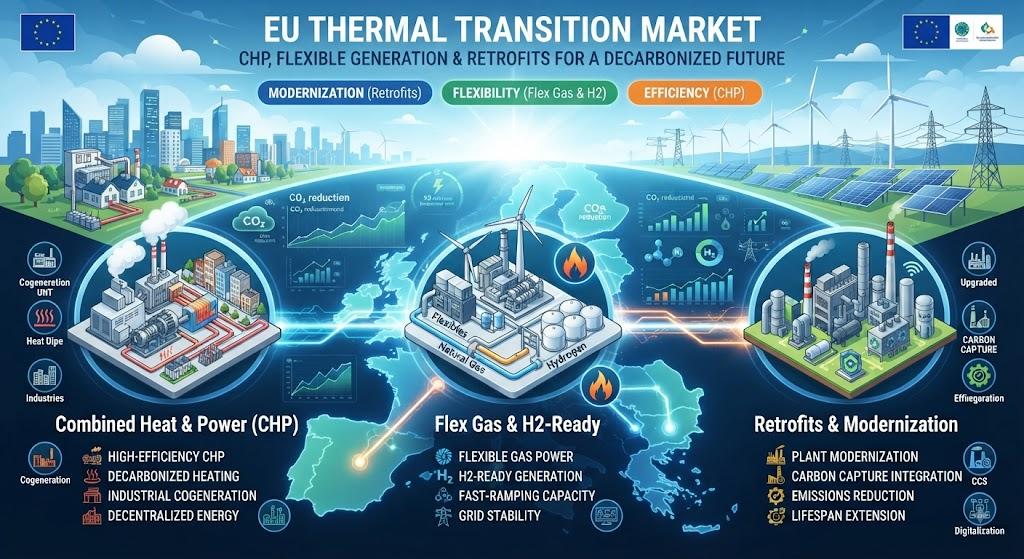
EU Thermal Transition Market Report: Retrofit Investment and Industrial Decarbonisation Opportunities
Industrial energy infrastructure is entering a period of significant modernisation. European manufacturers, utilities and commercial energy users must improve efficiency, manage operating costs and prepare for increasingly demanding environmental requirements. Existing boilers, turbines, heat exchangers and generation systems often represent substantial installed capital, making selective upgrades an important consideration for asset owners.
The thermal transition encompasses more than installing new equipment. It includes improving existing plant performance, integrating recovered heat, upgrading control systems and adjusting generation assets to a power system with greater renewable penetration. Combined heat and power, flexible gas generation and targeted retrofits offer different solutions to these interconnected challenges.
Where Retrofit Demand Is Emerging
The EU Thermal Transition (CHP + Flex Gas + Retrofits) Market Report opportunity spans industrial manufacturing, district heating, commercial facilities and electricity generation. Investment requirements differ across these segments, depending on plant age, operating conditions, fuel consumption and regulatory obligations.
Industrial facilities frequently rely on thermal processes that cannot be interrupted easily. Food production, chemical processing, pharmaceuticals, paper manufacturing and other energy-intensive activities require dependable heat at specific temperatures. Equipment modernisation can improve thermal efficiency while supporting operational continuity.
CHP upgrades may be attractive where electricity and useful heat are required simultaneously. Modern engines, turbines, heat-recovery equipment and improved controls can enhance plant performance. Nevertheless, operators must evaluate whether sufficient heat demand exists throughout the year to justify continued cogeneration.
Boiler and burner retrofits provide another route to improving performance. Replacing inefficient components, improving combustion controls and recovering waste heat may reduce fuel consumption. The scale of benefits depends on existing equipment condition, process requirements and achievable operating improvements.
Business Case for Modernisation
Retrofit projects often compete with alternative uses of capital. Industrial decision-makers therefore need to demonstrate financial returns alongside environmental and operational benefits.
Energy savings represent one important value source. Reduced fuel consumption can lower operating expenses and decrease exposure to volatile energy markets. Better equipment reliability may also reduce unplanned downtime, emergency maintenance and production losses.
A retrofit may be particularly attractive when existing infrastructure has substantial remaining life. Targeted upgrades can avoid some costs associated with complete replacement, although installation complexity and temporary shutdowns must be considered.
Investment appraisal should examine capital expenditure, financing costs, maintenance savings, expected operating hours and energy-price scenarios. Carbon costs and regulatory compliance can influence returns, but financial models should avoid assuming that every efficiency improvement guarantees commercial success.
Public funding mechanisms and financing programmes may improve project economics in some jurisdictions. Eligibility depends on applicable rules, project characteristics and current programme availability. Companies should confirm funding conditions before including prospective support in their investment cases.
Technology and Engineering Priorities
Modern control systems can help plants respond to changing operating requirements. Sensors and analytics provide visibility into combustion efficiency, turbine performance, heat demand and equipment condition. Predictive maintenance can support earlier intervention and more effective planning.
Waste-heat recovery can improve overall energy utilisation when suitable heat streams and end uses are available. Heat pumps may upgrade certain lower-temperature heat sources, while thermal storage can help separate production from consumption. These technologies should be evaluated according to temperature requirements, electricity prices and space constraints.
CHP plants may also benefit from improved integration with electrical and thermal storage. Such configurations can provide greater scheduling flexibility, although additional equipment introduces capital costs and operational complexity.
For gas-fired generation, retrofits may focus on efficiency, emissions controls, faster response and improved reliability. Any proposed alternative-fuel capability requires careful assessment of technical readiness, infrastructure and fuel economics.
Barriers and Commercial Risks
Retrofitting existing facilities can involve unexpected engineering challenges. Equipment compatibility, ageing pipework, limited installation space and complex control interfaces may increase project costs. Industrial shutdown windows can also restrict installation schedules.
Policy uncertainty creates another challenge. Operators must consider evolving emissions requirements and the potential risk of investing in equipment that could become less competitive before its expected payback period.
Workforce capability matters as well. Successful projects require coordination between engineering teams, equipment suppliers, contractors, operators and regulatory authorities. Poor commissioning or insufficient operator training can prevent expected performance improvements.
Future Investment Outlook
European thermal modernisation is likely to remain a practical route for improving existing infrastructure while wider energy systems evolve. The most compelling opportunities will combine measurable efficiency gains, reliable operation and credible decarbonisation planning.
Businesses should prioritise projects supported by detailed energy audits, realistic performance assumptions and clear operational objectives. By modernising strategically rather than replacing assets indiscriminately, organisations can strengthen industrial resilience and make more informed long-term energy investment decisions.

 English
 Arabic
 French
 Spanish
 Deutsch
 Turkish
 Dutch
Dutch
 Italiano
 Russian
 Romaian
 Portuguese (Brazil)
 Greek
Greek
