


US Transmission Line Monitoring Market: Growth, Technology Trends, and Forecast Through 2035
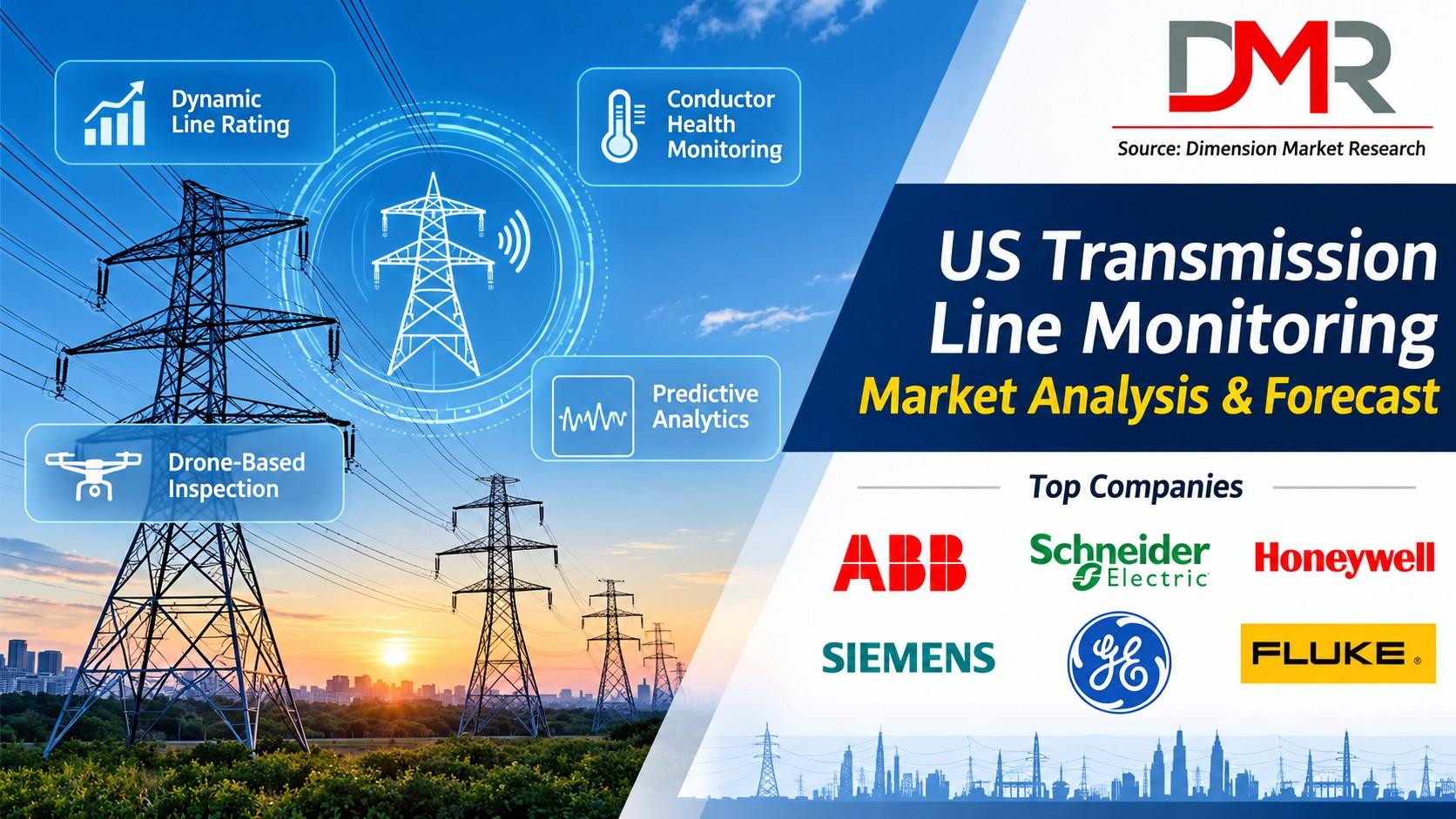
US Transmission Line Monitoring Market Overview
The US Transmission Line Monitoring Market size is estimated to reach USD 1.3 billion in 2026 and is projected to grow to USD 2.7 billion by 2035, expanding at a compound annual growth rate (CAGR) of 8.1% from 2026 to 2035, according to Dimension Market Research. The market includes hardware, software, sensors, communication systems, and professional services that help utilities monitor high-voltage transmission infrastructure, detect faults, improve asset reliability, and optimize electricity transmission capacity.
Increasing electricity consumption, aging grid infrastructure, renewable energy integration, and demand for more reliable power delivery are strengthening the need for advanced monitoring solutions. Technologies such as sensor-based monitoring, dynamic line rating (DLR), fiber-optic sensing, artificial intelligence, LiDAR, and drone-based inspection are helping utilities move beyond periodic inspections toward data-driven maintenance. These developments create opportunities for technology providers and electricity utilities seeking to improve grid performance, manage congestion, and support long-term transmission planning.
US Transmission Line Monitoring Market Snapshot
● 2026 market size: USD 1.3 billion.
● 2035 projected market size: USD 2.7 billion.
● 2026–2035 forecast CAGR: 8.1%.
● Leading component in 2026: Hardware, with a 68.0% share.
● Leading monitoring type in 2026: Condition monitoring, at 44.5%.
● Leading technology in 2026: Sensor-based monitoring, at 40.5%.
● Fastest-growing technology: Fiber-optic monitoring, at 12.8% CAGR.
● Historical analysis period: 2021–2025.
● Forecast period: 2026–2035.
Get insight you need (request free sample)
Market Research Findings
The market research findings indicate that hardware remains the dominant component of the US Transmission Line Monitoring Market, supported by demand for field sensors, monitoring devices, communications equipment, and inspection technologies. Condition monitoring leads by monitoring type because utilities require reliable information about conductor temperature, sag, vibration, and mechanical deterioration. Sensor-based monitoring maintains its leading technology position, while fiber-optic monitoring is expected to expand more rapidly. The market is also benefiting from the growing adoption of predictive maintenance, digital analytics, and dynamic line rating systems. Together, these developments are shifting transmission monitoring from a primarily inspection-focused activity toward continuous asset intelligence, improved operating efficiency, and more effective utilization of existing electricity infrastructure.
Why Is the US Transmission Line Monitoring Market Growing?
The market is growing as electricity providers respond to higher power demand, grid reliability requirements, and the need to integrate renewable energy resources. Data centers, artificial intelligence infrastructure, industrial electrification, and electric transportation are increasing pressure on transmission networks. Building new transmission lines can involve substantial investment, permitting requirements, and lengthy development timelines. Monitoring technologies offer utilities additional visibility into existing assets and help identify opportunities to improve capacity utilization without immediately constructing new infrastructure.
Federal transmission policies, grid modernization initiatives, and increased attention to extreme-weather resilience also support investment. Advanced sensors, connected monitoring platforms, and predictive analytics enable utilities to detect developing problems earlier, prioritize maintenance, and improve operational decision-making.
Key Growth Drivers in the US Transmission Line Monitoring Market
● Aging transmission infrastructure increases demand for continuous asset monitoring.
● Rising electricity consumption places additional pressure on grid capacity.
● Renewable energy integration increases the need for transmission visibility.
● Dynamic line rating helps utilities optimize existing transmission corridors.
● AI-driven analytics improves predictive maintenance and fault identification.
● Extreme weather and wildfire risks strengthen grid resilience requirements.
● Fiber-optic sensing creates opportunities for distributed corridor monitoring.
Market Segmentation and Leading Segments
Hardware: The Leading Component Segment
Hardware is projected to account for 68.0% of the market in 2026. Sensors, monitoring devices, communications equipment, and weather stations provide the measurements required to evaluate transmission line conditions. These technologies support temperature monitoring, conductor sag assessment, vibration detection, and environmental measurement. Although hardware leads the component category, software and services remain important for processing sensor information, integrating monitoring systems, and translating measurements into actionable maintenance decisions.
● Key categories: Hardware, software, and services.
● Primary applications: Asset monitoring, fault identification, and data collection.
Condition Monitoring: The Leading Monitoring Type
Condition monitoring is expected to hold a 44.5% share in 2026. Utilities use these solutions to assess conductor performance, identify mechanical deterioration, and recognize abnormal operating conditions before they result in costly failures. Condition monitoring also supports risk-based maintenance, allowing operators to prioritize assets according to observed conditions rather than relying exclusively on fixed inspection schedules.
● Key applications: Temperature, sag, vibration, and equipment-health monitoring.
● Related technologies: Sensors, thermal imaging, and predictive analytics.
Read full report: https://dimensionmarketresearch.com/report/us-transmission-line-monitoring-market/
Fiber-Optic Monitoring: The Fastest-Growing Technology
Fiber-optic monitoring is projected to register a 12.8% CAGR during the forecast period. Distributed sensing capabilities can help utilities monitor conditions across transmission corridors, while suitable existing optical infrastructure may reduce the need for additional field equipment. Integration with analytics platforms can further improve asset visibility and support proactive maintenance. Adoption will depend on installation economics, measurement requirements, network compatibility, and the ability to integrate monitoring data into utility operations.
● Growth opportunities: Distributed sensing and continuous corridor monitoring.
● Related applications: Asset diagnostics, temperature monitoring, and grid intelligence.
Market Dynamics: Trends, Opportunities, and Challenges
Trend: AI and Predictive Maintenance
Artificial intelligence and connected sensors are changing how utilities manage transmission assets. Monitoring platforms can combine field measurements, weather information, inspection images, and historical operating data to identify unusual conditions and prioritize maintenance. AI-assisted drone inspection and automated image analysis can also help detect vegetation encroachment and visible equipment defects. These capabilities support more informed maintenance planning and improve the usefulness of transmission monitoring data.
Opportunity: Dynamic Line Rating and Grid Optimization
Dynamic line rating represents an important opportunity because it calculates available transmission capacity using changing environmental and conductor conditions. Depending on operating circumstances, DLR can help utilities identify additional usable capacity on existing lines. This capability is particularly relevant when electricity demand increases or transmission expansion faces development constraints. Vendors that combine reliable sensors, rating algorithms, operational integration, and clear performance reporting may be well positioned to serve utilities seeking measurable grid improvements.
Challenge: Integration Costs and Cybersecurity
Utilities must integrate monitoring equipment with existing supervisory control and data acquisition systems, energy management platforms, communications networks, and asset management software. These projects can require significant engineering, testing, cybersecurity assessments, and staff training. Initial investment and differences between vendor technologies may also complicate purchasing decisions. Providers that demonstrate interoperability, dependable measurements, secure data handling, and clear economic benefits can help address these barriers.
Regional and Country Outlook
The report focuses on the United States, with the national market estimated at USD 1.3 billion in 2026 and projected to reach USD 2.7 billion by 2035, at an 8.1% CAGR. The supplied market figures do not include individual state-level market values or regional CAGRs, so separate regional estimates cannot be established from the available data.
Demand across the country is influenced by transmission infrastructure requirements, electricity consumption, renewable generation connections, grid reliability priorities, and the need to manage congestion. Deployment opportunities vary according to utility investment plans, operating conditions, and local infrastructure requirements.
Key Competitor Companies
The competitive landscape includes electrical equipment manufacturers, grid technology providers, and specialist monitoring companies. Key companies identified in the supplied report information include:
● LineVision
● Heimdall Power
● Ampacimon
● GE Vernova
● Siemens Energy
● Hitachi Energy
● ABB
● Schneider Electric
● Southwire
● Prisma Photonics
● Hubbell
● Schweitzer Engineering Laboratories
Competition increasingly centers on sensor accuracy, fiber-optic monitoring, dynamic line rating capabilities, analytics, cybersecurity, and integration with utility operating systems. Providers that combine hardware and software with practical deployment support can address utilities' demand for comprehensive monitoring solutions.
Get 10% instant discount on report purchase
Explore more report:
● US Data Center Battery Monitoring Market
● US Cybersecurity Automation Market
● US Business Process Automation Market
● US BESS Thermal Management System Market
Report Also Covers: Frequently Asked Questions
1. What is the US Transmission Line Monitoring Market size in 2026?
The US Transmission Line Monitoring Market is estimated at USD 1.3 billion in 2026, according to Dimension Market Research.
2. What is the projected market size by 2035?
The market is projected to reach USD 2.7 billion by 2035, supported by grid modernization and monitoring technology adoption.
3. What is the forecast CAGR from 2026 to 2035?
The market is expected to grow at a CAGR of 8.1% during the 2026–2035 forecast period.
4. Which component leads the US Transmission Line Monitoring Market?
Hardware is the leading component segment, accounting for an estimated 68.0% market share in 2026.
5. Which monitoring type holds the largest market share?
Condition monitoring leads the monitoring type segment, with an estimated 44.5% share in 2026.
6. Which technology is expected to grow the fastest?
Fiber-optic monitoring is projected to grow at a 12.8% CAGR during the forecast period.
7. What factors are driving market growth?
Grid modernization, rising electricity demand, aging infrastructure, renewable integration, and reliability requirements are key growth drivers.
8. What are the main applications of transmission line monitoring?
Applications include condition monitoring, dynamic line rating, fault localization, predictive maintenance, and transmission capacity optimization.
9. Who are the major companies in this market?
Key companies include LineVision, Heimdall Power, GE Vernova, Siemens Energy, Hitachi Energy, ABB, and specialist monitoring providers.
10. What does the US Transmission Line Monitoring Market report cover?
The report covers market forecasts, component and technology segments, monitoring types, line types, end users, growth drivers, challenges, and competitors.
Access the Full US Transmission Line Monitoring Market Report
For utilities, technology providers, investors, and industry stakeholders, understanding transmission monitoring trends can support informed decisions about grid modernization and infrastructure investment. The market's projected expansion highlights the importance of condition monitoring, dynamic line rating, fiber-optic sensing, and data-driven asset management.
Explore the full research report for detailed market estimates, segmentation, competitive analysis, and forecasts through 2035.
About Us
Dimension Market Research (DMR) is a global market intelligence and consulting firm delivering data-driven insights that help organizations make informed strategic decisions. With expertise across 12+ industries and global markets, DMR provides syndicated reports, custom research, competitive analysis, white space analysis, and business strategy consulting.
Our research solutions combine analytical rigor, industry expertise, and forward-looking intelligence to identify opportunities, reduce risks, and support sustainable growth. Trusted by clients across diverse sectors, DMR is committed to delivering accurate, actionable insights that enable businesses to navigate evolving market landscapes with confidence.
Contact Us
Phone USA: +17323699777
Phone India: +919310023843
E-mail: enquiry@dimensionmarketresearch.com
Address USA: 957 Route 33, Suite 12 #308, Hamilton Square, NJ-08690
Address India: D44, Sector 6, Noida 201301, India

 English
 Arabic
 French
 Spanish
 Portuguese
 Deutsch
 Turkish
 Dutch
Dutch
 Italiano
 Russian
 Romaian
 Greek
Greek
