


Can Cybersecurity Become a Competitive Advantage in China’s IoT Cloud Platform Market?
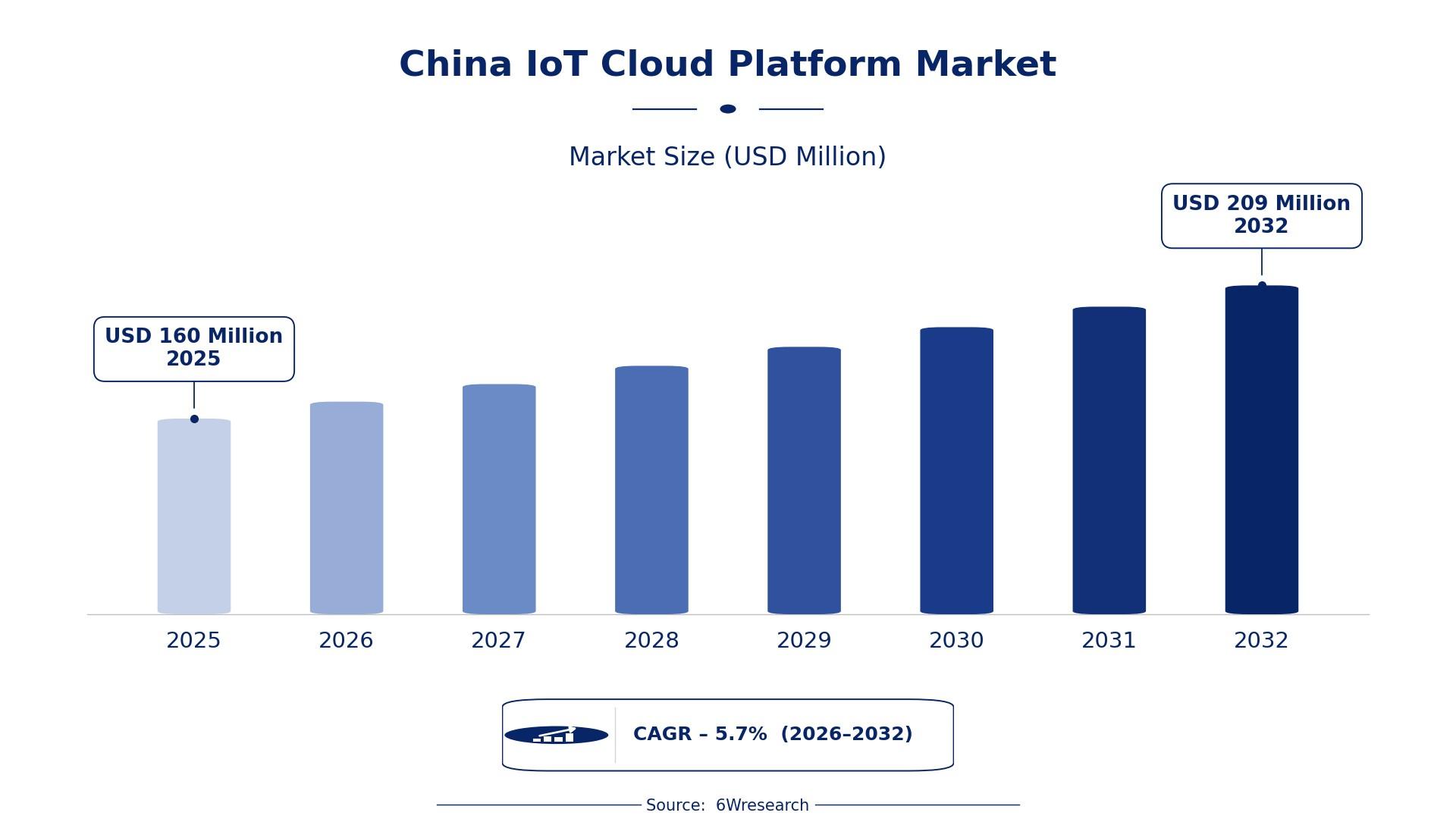
The China IoT Cloud Platform Market is developing alongside the growing number of connected devices used in factories, buildings, transport systems, retail operations, and utilities. Each new connection can improve operational visibility, but it can also introduce security and management challenges. Businesses therefore need platforms that support dependable connectivity while protecting devices, information, and applications. According to 6Wresearch, the market is projected to expand from USD 160 million in 2025 to USD 209 million by 2032, growing at a CAGR of 5.7% during 2026–2032.
Why Is IoT Security Different?
Traditional information systems often operate within relatively defined networks. IoT environments can include thousands of distributed sensors, gateways, controllers, and devices with different capabilities and lifecycles. Some devices have limited processing power, making security management more complicated.
Connected equipment may also remain in service for years. When manufacturers stop providing updates or businesses lose track of deployed devices, vulnerabilities can remain unresolved.
Cloud platforms can support device registration, access management, monitoring, and the analysis of security events. However, protection depends on the entire system, including endpoints, networks, applications, and user practices.
The Essential Layers of IoT Protection
A comprehensive security strategy should address several areas.
-
Device identity: Devices need reliable authentication before they receive access.
-
Data encryption: Information should be protected during transmission and, where appropriate, while stored.
-
Access management: Permissions should match users' responsibilities and be reviewed regularly.
-
Firmware maintenance: Organizations need processes for applying updates and responding to vulnerabilities.
-
Security monitoring: Unusual device behavior and suspicious access attempts should be investigated.
-
Incident response: Teams should know how to isolate affected devices and restore services.
These measures work best when integrated into the platform and deployment process.
How Can Cloud Platforms Improve Visibility?
Managing connected equipment manually becomes difficult as deployments spread across multiple sites. Cloud-based device registries and monitoring tools can provide information about device status, software versions, connectivity, and operational events.
For example, a business may discover that certain devices are running outdated firmware or repeatedly attempting unusual connections. Security teams can investigate and determine whether corrective action is necessary.
Centralized visibility also helps organizations maintain an accurate inventory of connected assets. Businesses cannot effectively protect devices they do not know exist.
Automated alerts can accelerate investigation, but poorly configured monitoring may generate excessive notifications. Effective systems need prioritization, escalation procedures, and regular tuning.
Data Governance and Compliance in China
Organizations operating in China must assess the legal and regulatory requirements applicable to their data and activities. Depending on the circumstances, obligations may involve cybersecurity, personal information protection, data classification, retention, and cross-border transfers.
Requirements can vary according to the organization, information type, and processing activity. Businesses should obtain appropriate legal guidance instead of assuming one configuration satisfies every obligation.
Providers can help by documenting data-handling practices, explaining access controls, supporting audits, and communicating relevant security capabilities.
Why Can Security Investment Be Difficult?
Security improvements can require additional hardware, software, testing, specialist personnel, and maintenance. Smaller organizations may struggle to balance these costs with other digital transformation priorities.
Legacy equipment creates another obstacle. Some older devices cannot support modern authentication or receive software updates. Where immediate replacement is impractical, organizations may consider network segmentation, secure gateways, compensating controls, and phased modernization.
The objective should be proportionate risk reduction based on the potential consequences of a security failure.
Turning Trust into a Competitive Advantage
Providers can strengthen their position by making security capabilities understandable and manageable. Useful features include secure onboarding, clear access policies, device lifecycle management, audit trails, vulnerability reporting, and integration with existing security systems.
Buyers should evaluate actual capabilities rather than relying on general claims. Transparent documentation, service commitments, and a clear incident-response process can support informed decisions.
What Lies Ahead?
As connected systems become more important to business operations, cybersecurity will remain central to platform selection. Organizations will need to assess security throughout the device lifecycle, from deployment and configuration to updates, retirement, and data deletion.
Providers that combine scalable infrastructure with practical security controls may be better positioned to earn customer trust. Security is therefore an important foundation for sustainable IoT adoption in China.
About 6Wresearch
About 6Wresearch: 6Wresearch is a commercial strategy and growth advisory firm founded in 2011 and headquartered in New Delhi, India, with partners across Southeast Asia and the Middle East & Africa. The firm has delivered over 20,000 commercial engagements for over 2,000 organizations, including Fortune 500 companies, government agencies, and multilateral institutions such as the World Bank and the Asian Development Bank. Backed by proprietary market research and advanced analytics, 6Wresearch combines sector expertise with data-driven intelligence to help organizations navigate market complexity and drive sustainable growth. These capabilities explain why organizations trust 6Wresearch Global Market Research & Consulting Firm for reliable commercial insights and confident decision-making.
Our Proprietary Platform: 6W Export GTM
6W Export GTM is 6Wresearch's proprietary trade intelligence and go-to-market platform, built on UN Comtrade data and enhanced with 6Wresearch's in-house analytical and simulation models, including system dynamics-based forecasting. Unlike broad, sector-level market sizing tools, 6W Export GTM operates at the individual product level down to specific HS codes and micro-segments to identify precise, actionable export opportunities by country and product pair, including markets where trade currently does not exist. This granular, simulation-driven approach allows 6W Export GTM to surface opportunities that sector-wide analysis typically misses, positioning it among a small number of platforms globally offering this depth of product-and-country-specific export intelligence.

 English
 Arabic
 French
 Spanish
 Portuguese
 Deutsch
 Turkish
 Italiano
 Russian
 Romaian
 Portuguese (Brazil)
 Greek
Greek
