


How Enterprises Can Improve Cryptographic Governance With Centralized Key Management
Introduction
Modern enterprises rely heavily on cryptography.
Organizations use encryption to protect databases, cloud storage, applications, backups, communications, and business information.
They also use cryptographic technologies for authentication, digital certificates, digital signatures, and secure application communication.
These technologies depend on cryptographic keys.
As enterprises adopt more applications and infrastructure platforms, the number of cryptographic keys can increase significantly.
Without proper governance, organizations may lose visibility into these keys and struggle to maintain consistent security policies.
This creates the need for effective cryptographic governance.
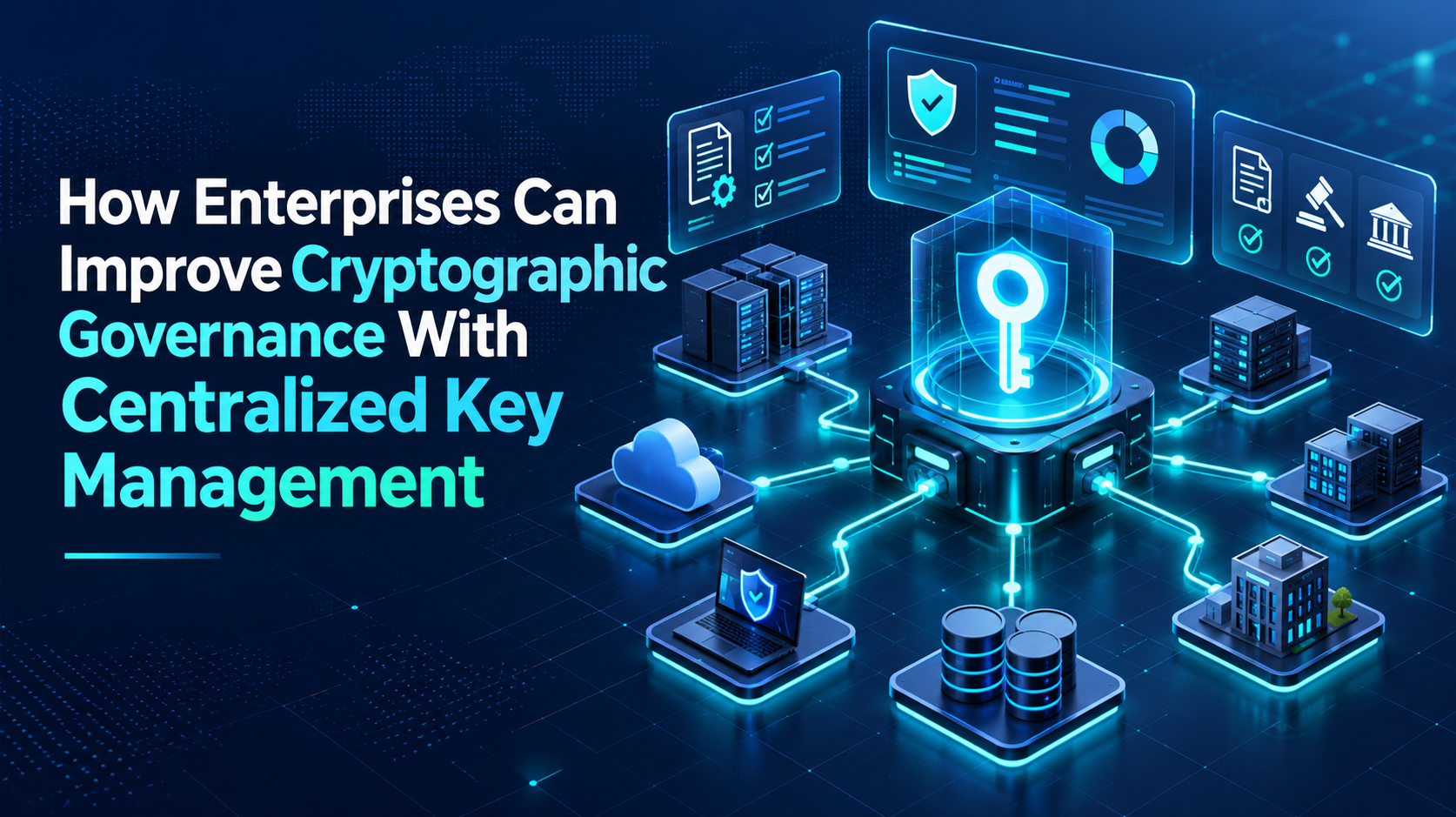
Centralized Key management can help organizations establish a structured approach to managing cryptographic assets across their IT environment.
What Is Cryptographic Governance?
Cryptographic governance refers to the policies, responsibilities, processes, and controls an organization uses to manage cryptographic technologies and assets.
A governance framework should define:
-
Who owns cryptographic keys
-
Who can access them
-
How keys are generated
-
Where keys are stored
-
When keys rotate
-
How keys are recovered
-
When keys are retired
-
How cryptographic activity is monitored
Governance provides accountability.
Why Enterprises Need Cryptographic Governance
Large organizations often operate across multiple business units and technology environments.
A business may have:
-
Multiple cloud platforms
-
On-premises infrastructure
-
Enterprise databases
-
SaaS applications
-
APIs
-
Mobile applications
-
Backup systems
-
Digital certificate infrastructure
Each environment may use different cryptographic assets.
Without governance, individual teams may create their own processes.
This can lead to inconsistent security controls.
The Role of Key Management in Cryptography
Key management in cryptography provides the operational framework for controlling cryptographic keys.
A complete lifecycle typically includes:
-
Generation
-
Storage
-
Distribution
-
Access
-
Usage
-
Rotation
-
Backup
-
Recovery
-
Retirement
-
Destruction
Governance policies should address each stage.
Establishing Key Ownership
Every critical cryptographic key should have a defined owner.
Ownership should include responsibility for:
-
Purpose
-
Access
-
Rotation
-
Recovery
-
Retirement
Without clear ownership, organizations may struggle to determine who should respond when a key requires immediate action.
Creating a Central Key Inventory
Organizations should maintain an accurate inventory of cryptographic assets.
The inventory should record:
-
Key identifier
-
Key purpose
-
Key owner
-
Associated application
-
Protected data
-
Lifecycle status
-
Rotation schedule
A centralized inventory provides better visibility.
Centralized Key Management
Centralized Key management can help organizations manage cryptographic assets through common policies and processes.
Security teams can establish centralized controls for:
-
Access
-
Lifecycle management
-
Rotation
-
Ownership
-
Monitoring
-
Recovery
This approach can reduce fragmented processes.
Improving Access Governance
Organizations should apply least privilege to cryptographic keys.
A user or application should receive only the permissions required for its approved function.
Security teams should regularly review permissions.
They should remove unnecessary access when users change roles or applications are retired.
Establishing Key Rotation Policies
Organizations should define clear rotation requirements.
Rotation policies may consider:
-
Key age
-
Risk
-
Data sensitivity
-
Regulatory requirements
-
Application architecture
-
Suspected compromise
Security teams should document the process and test it before applying it to critical systems.
Managing Key Recovery
Governance should also address recovery.
Organizations should determine:
-
Who can recover keys
-
What authorization is required
-
Where backups are stored
-
How recovery events are logged
-
How recovery procedures are tested
Recovery processes should receive strong security controls.
Monitoring Cryptographic Activity
Cryptographic governance requires visibility.
Security teams should monitor:
-
Key creation
-
Key access
-
Key rotation
-
Administrative changes
-
Failed access attempts
-
Key retirement
These records can support investigations and governance reviews.
Managing Cloud and Hybrid Environments
Cloud adoption has increased the complexity of enterprise Key management.
Organizations may use several cloud providers while maintaining on-premises systems.
A centralized governance model can help organizations establish consistent policies across these environments.
Security teams should know which applications use which keys and where those keys reside.
Managing Database Encryption
Databases frequently contain sensitive information.
Organizations may encrypt:
-
Customer data
-
Financial records
-
Employee information
-
Transaction records
-
Business information
The associated encryption keys should receive appropriate protection.
Key management governance should define how database encryption keys are generated, accessed, rotated, backed up, and retired.
Managing Application Keys
Applications can use cryptographic keys for:
-
Encryption
-
Authentication
-
Digital signatures
-
API security
Organizations should ensure that developers do not manage sensitive keys through insecure methods.
Application teams should follow enterprise Key management policies.
Digital Certificates
Digital certificates also require cryptographic governance.
Organizations should track:
-
Certificate ownership
-
Expiration
-
Associated private keys
-
Renewal requirements
-
Replacement procedures
This helps prevent certificate-related security and availability issues.
Creating Standard Policies
A centralized governance framework should define standard requirements.
Policies can address:
Key Generation
Define approved methods and cryptographic requirements.
Key Storage
Specify approved key protection mechanisms.
Access
Define who and what can access keys.
Rotation
Establish appropriate lifecycle requirements.
Recovery
Document backup and recovery procedures.
Retirement
Define how obsolete keys are removed.
Automating Governance
Automation can help organizations enforce policies at scale.
Organizations can automate appropriate activities such as:
-
Rotation reminders
-
Inventory updates
-
Access reviews
-
Expiration notifications
-
Lifecycle workflows
Automation can reduce repetitive work and improve consistency.
Challenges in Cryptographic Governance
Fragmented Ownership
Multiple teams may manage cryptographic assets independently.
Incomplete Inventories
Organizations may not know every key they operate.
Inconsistent Policies
Different departments may follow different practices.
Manual Administration
Manual processes can introduce errors.
Legacy Systems
Older applications may not support modern governance mechanisms.
Best Practices
Organizations should:
-
Establish a formal cryptographic governance framework
-
Maintain a centralized key inventory
-
Assign clear ownership
-
Apply least privilege
-
Separate keys from protected data
-
Establish lifecycle policies
-
Monitor key activity
-
Automate appropriate processes
-
Conduct regular access reviews
-
Test recovery procedures
-
Retire obsolete keys
-
Integrate Key management with enterprise security governance
Measuring Cryptographic Governance
Organizations should measure whether their governance program works effectively.
Useful indicators may include:
-
Percentage of keys with assigned owners
-
Number of unknown keys
-
Rotation compliance
-
Number of excessive permissions
-
Recovery test success
-
Number of obsolete keys
-
Time required to respond to key incidents
These metrics can help security teams identify improvement areas.
Conclusion
Cryptographic governance provides the foundation for managing encryption and other cryptographic technologies consistently across an enterprise.
Key management in cryptography provides the lifecycle framework for managing cryptographic keys.
Centralized Key management can improve visibility, ownership, access control, rotation, recovery, and monitoring.
By creating clear policies, assigning responsibility, maintaining an accurate inventory, applying least privilege, and automating appropriate processes, enterprises can establish stronger cryptographic governance and improve the protection of sensitive information across their digital infrastructure.

 English
 Arabic
 French
 Spanish
 Portuguese
 Deutsch
 Turkish
 Dutch
Dutch
 Italiano
 Russian
 Romaian
 Portuguese (Brazil)
