


What Businesses Should Consider Before Setting Up Cross Border Payments
Excerpt
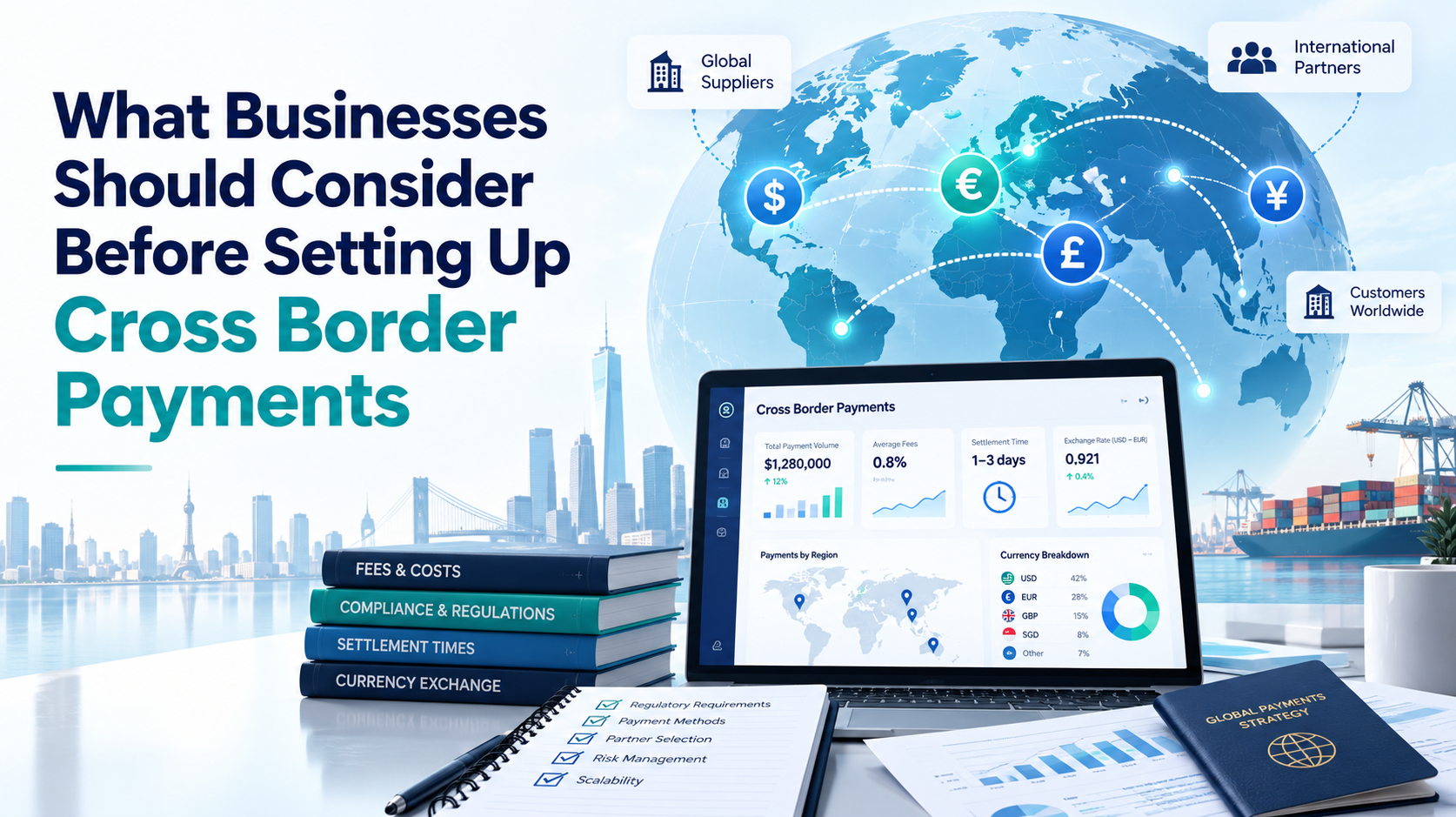
Setting up international payment processes requires businesses to evaluate currencies, transaction costs, settlement timelines, security, compliance, and reporting.
Reliable cross border payments can help companies work more efficiently with international customers, suppliers, and commercial partners.
Before selecting payment solutions, businesses should understand both their current transaction requirements and future international expansion plans.
Introduction
International business opportunities are no longer limited to large multinational companies.
E-commerce brands, service companies, manufacturers, technology businesses, and B2B organizations can now reach customers and partners across multiple countries.
However, entering international markets also means businesses need reliable ways to move money between regions.
Setting up cross-border payments requires careful planning.
Businesses need to understand how they will receive customer funds, pay international suppliers, manage currencies, track settlements, and maintain accurate financial records.
Choosing the right business payment solution can simplify these activities and help companies build more scalable international operations.
1. Identify the Markets You Need to Support
Businesses should begin by identifying the countries in which they expect to send or receive money.
A company should review:
-
Customer locations
-
Supplier locations
-
Distributor networks
-
Service providers
-
Future expansion markets
Understanding geographic requirements helps businesses narrow down suitable payment solutions.
A platform that works well in one region may not necessarily meet the company's requirements in another.
2. Review Currency Requirements
International transactions often involve different currencies.
Businesses should identify the currencies used by their customers and suppliers.
Finance teams should understand:
-
Transaction currency
-
Settlement currency
-
Currency conversion
-
Conversion-related fees
-
Net settlement amount
Clear currency information allows businesses to estimate transaction costs more accurately.
It also supports better financial forecasting.
3. Understand Settlement Timelines
Payment processing and settlement are not always immediate.
Businesses should understand how long international transactions may take to settle.
Settlement timelines can influence working capital and supplier payments.
Before selecting a provider, companies should ask:
-
How quickly are payments settled?
-
Does timing vary by market?
-
Can settlement status be tracked?
-
Which currencies can be settled?
Predictable settlement processes help businesses plan cash flow more effectively.
4. Calculate Total Transaction Costs
Companies should avoid comparing international payment providers based only on one advertised fee.
The real cost of cross border payments may include:
-
Processing fees
-
Currency conversion charges
-
Settlement costs
-
Platform fees
-
International transaction charges
Businesses should calculate costs based on their expected transaction profile.
A provider with a slightly higher processing rate may still provide better overall value if it offers stronger reporting, integration, or operational capabilities.
5. Evaluate Pay-in Services
Businesses selling internationally need efficient ways to collect money.
Pay-in services can support structured incoming payment processes.
They may help businesses:
-
Accept digital payments
-
Track transactions
-
Monitor settlements
-
Reconcile customer payments
-
Maintain financial records
Reliable Pay-in services improve cash flow visibility.
They also reduce manual payment management.
6. Consider Online Payment Solutions
International customers may expect to pay through digital channels.
Flexible online payment solutions can help businesses create convenient payment experiences through websites, applications, portals, or payment links.
Businesses should evaluate whether available payment methods align with customer expectations in each target market.
A familiar and straightforward payment experience can reduce friction.
7. Understand B2B Requirements
Companies working with international businesses may have different requirements from consumer-focused organizations.
B2b cross border payments often involve:
-
Larger transaction values
-
Invoices
-
Purchase orders
-
Approval workflows
-
Detailed financial documentation
Businesses should select payment infrastructure that provides enough information to manage these transactions properly.
Accurate records make reconciliation easier and reduce disputes.
8. Review Security
International transactions require strong security.
Businesses should evaluate controls such as:
-
Authentication
-
Transaction authorization
-
Fraud monitoring
-
User permissions
-
Secure data handling
Companies should also define who can initiate and approve large business payments.
Appropriate controls reduce financial risk.
9. Understand Regulatory Requirements
Cross-border transactions can involve regulatory obligations in multiple jurisdictions.
Requirements may relate to:
-
Identity verification
-
Transaction monitoring
-
Financial reporting
-
Record keeping
-
Data protection
Businesses should understand which rules apply to their transactions and markets.
Payment providers should be evaluated in the context of these requirements.
10. Evaluate Reporting Capabilities
Good reporting helps businesses understand international payment activity.
Finance teams should be able to identify:
-
Transaction amount
-
Currency
-
Date
-
Payment status
-
Settlement status
-
Customer or supplier
-
Fees
Detailed reporting improves accounting and reconciliation.
It also supports management decision-making.
11. Assess Integration Requirements
Payment infrastructure should fit into the company's wider technology environment.
Businesses may need to integrate payment systems with:
-
ERP software
-
Accounting platforms
-
Billing systems
-
E-commerce websites
-
CRM platforms
Integration reduces duplicate data entry and allows financial information to flow between systems.
12. Consider Transaction Volume
Businesses should estimate how many transactions they expect to process.
A platform should not only support current volumes but also future growth.
Scalable payment solutions can handle increasing payment activity without requiring major changes to financial operations.
13. Plan for Reconciliation
Reconciliation becomes more difficult when transactions involve multiple currencies and international customers.
Businesses should decide how payment records will be matched with invoices and customer accounts.
Automated reconciliation can reduce administrative workload.
It can also help finance teams identify missing or delayed payments more quickly.
14. Consider Supplier Payments
Cross-border infrastructure should support both incoming and outgoing transactions where relevant.
Businesses may need to pay:
-
Manufacturers
-
Vendors
-
Consultants
-
Logistics companies
-
Technology providers
Reliable supplier payment processes help maintain strong commercial relationships.
15. Build a Clear Approval Process
Businesses should establish internal controls before transaction volumes increase.
Approval rules may depend on:
-
Payment value
-
Supplier category
-
Market
-
Currency
-
Department
Structured approvals improve security and accountability.
16. Monitor Cash Flow Impact
International transactions can have a significant impact on cash flow.
Finance teams should understand when money is expected to arrive and when international obligations are due.
Better visibility allows businesses to coordinate receivables and payables more effectively.
17. Review Scalability
A payment platform should support future expansion.
Companies should ask whether it can handle:
-
Additional markets
-
More currencies
-
New payment methods
-
Higher transaction volumes
-
More complex reporting
Scalable infrastructure reduces the need for disruptive migrations.
Where Uniteller Can Be Considered
Businesses setting up international payment infrastructure may evaluate Uniteller alongside other providers.
The comparison should consider cross-border capabilities, Pay-in services, digital payment support, security, reporting, integration, scalability, and B2B requirements.
Choosing a provider should always begin with the company's actual operational needs.
Conclusion
Setting up cross border payments requires more than finding a way to transfer money internationally.
Businesses need to consider markets, currencies, settlement timelines, payment costs, security, compliance, reporting, integration, and scalability.
Modern payment solutions can simplify international transactions and give companies better financial visibility.
Reliable Pay-in services and online payment solutions can support international collections, while structured b2b cross border payments help businesses manage suppliers and corporate customers.
By selecting a suitable business payment solution and organizing international business payments carefully, companies can create payment infrastructure that supports sustainable global growth.
Providers such as Uniteller can be evaluated as part of this process based on the company's specific transaction and expansion requirements.

 English
 Arabic
 French
 Spanish
 Portuguese
 Deutsch
 Turkish
 Italiano
 Russian
 Romaian
 Portuguese (Brazil)
 Greek
Greek
