


Best Solar Battery WA: Which System Delivers the Most Value for Your Money?
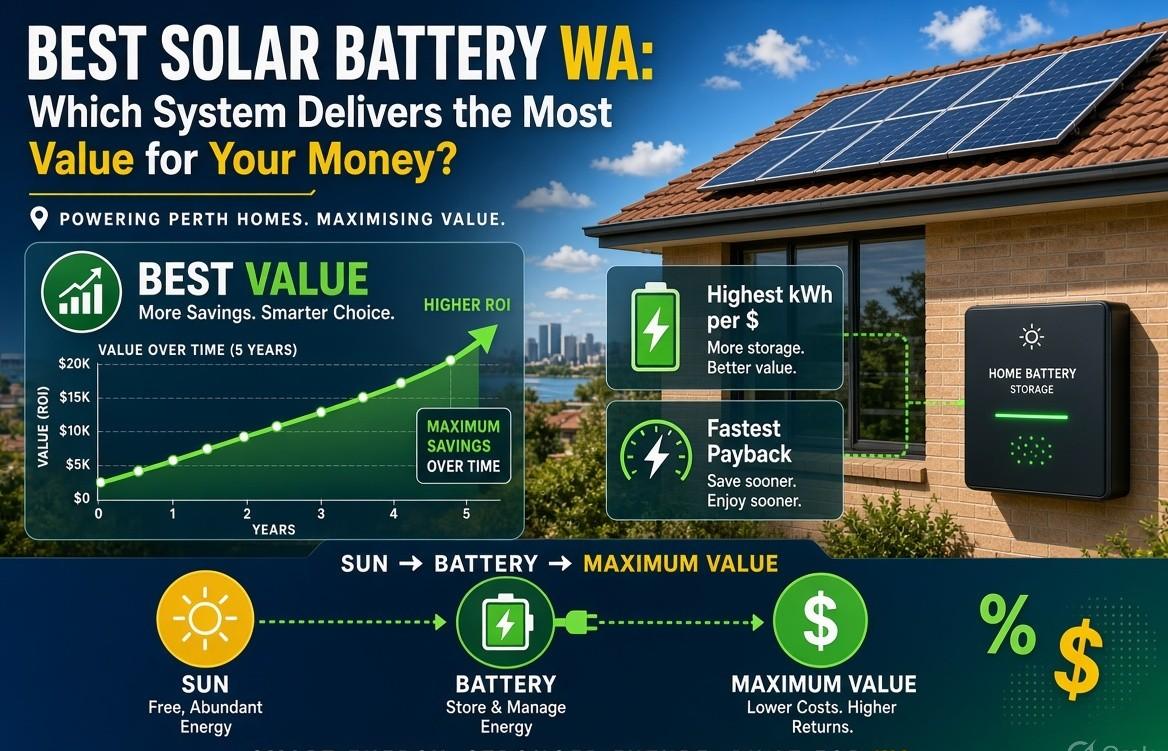
Don't Pay More Than You Need to for Solar Storage
Have you installed solar panels in your Western Australian home but still rely heavily on grid electricity after sunset? Or are you considering a solar battery but unsure whether the investment will deliver worthwhile savings?
You are not alone. With multiple battery brands, different storage capacities and changing government incentives, finding the best solar battery in WA can feel overwhelming. A system that works well for one household may be too expensive or unnecessarily large for another.
The key is to look beyond the advertised price. A good-value solar battery should store enough energy for your needs, work with your solar installation, provide reliable warranty coverage and help reduce your electricity costs over time.
In this guide, we examine how to compare solar batteries in Western Australia, explore three established battery options and explain the practical steps homeowners can take to make a more informed buying decision.
Why Solar Battery Value Matters in Western Australia
Western Australia has strong potential for rooftop solar generation, particularly in Perth and many surrounding areas. However, solar panels produce electricity mainly during daylight hours, while many households consume more energy in the evening.
This mismatch can mean exporting surplus electricity during the day and purchasing electricity from the grid later.
A solar battery stores some of that surplus energy for use when solar generation falls. This can increase the proportion of solar electricity your household uses directly and reduce your reliance on grid power.
However, savings are not automatic. Battery performance, your electricity tariff, feed-in credits, seasonal solar generation and household habits all influence the financial outcome.
For regional households, backup requirements and access to local installation and servicing may also affect which battery represents the best value.
Three Solar Batteries Worth Comparing in WA
Rather than choosing a product based on advertising alone, compare the complete system, including the battery, inverter, installation, warranty and backup features.
The following options illustrate different approaches to residential battery storage.
|
Battery system |
Approximate usable capacity |
Main strength |
Important consideration |
|
Tesla Powerwall 3 |
13.5 kWh |
Integrated inverter and battery system |
Check compatibility and total installation cost |
|
Sungrow SBR |
Common configurations of 9.6–25.6 kWh |
Modular capacity options |
Requires compatible equipment |
|
BYD Battery-Box Premium HVM |
Common configurations of 8.3–22.1 kWh |
Flexible system configurations |
Confirm inverter compatibility |
Capacity ranges refer to commonly available configurations and may vary by model and market availability. Prices are not included as fixed figures because installation costs depend on system design, installer pricing and site conditions. Request current, itemised quotes for an accurate comparison.
1. Tesla Powerwall 3: For Households Seeking an Integrated System
Tesla Powerwall 3 combines battery storage with integrated solar inverter functionality. Its approximately 13.5 kWh of usable storage may suit households that want to shift a substantial amount of daytime solar generation into the evening.
What makes it worth considering?
- Integrated design: Can simplify system planning for suitable installations.
- Energy monitoring: Helps households track solar generation, storage and consumption.
- Backup options: Can support backup power when the system is installed with the required configuration.
- Substantial storage: May suit families with regular evening electricity demand.
What should you consider?
An integrated system is not automatically the cheapest option. If your existing solar inverter is working well, compare the cost of retaining it with the cost of changing equipment. Also assess whether your household can regularly charge and use the battery's available capacity.
Value assessment: Powerwall 3 is worth investigating if its integrated features and storage capacity match your needs. Households with lower energy consumption should compare smaller or less expensive alternatives before committing.
2. Sungrow SBR: For Homeowners Who Want to Match Capacity to Demand
Sungrow SBR is a modular high-voltage battery range using lithium iron phosphate (LFP) technology. Its different configurations allow installers to design a system around the amount of storage a property requires.
What makes it worth considering?
- Flexible capacity: Multiple configurations can accommodate different household energy requirements.
- LFP chemistry: Commonly used in stationary energy storage because of its thermal stability and cycle-life characteristics.
- Compatible energy management: Supported systems can help homeowners monitor energy use.
- System planning flexibility: Can be suitable for new installations and certain compatible system upgrades.
What should you consider?
The total cost depends on the battery configuration, compatible inverter and electrical work. Before purchasing, ask your installer to confirm whether your existing solar equipment can be retained.
Value assessment: Sungrow SBR deserves consideration when the selected capacity meets your evening demand without adding unnecessary cost. Compare the complete installed price rather than the price of battery modules alone.
3. BYD Battery-Box Premium HVM: For Flexible System Design
The BYD Battery-Box Premium HVM is a modular battery system designed for use with compatible inverters. Its range of configurations gives installers options when matching storage capacity to household requirements.
What makes it worth considering?
- Multiple configurations: Helps installers choose a capacity suited to the property.
- LFP battery technology: Suitable for residential energy storage applications.
- Supported inverter options: Offers flexibility when designing compatible systems.
- Expandable design within manufacturer limits: May provide options for future system planning.
What should you consider?
Not every inverter supports every battery configuration. Expansion also depends on manufacturer specifications and the design of the installed system. Ask for confirmation of usable capacity, warranty conditions and any future expansion limitations.
Value assessment: BYD may be a competitive option when its configuration matches your needs and the complete installed price compares favourably with alternatives.
How to Compare the True Cost of a Solar Battery
A battery's purchase price is only one part of its lifetime cost. Before making a decision, assess the following factors.
1. Usable capacity, not just advertised size
Usable capacity tells you how much stored energy is available for household use. Review your electricity bills and smart-meter data to estimate your evening consumption.
A household using relatively little electricity after sunset may not benefit from paying for a large battery. Conversely, a family using air conditioning, cooking appliances and other equipment in the evening may need more storage.
2. Efficiency and usable energy
Charging and discharging cause energy losses. Compare published round-trip efficiency figures using the same measurement basis, and ask how much electricity the system is expected to deliver under your household's conditions.
A higher efficiency figure can be beneficial, but it does not guarantee the lowest electricity bill.
3. Warranty and after-sales support
Check the warranty duration, guaranteed capacity retention, energy-throughput limits and conditions for maintaining coverage. Confirm who handles repairs and warranty claims in Western Australia.
A battery with a lower purchase price may not offer the best overall value if support arrangements or warranty coverage are less suitable for your needs.
4. Installation and backup requirements
Ask whether your system requires a new inverter, switchboard upgrades, additional wiring or backup equipment. If you need electricity during outages, confirm exactly which circuits can receive backup power and whether solar panels can continue supplying energy during an outage.
Backup capability should be specified in the quotation rather than assumed.
How Much Could a Solar Battery Save You?
The financial benefit depends on how much stored solar energy replaces grid electricity and the feed-in credit you would otherwise receive.
Consider this simplified example for a WA household:
- Battery electricity used in the home: 7 kWh per day.
- Avoided grid electricity cost: $0.30 per kWh.
- Forgone solar feed-in credit: $0.08 per kWh.
The estimated daily benefit is:
7 × ($0.30 − $0.08) = $1.54 per day
If that benefit occurred every day, it would amount to approximately $562 per year.
This is an illustration, not a guaranteed saving. Actual results depend on charging losses, seasonal conditions, electricity tariffs, available solar energy and household usage. The estimate also excludes the battery's installed cost and any financing or maintenance expenses.
To determine whether a battery is financially worthwhile, compare your expected annual savings with its net installed price. Ask installers to show the assumptions behind their payback calculations.
Are Solar Battery Rebates Available in WA?
Eligible households may be able to reduce the upfront cost of a battery through state and federal incentive programs. However, eligibility requirements, approved products, installer conditions and support amounts can change.
Before purchasing, check the current requirements of the WA Residential Battery Scheme and the Australian Government's Cheaper Home Batteries Program.
Confirm whether the proposed battery qualifies, whether any Virtual Power Plant (VPP) participation is required and how incentives affect your final quote. Do not treat an advertised rebate as guaranteed until your eligibility has been confirmed.
How to Get the Best Value: A Practical Buying Checklist
Before selecting a solar battery in Western Australia, work through these steps:
- Review your electricity bills to understand your daily and evening consumption.
- Check how much surplus solar electricity your current system exports.
- Request quotes for at least two or three compatible battery systems.
- Compare usable capacity, efficiency, warranty and total installed cost.
- Ask for a realistic savings estimate based on your actual tariff and usage.
- Confirm current rebates, eligibility requirements and any VPP commitments.
- Check backup capability, local support and the installer’s credentials.
Frequently Asked Questions
Which solar battery offers the best value for money in WA?
There is no single best battery for every home. Tesla Powerwall 3, Sungrow SBR and BYD Battery-Box Premium HVM are useful options to compare. The best value depends on the installed cost, household energy use, compatible equipment and expected savings.
Is a larger solar battery always better?
No. A larger battery may cost more without providing additional savings if your home does not use the stored electricity or your solar system cannot charge it consistently.
Can I install a battery with existing solar panels?
Often, yes. However, the installer must assess inverter compatibility, electrical requirements and whether additional equipment is necessary.
Will a solar battery eliminate my electricity bill?
Not necessarily. Daily supply charges and electricity purchases during periods of low solar generation or high demand may still apply.
Conclusion: Choose a Battery That Fits Your Budget and Energy Needs
Finding the best solar battery in WA is about making an informed comparison, not following a brand trend. Tesla Powerwall 3 offers an integrated approach, Sungrow SBR provides modular capacity options, and BYD Battery-Box Premium HVM offers flexibility across compatible system configurations.
The most cost-effective choice is the battery that fits your household's energy use, provides suitable warranty protection and delivers realistic savings at an acceptable installed cost.
Before committing, compare itemised quotes, confirm current incentives and assess the expected financial return using your own electricity data.
Ready to explore your options? Read Solar 365's guide to the top solar batteries in Perth, WA to continue comparing systems and identify the features that matter most for your property.

 English
 Arabic
 French
 Spanish
 Portuguese
 Deutsch
 Turkish
 Dutch
Dutch
 Italiano
 Russian
 Romaian
 Greek
Greek
