


Quality Control for Industrial Transmission Components
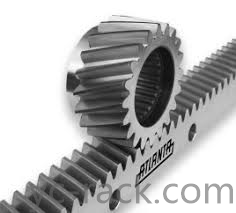
Modern industrial machinery depends on consistent force transfer and controlled movement, and the relationship between tooth geometry and surface quality plays a major role in achieving these objectives. A properly manufactured Helical Gear Rack can support progressive engagement with a mating pinion, making it suitable for transmission systems where smooth movement and repeatable positioning are important. Zhejiang Yuchen Transmission Technology Co., Ltd. considers geometry, materials, machining, and inspection as interconnected elements of the manufacturing process.
The material selected for a transmission component influences its strength, toughness, wear resistance, and response to manufacturing operations. Carbon steel and alloy steel are commonly evaluated for mechanical transmission applications because their properties can be adapted through material selection and suitable heat treatment. Engineers must consider not only the expected working loads but also machinability, thermal stability, and the requirements of subsequent finishing operations.
Helical tooth geometry differs from a straight-tooth arrangement through the angled orientation of the tooth line. This design creates progressive contact as the mating pinion moves along the rack, potentially reducing abrupt engagement and supporting smoother force transfer. However, the actual result depends on the accuracy of the tooth profile, the consistency of spacing, the rigidity of the installation, and the relationship between the mating components.
Before tooth machining begins, the rack blank must be prepared with appropriate dimensional consistency. Cutting and milling operations establish the initial structure and provide a foundation for subsequent precision work. The choice of machining method depends on the required geometry, production volume, and manufacturing capabilities. Stable machine conditions and properly maintained tooling help control variation during tooth generation.
Heat treatment can be used to improve resistance to repeated contact and mechanical wear. Depending on the selected material, manufacturers may consider processes such as carburizing, quenching, and tempering. These processes modify the material structure and can establish a hardened working surface while retaining suitable internal toughness. Thermal processing must be controlled carefully because distortion or dimensional changes may affect the accuracy of the finished teeth.
Precision grinding can refine the tooth surface after thermal treatment. By removing small amounts of material under controlled conditions, grinding helps improve profile consistency and surface quality. The process is especially relevant when the application requires predictable contact between the rack and pinion. Zhejiang Yuchen Transmission Technology Co., Ltd. considers the relationship between heat-treatment results and finishing requirements to help maintain the intended geometry.
Surface quality also affects friction and lubrication. During operation, the mating components experience repeated contact, and irregularities may influence local stress, lubricant distribution, and wear behavior. A carefully finished tooth surface can help establish more consistent contact conditions, although appropriate lubrication and installation remain necessary for reliable operation. Surface finishing should therefore be treated as a functional engineering step rather than merely a cosmetic operation.
Dimensional inspection verifies whether the finished component matches its design requirements. Important characteristics can include tooth profile, spacing, straightness, mounting dimensions, and surface condition. Measurement equipment allows manufacturers to identify deviations and evaluate whether additional correction is required. Digital records can help track manufacturing consistency over time and support adjustments to machining or finishing processes when recurring issues are detected.
Computer-aided engineering helps connect product design with production. Digital models can define tooth geometry, assembly relationships, and potential interference before manufacturing begins. Manufacturing systems can use this information to guide machining operations, while inspection data can be compared with the original design. This feedback loop helps reduce the gap between engineering specifications and actual production results.
Application requirements remain central to component selection. Automated production lines, CNC machine tools, robotic positioning systems, and material-handling equipment can differ significantly in their movement profiles and operating environments. Load direction, acceleration, duty cycle, lubrication, mounting rigidity, and exposure to dust or moisture all influence transmission behavior. Evaluating these factors together helps equipment designers select components that fit the broader mechanical system.
Noise and vibration can provide useful indicators of transmission condition. Uneven contact, poor alignment, or insufficient structural rigidity may create unwanted vibration during repeated movement. Accurate tooth geometry and controlled finishing help establish more consistent engagement, while careful installation supports the designed contact relationship. In automated equipment, these factors can influence both movement quality and the consistency of positioning operations.
Maintenance planning also contributes to transmission reliability. Regular inspection, suitable lubrication, alignment verification, and contamination management can help reduce avoidable wear. The required maintenance approach depends on operating conditions and equipment design, so manufacturers and system integrators should evaluate the transmission as part of the complete machine rather than as an isolated part.
Reliable transmission performance results from coordinating material engineering, tooth geometry, machining, thermal treatment, finishing, and application analysis. Zhejiang Yuchen Transmission Technology Co., Ltd. uses this integrated perspective to support industrial transmission requirements across different types of machinery. With appropriate engineering and manufacturing controls, a Helical Gear Rack can contribute to progressive engagement and stable linear movement. Additional product information is available at https://www.yc-rack.com/product/spur-gear-rack/.

 English
 Arabic
 French
 Spanish
 Portuguese
 Deutsch
 Turkish
 Dutch
Dutch
 Italiano
 Romaian
 Portuguese (Brazil)
 Greek
Greek
