


Frozen Seafood Market Valued at USD 24.12 Billion Driven by Cold Chain Advances
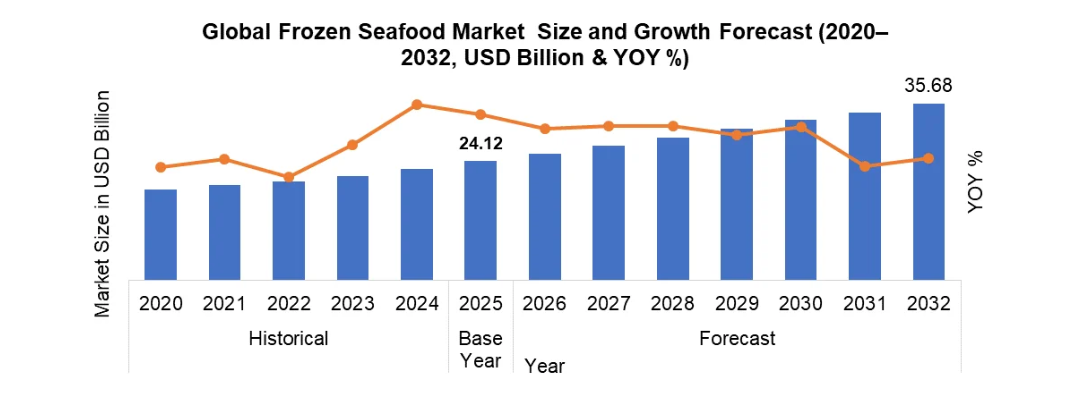
The Global Frozen Seafood Market is experiencing a structural evolution, driven by shifting consumer habits, rapid urbanization, and advanced cold-chain logistics, according to a comprehensive intelligence report published by Stellar Market Research. Valued at USD 24.12 billion in 2025, the market is poised to climb to USD 35.68 billion by 2032, expanding at a compound annual growth rate (CAGR) of 5.75% during the forecast period. This report underscores the strategic importance of frozen seafood as a resilient, protein-dense staple addressing global food security and year-round availability demands amidst fluctuating wild-catch yields and expanding aquaculture production.
The modern seafood supply chain is undergoing a profound paradigm shift. No longer viewed merely as an alternative to fresh catch, frozen seafood has emerged as a premier category characterized by advanced Individually Quick Frozen (IQF) technologies, traceable provenance, and sustainable certifications. Macroeconomic pressures, including inflationary dynamics in fresh food retail and heightened consumer focus on functional nutrition, have accelerated household and foodservice adoption of frozen fish, shrimp, and mollusks. Furthermore, digital transformation across cold storage facilities—incorporating IoT-enabled temperature tracking and automated inventory management—is drastically reducing spoilage rates and unlocking higher profit margins across the value chain.
Key Findings from the Report
-
Market Valuation & Growth: The global frozen seafood market is projected to expand from USD 24.12 billion in 2025 to USD 35.68 billion by 2032, registering a steady 5.75% CAGR.
-
Dominant Product Segment: Fish (including tuna, salmon, and cod) commands the dominant market share, supported by high daily consumption rates and established global distribution networks.
-
Fastest-Growing Segment: Crustaceans (specifically shrimp and prawns) represent the fastest-growing product segment, propelled by surging demand in Asian and North American quick-service restaurants (QSRs) and retail convenience channels.
-
Distribution Channel Insights: Supermarkets and hypermarkets retain the largest revenue share, though online retail and direct-to-consumer e-commerce platforms are exhibiting the fastest growth due to expanding urban delivery infrastructures.
-
Regional Dominance: Asia-Pacific leads the global market landscape, driven by massive domestic production, rising disposable incomes, and robust aquaculture sectors in nations like China, Vietnam, and India.
-
Emerging Growth Hubs: North America and Europe are witnessing accelerated demand for premium, sustainably certified (e.g., MSC-certified) frozen seafood, creating lucrative entry barriers and high-value opportunities for exporters.
-
Investment Relevance: Rising capital expenditures in automated cold-storage facilities and blockchain-based traceability solutions present high-yield prospects for supply-chain technology investors.
For further information, click the following link:https://www.stellarmr.com/report/req_sample/frozen-seafood-market/2911
Market Drivers and Restraints
-
Driver 1: Expansion of Cold Chain Infrastructure: Investments in temperature-controlled warehousing, refrigerated transport fleets, and IoT-enabled logistics ensure product integrity from port to plate, mitigating spoilage and expanding market reach into landlocked regions.
-
Driver 2: Rising Demand for Convenience and Ready-to-Cook Foods: Hectic urban lifestyles and the proliferation of working populations have amplified consumer preference for pre-cleaned, portion-controlled, and easy-to-prepare frozen seafood meals.
-
Driver 3: Growth in Aquaculture Production: As wild-catch quotas face tightening regulatory limits, commercial aquaculture is scaling up to provide a stable, year-round volume of raw materials for processing and freezing.
-
Restraint 1: High Energy Costs and Logistical Bottlenecks: Fluctuating electricity prices and specialized refrigeration requirements impose high operational overheads on processors and distributors, squeezing margins.
-
Restraint 2: Stringent Food Safety and Import Regulations: Strict compliance mandates regarding heavy metal testing, chemical residues, and traceability documentation can create trade frictions and delay market entry.
Technology, Regulation, and Sustainability Trends Technological innovation is redefining frozen seafood standards, with IQF technology and cryogenic freezing preserving cellular structure, flavor, and nutritional value better than traditional bulk freezing. Concurrently, regulatory frameworks are tightening globally, with traceability mandates requiring end-to-end digital documentation to combat illegal, unreported, and unregulated (IUU) fishing. On the ESG front, sustainability has moved from a marketing differentiator to a license to operate; major retailers increasingly require Marine Stewardship Council (MSC) or Aquaculture Stewardship Council (ASC) certifications, accelerating investments in eco-friendly harvesting, renewable-powered cold storage, and biodegradable packaging materials.
Regional Insights Asia-Pacific stands as the leading geographic market, underpinned by massive domestic consumption in China, Japan, and Southeast Asian economies, coupled with significant export-oriented processing hubs in Vietnam and Thailand. Meanwhile, Europe and North America represent high-value markets where stringent consumer preferences for sustainability and premium product varieties (such as wild-caught Alaska pollock and Atlantic salmon) dictate pricing power. Emerging markets in Latin America and the Middle East & Africa are also gaining traction, fueled by expanding retail modern-trade networks and rising tourism-driven HoReCa (Hotel, Restaurant, and Café) demand.
Recent Industry Developments
-
Mowi ASA (2025): Completed the expansion of its primary processing and automated cold-storage facility in Norway, increasing frozen fillet output capacity by 15% and streamlining export logistics to European and Asian retail markets.
-
Thai Union Group (2025): Partnered with a supply-chain blockchain provider to deploy end-to-end digital traceability across its major frozen shrimp lines, resulting in a 25% reduction in compliance verification times and heightened consumer transparency.
-
Maruha Nichiro Corporation (2024): Acquired a majority stake in a regional cold-chain logistics provider in Southeast Asia, strengthening its distribution footprint and enhancing cold-storage capacity by 30,000 metric tons.
-
High Liner Foods (2024): Launched a new line of sustainably sourced, value-added breaded frozen fish products packaged in 100% recyclable materials, capturing a 4.5% lift in retail market share within the North American frozen aisle.
-
Cermaq Group (2024): Invested in proprietary AI-driven optical sorting and flash-freezing technology at its processing plants, improving yield recovery rates by 8% while lowering carbon emissions across its freezing operations.
Competitive Landscape The global frozen seafood market is characterized by a consolidated core of multinational giants competing alongside agile regional processors. Key industry players—including Mowi ASA, Thai Union Group, Maruha Nichiro Corporation, Nissui Corporation, High Liner Foods, Nippon Suisan Kaisha, and Clearwater Seafoods—employ aggressive growth strategies focused on vertical integration, strategic mergers and acquisitions, eco-certifications, and product diversification into ready-to-eat formats. Leading firms are heavily investing in proprietary freezing technologies and direct-to-retail branding to secure customer loyalty and insulate margins against raw material price volatility.
Analyst Commentary
"The frozen seafood sector is successfully shedding its legacy image as a secondary alternative to fresh produce," said a Senior Research Analyst at Stellar Market Research. "Driven by breakthroughs in IQF technology and rigorous cold-chain digitization, the market is achieving unprecedented levels of quality retention and supply chain transparency. For industry stakeholders, future success will depend on aligning operational expansion with strict ESG compliance and meeting the rising global appetite for premium, sustainably sourced protein."
Future Outlook Through 2032, the global frozen seafood market is projected to evolve rapidly in response to shifting consumer demographics, climate-conscious agriculture policies, and next-generation cold-chain automation. Demand will increasingly favor value-added, ready-to-cook formulations that cater to convenience-driven urban households. Regulatory environments will become more stringent, rewarding sustainable players while squeezing unverified operators. Concurrently, intensifying competition among market leaders will accelerate merger and acquisition activity aimed at securing proprietary processing technologies, expanding regional distribution nodes, and solidifying omnichannel retail presence.
For further information, click the following link:https://www.stellarmr.com/report/req_sample/frozen-seafood-market/2911
About Stellar Market Research
Stellar Market Research is a multifaceted market research and consulting company with professionals from several industries. Some of the industries we cover include medical devices, pharmaceutical manufacturers, science and engineering, electronic components, industrial equipment, technology and communication, cars and automobiles, chemical products and substances, general merchandise, beverages, personal care, and automated systems. To mention a few, we provide market-verified industry estimations, technical trend analysis, crucial market research, strategic advice, competition analysis, production and demand analysis, and client impact studies.
Address
Phase 3, Navale IT Zone, S.No. 51/2A/2, Office No. 202, 2nd floor, Near, Navale Brg, Narhe, Pune, Maharashtra 411041
Email
sales@stellarmr.com
Mobile
+91 9607365656

 English
 Arabic
 French
 Spanish
 Portuguese
 Deutsch
 Turkish
 Dutch
Dutch
 Italiano
 Russian
 Romaian
 Portuguese (Brazil)
