


From Requisition to Payment: How Leading P2P Platforms Are Closing the Gaps in Spend Control
A purchase request starts in an email. It moves to a spreadsheet, then to a manager's inbox. A supplier ships the goods and sends a PDF invoice. Someone in finance re-keys the data, matches it to a purchase order, and chases an approval. Weeks later, the payment goes out, sometimes late, sometimes twice.
This pattern is still common, and it is expensive. It is why Procure-to-Pay (P2P) platforms are now a priority for CFOs, CPOs, and IT leaders. A modern P2P system connects every step from requisition to payment in one governed flow. It also gives procurement a seat at the table when enterprise performance is discussed.
Click Here For More Information: https://qksgroup.com/market-research/spark-matrix-procure-to-pay-p2p-q4-2025-9627
Market Overview: One Flow from Requisition to Payment
QKS Group defines a Procure-to-Pay (P2P) platform as an end-to-end solution that streamlines requisitioning, supplier collaboration, invoicing, and payment execution. Today's platforms go beyond basic automation. They embed AI for document classification and anomaly detection, predictive analytics for spend visibility and risk, and ESG indicators within procurement workflows.
Core capabilities typically include:
- Requisitioning and guided buying
- Purchase order management
- Supplier onboarding and collaboration portals
- Invoice capture, matching, and approval
- Payment execution and reconciliation
- Spend analytics and compliance controls
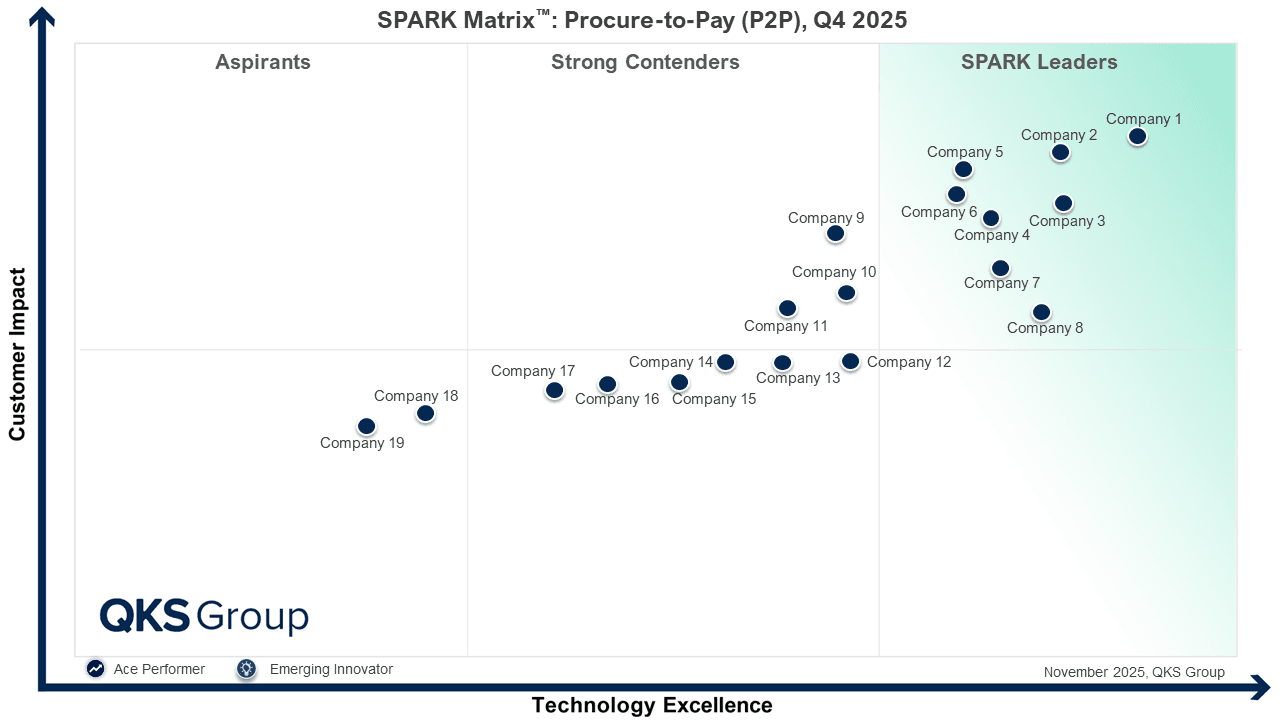
QKS Group's SPARK Matrix evaluates vendors including BirchStreet Systems, Corcentric, Coupa, Elcom, Esker, GEP, JAGGAER, Medius, Oracle, Pipefy, Proactis, SAP Business Network, Synertrade, Varis, ZipHQ, and Zycus. The list covers suite providers, accounts payable specialists, and agile newcomers, which shows how varied the buying options have become.
Check SPARK Plus Study Here: https://qksgroup.com/sparkplus?market-id=338&market-name=procure-to-pay-%28p2p%29
Key Challenges Businesses Face
Many organizations invest in procurement but still struggle with the basics:
- Maverick spend. Employees buy outside approved channels, which weakens contracts and negotiated pricing.
- Manual invoice handling. Paper, email, and re-keying slow processing and raise error rates.
- Duplicate and fraudulent payments. Weak controls leave room for costly mistakes.
- Poor spend visibility. Data scattered across systems hides savings and risk.
- Supplier friction. Slow onboarding and late payments strain relationships.
- Approval bottlenecks. Requests wait in queues while business needs go unmet.
- Compliance and ESG pressure. Regulators and customers expect transparency across the supply base.
Key Trends and Innovations
AI document processing. Platforms read invoices, purchase orders, and contracts, then classify and route them with little manual effort.
Anomaly detection. Machine learning flags duplicate invoices, unusual pricing, and suspicious supplier behavior before payment.
Predictive analytics. Teams forecast spend, spot supplier risk, and plan cash flow with greater confidence.
ESG built into workflows. Sustainability and supplier diversity indicators now appear at the point of purchase, not just in annual reports.
Guided buying and conversational interfaces. Employees get a consumer-style experience that nudges them toward approved suppliers and catalogs.
Supplier networks and collaboration. Shared portals and business networks speed onboarding, order confirmation, and invoice exchange.
Embedded payments and working capital tools. Dynamic discounting and flexible payment options help both buyers and suppliers manage cash.
Composable and API-first design. Open architectures make it easier to connect ERP, finance, and sourcing systems.
Benefits and Business Impact
A well-chosen P2P platform pays back across the enterprise:
- Lower processing costs. Automation reduces the effort behind each invoice and order.
- Stronger spend control. Policy-driven workflows steer purchases to preferred suppliers and contracts.
- Fewer errors and less fraud. Automated matching and anomaly detection protect cash.
- Faster cycles. Quicker approvals and payments improve supplier relationships.
- Better cash management. Visibility into liabilities supports smarter payment timing.
- Improved compliance. Audit trails and consistent controls simplify reviews.
- Strategic insight. Clean data turns procurement into a source of business intelligence.
Real-World Use Cases
Taming invoice volume. A manufacturer receives thousands of invoices monthly in different formats. AI-based capture and automated matching cut manual touches and shorten approval times.
Curbing off-contract buying. A hospital network introduces guided buying with approved catalogs. Employees find what they need faster, and spend shifts toward negotiated contracts.
Detecting duplicate payments. A retail group uses anomaly detection to identify repeated invoices before payment, recovering money that once went unnoticed.
Supplier onboarding at scale. A global services firm brings new suppliers onto a portal that collects compliance documents and tax details in one place, reducing onboarding delays.
ESG-aware sourcing. A consumer goods company tracks supplier sustainability scores inside purchasing workflows and prioritizes lower-impact options.
How to Choose the Right Solution
Begin with your biggest process gaps, whether they sit in purchasing, invoicing, or supplier management. Then evaluate vendors against these criteria:
- End-to-end coverage. Check requisitioning, invoicing, and payment in one platform or a well-integrated stack.
- AI depth. Ask for proof of accuracy in document capture, matching, and anomaly detection.
- ERP integration. Confirm clean connections with your finance and ERP systems.
- Supplier experience. Test onboarding, portals, and communication features.
- Analytics. Look for real-time visibility into spend, savings, and risk.
- Compliance and ESG. Review controls, audit trails, and sustainability indicators.
- Ease of use. Business users adopt tools that feel simple and intuitive.
- Vendor strength. Assess roadmap, customer references, and implementation support.
An independent benchmark helps reduce guesswork. QKS Group's SPARK Matrix compares vendors on capability, differentiation, and market position, giving buyers a structured way to shortlist.
Future Outlook (2025–2028)
Over the next few years, P2P will become more autonomous and more predictive. Expect AI agents to handle routine requisitions, invoice exceptions, and supplier queries, with people stepping in only for judgment calls.
Real-time payments, tighter e-invoicing mandates, and ESG disclosure rules will raise expectations for data quality and transparency. Platforms will also blend procurement, finance, and supplier risk data into a shared view. Vendors that pair intelligent automation with open integration and a strong supplier experience will lead the market.
Download Sample Report Here: https://qksgroup.com/download-sample-form/spark-matrix-procure-to-pay-p2p-q4-2025-9627
Conclusion
P2P is where procurement strategy meets financial reality. Done well, it saves money, reduces risk, and strengthens supplier relationships. A modern Procure-to-Pay platform replaces scattered steps with one connected, intelligent process.
For CXOs and finance leaders, the next move is clear: assess where your purchase cycle leaks time and money, then compare vendors through an independent lens such as QKS Group's SPARK Matrix.

 English
 Arabic
 French
 Spanish
 Portuguese
 Turkish
 Dutch
Dutch
 Italiano
 Russian
 Romaian
 Portuguese (Brazil)
 Greek
Greek
