


Heat Treatment Process Plant For Enhancing Metal Performance with Hiren Engineers
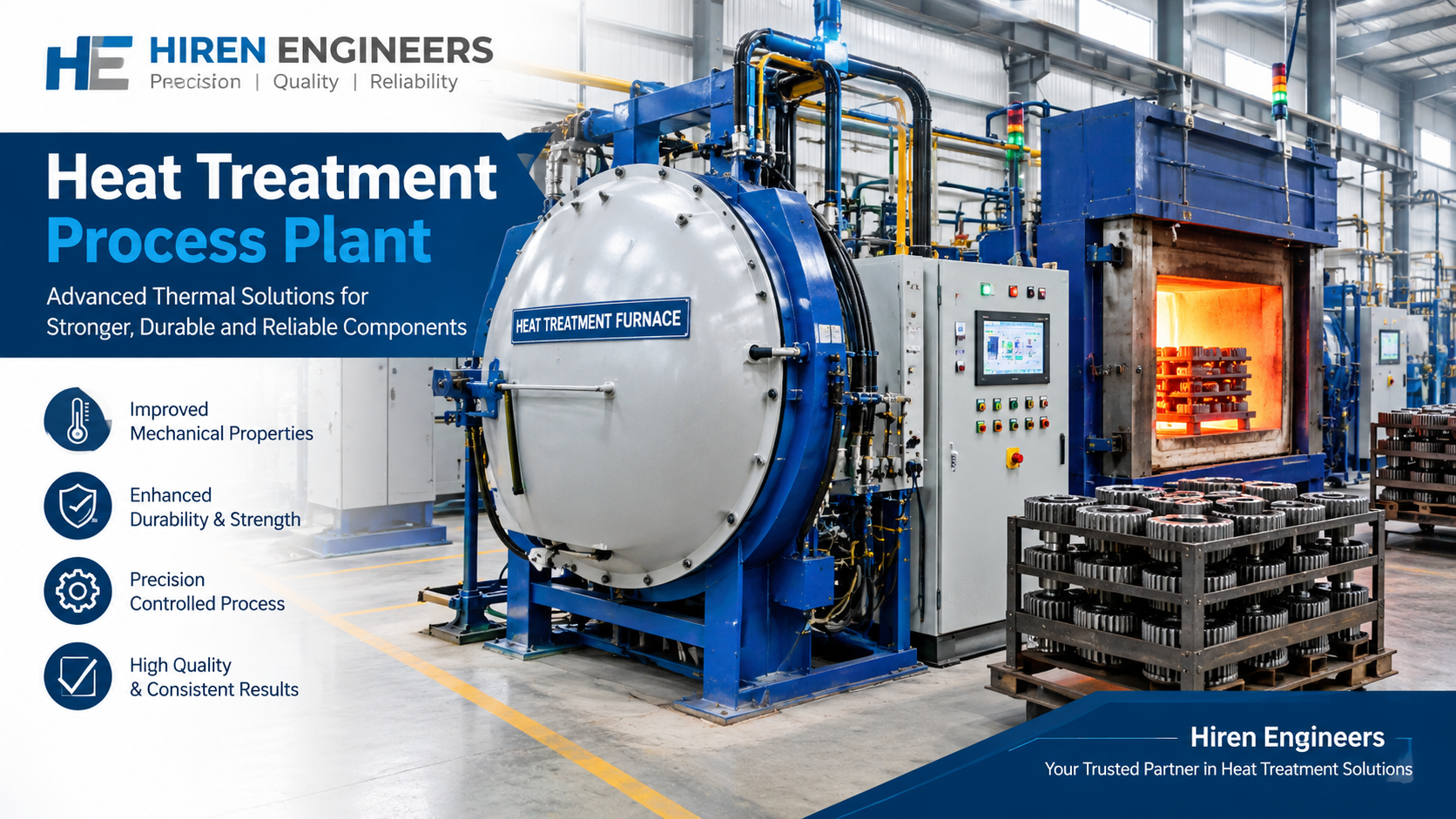
Hiren Engineers provides industrial engineering solutions designed to support manufacturers seeking reliable and efficient metal processing capabilities. Hiren Engineers offers Heat Treatment Process Plant plays an important role in improving the mechanical and physical properties of metals and components. By applying controlled heating, holding and cooling cycles, heat treatment can help achieve desired characteristics such as hardness, strength, toughness, wear resistance and dimensional stability.
Heat treatment is widely used across engineering and manufacturing industries where metal components must meet specific performance requirements. Properly designed equipment and accurate process control can help manufacturers maintain consistency while optimizing production operations.
1. Understanding the Heat Treatment Process Plant
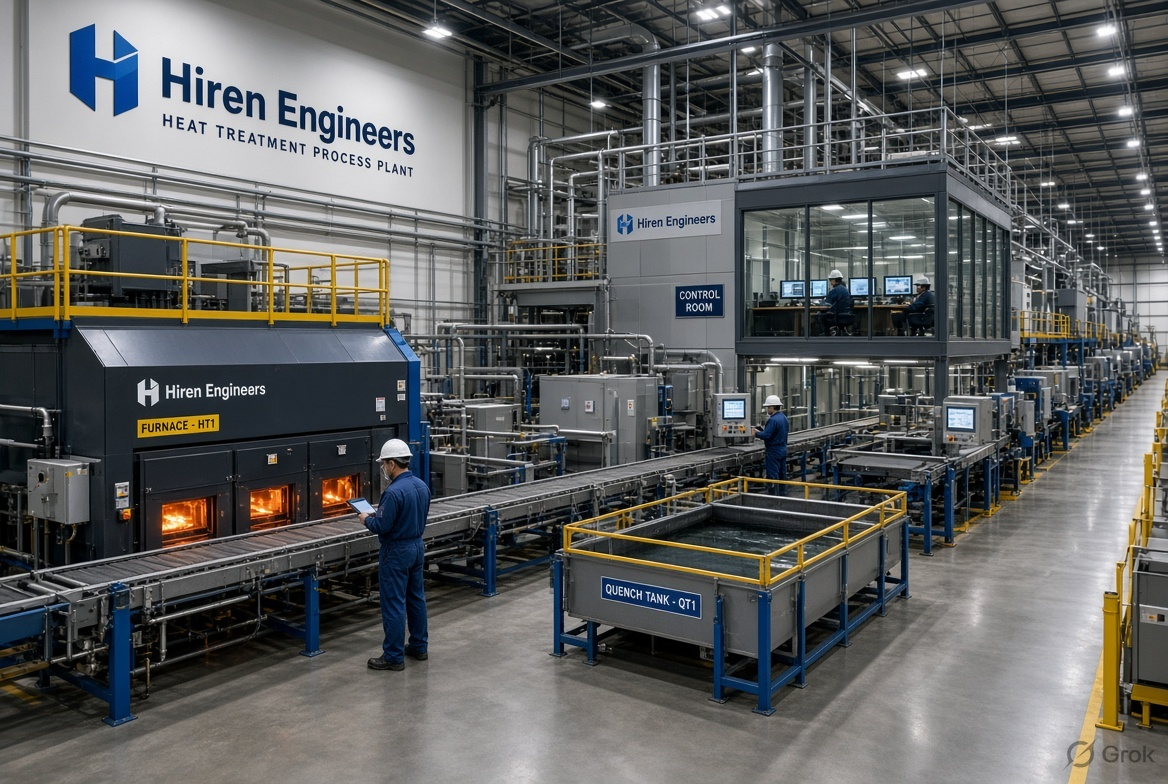
A Heat Treatment Process Plant is an industrial setup designed to perform controlled thermal processes on metallic materials and components. Depending on the application, different heating and cooling methods can be incorporated into the plant.
The process generally involves:
-
Heating components to a specified temperature
-
Maintaining the required temperature for a defined period
-
Cooling the material under controlled conditions
-
Inspecting the treated components
The exact process depends on the material composition, component geometry and required mechanical properties.
2. Importance of Controlled Heat Treatment
Metal components may require specific properties to perform effectively under demanding operating conditions. Heat treatment helps modify the internal structure of metals without necessarily changing their overall shape.
Controlled heat treatment can contribute to:
-
Improved hardness
-
Greater tensile strength
-
Enhanced toughness
-
Better wear resistance
-
Improved machinability
-
Increased service life
Accurate temperature control and process timing are therefore important factors in achieving repeatable treatment results.
3. Major Types of Heat Treatment
Different heat treatment techniques are selected according to the desired properties and material requirements. Common processes include annealing, normalizing, hardening, tempering and stress relieving.
-
Annealing: Often used to soften materials, improve ductility and reduce internal stresses.
-
Normalizing: Helps refine the grain structure and improve mechanical properties.
-
Hardening: Used to increase hardness and strength through controlled heating and cooling.
-
Tempering: Commonly performed after hardening to achieve a suitable balance between hardness and toughness.
-
Stress Relieving: Helps reduce residual stresses generated during manufacturing operations such as welding, forming and machining.
4. Industrial Applications of Heat Treatment
Heat treatment plants are used across numerous engineering sectors where metal components require enhanced performance. Automotive, machinery, construction, forging, fabrication and general engineering industries can all benefit from controlled thermal processing.
Typical applications include:
-
Shafts and pins
-
Gears and mechanical components
-
Forged parts
-
Machine components
-
Industrial tools
-
Fabricated structures
-
Wear-resistant components
The appropriate process depends on the material and the functional requirements of the finished component.
5. Furnace and Heating Systems
The furnace is one of the key elements of a Heat Treatment Process Plant. Its design depends on the operating temperature, component size, production volume and selected heat treatment process.
An industrial furnace may be designed with features such as:
-
Controlled heating zones
-
Temperature monitoring
-
Insulated chambers
-
Automated process controls
-
Uniform heat distribution
-
Safety systems
Proper furnace configuration helps maintain consistent thermal conditions throughout the treatment cycle.
6. Temperature Monitoring and Process Control
Precise temperature management is essential for repeatable heat treatment. Even relatively small variations can influence the properties of treated materials.
Modern process control systems can assist with:
-
Temperature monitoring
-
Heating cycle management
-
Holding-time control
-
Cooling-cycle coordination
-
Process data recording
These features can help operators maintain process consistency and identify deviations during production.
7. Cooling and Quenching Arrangements
Cooling is another important stage of many heat treatment processes. Depending on the material and required properties, components may be cooled using air, oil, water, or other controlled methods.
-
Controlled Cooling: Used where gradual temperature reduction is required.
-
Quenching: Rapid cooling may be used following specific heating cycles to obtain increased hardness.
-
Cooling Equipment: Properly designed cooling arrangements can help manage the cooling rate and support consistent results.
The appropriate cooling method should always be selected according to the material specification and treatment requirements.
8. Benefits for Manufacturing Industries
Investing in an appropriate heat treatment setup can support manufacturers in producing components with consistent mechanical characteristics. Proper thermal processing can also complement other manufacturing operations such as forging, machining, grinding and fabrication.
Key benefits may include:
-
Consistent material properties
-
Improved component durability
-
Better resistance to wear
-
Reduced residual stress
-
Improved production quality
-
Greater suitability for demanding applications
A well-planned process can also help manufacturers establish repeatable production standards.
9. Selecting the Right Heat Treatment Solution
Every manufacturing application has different requirements. Before selecting a Heat Treatment Process Plant, manufacturers should consider factors such as material type, component dimensions, required temperature, production capacity, treatment cycle and available space.
Important considerations include:
-
Furnace capacity
-
Maximum operating temperature
-
Heating uniformity
-
Automation requirements
-
Cooling system
-
Energy efficiency
-
Safety provisions
-
Maintenance requirements
Working with an experienced engineering solution provider can help manufacturers evaluate these requirements before implementing a suitable system.
10. Hiren Engineers for Industrial Engineering Solutions
Hiren Engineers focuses on engineering and industrial equipment solutions for manufacturing requirements. Along with heat treatment-related applications, the company works across various areas of industrial machinery and engineering components.
A professionally designed Heat Treatment Process Plant can become an important part of a manufacturing operation where controlled thermal processing is required. From furnace configuration and temperature management to cooling arrangements and process control, every component of the system contributes to reliable operation.
For manufacturers working with steel, alloy components, forged parts, machinery components and other engineering materials, selecting an appropriately designed heat treatment system can support consistent quality and long-term component performance. Hiren Engineers can assist businesses in evaluating their application requirements and developing an industrial solution aligned with their production needs.
A combination of suitable equipment, controlled processing, regular maintenance and proper operating practices can help manufacturers achieve dependable heat treatment results while supporting efficient industrial production. For more visit us!

 English
 Arabic
 French
 Spanish
 Portuguese
 Deutsch
 Turkish
 Italiano
 Russian
 Romaian
 Portuguese (Brazil)
 Greek
Greek
