


Resilient by Design: How Supplier Relationship and Risk Management Solutions Protect Your Supply Chain
A key supplier misses a shipment. Then a second one. By the time the procurement team connects the dots, the plant has paused a production line, a customer is asking questions, and finance is calculating the cost of expedited freight. Nobody saw it coming, even though the warning signs were there: a credit downgrade, a port delay, a compliance flag buried in a report.
This is why Supplier Relationship & Risk Management has become a boardroom topic. Supply chains are longer, regulations are tighter, and customers expect proof of ethical sourcing. For CXOs, CPOs, and risk leaders, knowing your suppliers is no longer enough. You need to see risk early, act on it quickly, and build relationships that hold up under pressure.
Click Here For More Information: https://qksgroup.com/market-research/spark-matrix-supplier-relationship-risk-management-q2-2026-9391
Market Overview: One Place to Manage Suppliers and the Risks They Carry
QKS Group describes Supplier Relationship and Risk Management (SRRM) platforms as solutions that help organizations manage supplier onboarding, qualification, performance, compliance, and risk through centralized workflows, analytics, and collaboration. Market growth is driven by supply chain disruptions, stricter regulatory and ESG requirements, and the need for proactive risk management.
Core capabilities typically include:
- Supplier onboarding and qualification
- Supplier master data management
- Performance scorecards and reviews
- Compliance and certification tracking
- Risk assessment and continuous monitoring
- Collaboration portals for supplier engagement
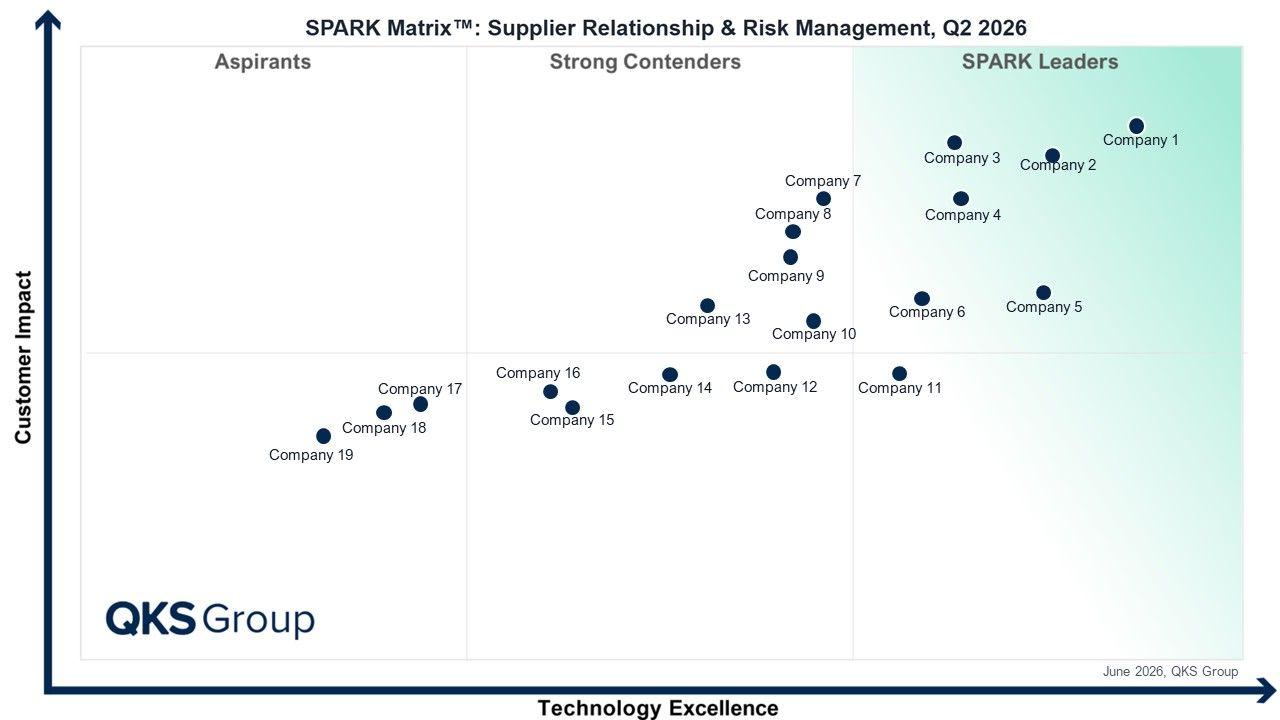
QKS Group's SPARK Matrix evaluates vendors including Tesisquare, HICX Solutions, Corcentric, Coupa, GEP, JAGGAER, LevaData, Oracle, Proactis, Procurence, SAP, SourceDay, Synertrade, Workday, Zycus, Unit4, GraphiteConnect, apexanalytix, and Kodiak Hub. The range covers broad procurement suites and specialists focused purely on supplier data and risk.
Key Challenges Businesses Face
Even mature procurement teams struggle with the same issues:
- Fragmented supplier data. Records sit across ERP, spreadsheets, and email, with duplicates and gaps.
- Legacy system integration. Older enterprise platforms make it difficult to share clean data across functions.
- Supplier engagement barriers. Suppliers resist portals and forms that feel slow or repetitive.
- Data quality concerns. Outdated or inaccurate information weakens every risk score.
- Reactive risk management. Teams learn about problems after they have already affected operations.
- Rising compliance demands. ESG, ethics, and regulatory requirements keep growing, and so does the evidence needed.
- Limited visibility beyond tier one. Risk often hides with sub-tier suppliers.
Key Trends and Innovations
AI-driven risk assessment. Machine learning scores suppliers using financial, operational, and compliance signals, then highlights the ones that need attention first.
Continuous supplier monitoring. Instead of annual reviews, platforms track changes in near real time, such as credit shifts, sanctions, adverse news, and certification expiry.
Predictive analytics. Models estimate the likelihood of delay, quality problems, or financial distress before they happen.
Third-party data intelligence. External data feeds enrich internal records and widen visibility across the supply base.
Automation of onboarding and compliance. Workflows collect documents, validate details, and chase expiring certificates with less manual effort.
Sustainability and ESG tracking. Carbon, labor practices, and diversity data now sit alongside cost and quality in supplier evaluation.
Supplier collaboration tools. Shared portals allow joint action plans, corrective actions, and performance reviews.
Benefits and Business Impact
Organizations that mature their SRRM capability see value in several areas:
- Stronger resilience. Early warnings give teams time to switch sources or adjust plans.
- Lower risk exposure. Continuous monitoring reduces surprise failures and compliance breaches.
- Better supplier performance. Clear scorecards and joint improvement plans raise quality and delivery.
- Operational efficiency. Automated onboarding and document management cut administrative work.
- Cleaner data. A single supplier record supports better decisions across procurement, finance, and legal.
- Regulatory confidence. Audit trails and documented checks simplify reporting.
- Business continuity. Fewer disruptions protect revenue and customer relationships.
Real-World Use Cases
Early financial warning. A manufacturer receives an alert that a critical supplier's financial health has weakened. The team qualifies a backup source before supply is affected.
Faster onboarding. A services company moves supplier registration into one portal that collects tax, banking, and compliance data once. Time to activate new vendors falls.
Compliance tracking. A food business monitors certifications and audit results across hundreds of suppliers. Expiring documents trigger automated reminders.
Performance improvement. A retailer uses scorecards on delivery and quality, then works with underperforming suppliers on corrective plans.
ESG reporting. A consumer goods firm gathers sustainability data from suppliers in one place, making disclosure and customer questionnaires easier to handle.
Check SPARK Plus Study Here: https://qksgroup.com/sparkplus?market-id=340&market-name=supplier-relationship-%26-risk-management%28srrm%29
How to Choose the Right Solution
Start with your largest exposure, whether it is disruption, compliance, or poor supplier data. Then evaluate vendors against these criteria:
- Data foundation. Check how the platform builds and maintains a trusted supplier master record.
- Risk coverage. Look for financial, operational, compliance, geopolitical, and ESG dimensions.
- Continuous monitoring. Ask how often data refreshes and how alerts reach the right people.
- AI and analytics. Request live examples of predictive scoring and explainable results.
- Supplier experience. A simple, welcoming portal drives participation.
- Integration. Confirm connections to ERP, source-to-pay, and finance systems, including legacy platforms.
- Workflow and configurability. The platform should adapt to your approval and qualification processes.
- Vendor strength. Review roadmap, references, and support quality.
An independent benchmark makes shortlisting more objective. QKS Group's SPARK Matrix compares vendors on capability, differentiation, and market position, giving buyers a structured starting point.
Future Outlook (2026–2029)
Over the next few years, SRRM will shift from periodic reviews to continuous, intelligence-led supplier governance. Expect AI to prioritize risks automatically and recommend responses, while automation handles more onboarding, compliance checks, and routine supplier communication.
Regulatory and ESG expectations will grow, pushing buyers to look deeper into their supply networks. Platforms that connect supplier data, risk signals, and performance insight with the rest of procurement will gain the advantage. Vendors that pair strong data quality with intelligent monitoring and easy supplier engagement will lead.
Download Sample Report Here: https://qksgroup.com/download-sample-form/spark-matrix-supplier-relationship-risk-management-q2-2026-9391
Conclusion
Suppliers are an extension of your business. When they falter, you feel it. A modern Supplier Relationship & Risk Management platform gives enterprises the visibility to spot trouble early, the tools to strengthen partnerships, and the evidence to prove compliance.
For CXOs and procurement leaders, the next step is clear: assess how well you know your supply base today, find the blind spots, and compare vendors through an independent lens such as QKS Group's SPARK Matrix.

 English
 Arabic
 French
 Spanish
 Portuguese
 Deutsch
 Turkish
 Dutch
Dutch
 Russian
 Romaian
 Portuguese (Brazil)
 Greek
Greek
