


Europe Baby Products Market: Sustainable Parenting and Smart Baby Care Fuel Growth
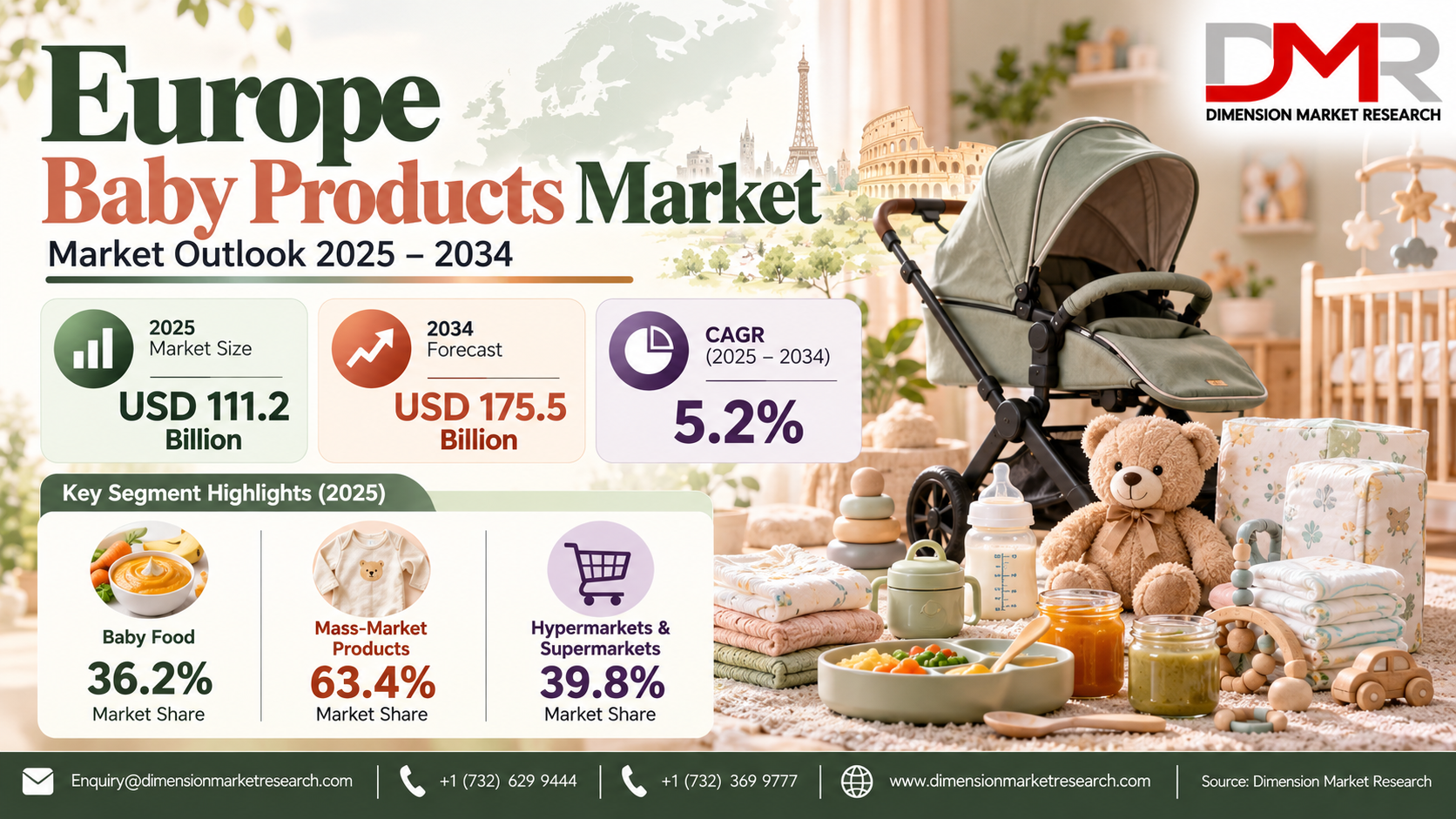
The Europe Baby Products Market is evolving as parents increasingly prioritize infant safety, nutritional quality, environmentally responsible products, and convenient childcare solutions. According to Dimension Market Research, the market is projected to reach USD 111.2 billion in 2025 and USD 175.5 billion by 2034, expanding at a CAGR of 5.2%.
Growing demand for organic baby food, gentle skincare products, sustainable diapers, and advanced monitoring devices is reshaping purchasing preferences across European countries. Consumers are placing greater emphasis on ingredient transparency, product certifications, and reliable performance.
Meanwhile, e-commerce expansion, subscription services, and connected baby care technologies are changing how brands engage with families. Manufacturers are responding through premium product development, recyclable packaging, and digital retail strategies.
What Is the Europe Baby Products Market?
The Europe Baby Products Market includes goods designed to support infant and toddler nutrition, hygiene, safety, comfort, and development.
Major product categories include baby food, cosmetics and toiletries, toys, safety equipment, clothing, nursery furniture, and feeding accessories.
These products are sold through supermarkets, specialty retailers, pharmacies, and digital platforms. Their development increasingly emphasizes safety compliance, ergonomic design, sustainable materials, and convenience for parents and caregivers.
Why Is the Europe Baby Products Market Growing?
Growing awareness of infant health and safety is an important market driver. European consumers increasingly prefer organic nutrition, dermatologically tested skincare, BPA-free feeding accessories, and products manufactured using safer materials.
Digital retail is another major growth factor. Online shopping platforms allow parents to compare product ingredients, examine certifications, read customer reviews, and access subscription services for frequently purchased necessities.
Innovation in childcare technology is also supporting demand. Smart baby monitors, connected feeding systems, and digital safety devices offer additional convenience and monitoring capabilities.
However, declining birth rates in several European countries, rising production costs, and stringent safety requirements are creating challenges. Manufacturers must balance affordability, product quality, regulatory compliance, and differentiation.
Get a Free Sample of the Europe Baby Products Market Report
Explore detailed market forecasts, consumer demand patterns, product segmentation, distribution channel analysis, competitive developments, and country-specific opportunities through Dimension Market Research's sample report.
https://dimensionmarketresearch.com/request-sample/europe-baby-products-market/
Europe Baby Products Market Size and Key Statistics
● 2025 Market Size: USD 111.2 Billion
● 2034 Forecast Revenue: USD 175.5 Billion
● Forecast CAGR: 5.2%
● Leading Product: Baby Food, 36.2% share in 2025
● Leading Type: Mass Products, 63.4% share in 2025
● Leading Distribution Channel: Hypermarkets & Supermarkets, 39.8% share in 2025
● Fastest-Growing Product Category: Baby Safety & Convenience
● Fastest-Growing Distribution Channel: Online
Market Segmentation: Baby Food and Mass Products Lead
Baby food is expected to dominate the product segment with a 36.2% share in 2025. Infant formula, cereals, purees, and ready-to-eat meals remain essential purchases for families.
Increasing demand for organic, allergen-free, fortified, and convenient nutrition products is encouraging manufacturers to develop differentiated offerings.
Mass-market baby products are projected to hold a 63.4% share, supported by affordability, widespread retail availability, and consistent demand for everyday essentials.
Premium products represent an important growth opportunity as consumers seek sustainable materials, certified ingredients, and enhanced product functionality.
Hypermarkets and supermarkets lead distribution with a 39.8% share, while online channels are expanding rapidly through home delivery, subscription services, and personalized shopping experiences.
How Sustainability and AI Are Transforming Baby Care
Sustainability is becoming a significant purchasing consideration across European baby product categories.
Manufacturers are introducing recyclable packaging, biodegradable materials, organic ingredients, and responsibly sourced products to meet changing consumer expectations.
Artificial intelligence is also influencing product innovation. AI-enabled monitoring devices, digital feeding applications, and personalized shopping platforms are creating new opportunities for technology-driven childcare solutions.
AI-based demand forecasting and quality inspection can also help manufacturers improve inventory planning, identify production defects, and strengthen operational efficiency.
European Country Outlook: Different Consumer Priorities Shape Demand
Germany, France, and the United Kingdom represent important European markets, supported by consumer spending, established retail networks, and demand for premium and organic baby products.
Northern European countries, including Sweden, Norway, and Denmark, demonstrate strong interest in sustainability and environmentally responsible product choices.
Southern European markets such as Italy, Spain, and Portugal maintain significant demand for affordable essentials, while premium products are gaining interest among urban consumers.
Eastern European countries, including Poland, Romania, and Hungary, offer opportunities through improving incomes and growing awareness of infant nutrition and safety.
These differences highlight the importance of localized product portfolios, pricing strategies, and distribution partnerships.
Competitive Landscape and Strategic Opportunities
The Europe Baby Products Market features established companies including Nestlé, Danone, Reckitt, Procter & Gamble, Kimberly-Clark, Unilever, Johnson & Johnson, Beiersdorf, Philips Avent, and Chicco.
Competition centers on product safety, affordability, nutritional innovation, sustainable packaging, brand trust, and retail accessibility.
Established manufacturers are strengthening premium offerings, while emerging brands are exploring organic products, connected baby care equipment, and direct-to-consumer distribution.
Companies offering transparent product information, reliable certification, and convenient purchasing experiences may gain competitive advantages.
Future Outlook for the Europe Baby Products Market
Through 2034, growth is expected to be shaped by premiumization, sustainable product innovation, digital commerce, and advanced childcare technology.
Online retail and subscription models will create opportunities to strengthen consumer relationships, while smart monitoring and connected products will support category diversification.
Manufacturers will also need to address demographic challenges, cost pressures, and changing regulatory requirements.
Explore the Complete Europe Baby Products Market Analysis
Access the full Dimension Market Research report for detailed market projections, product and channel comparisons, European country analysis, competitive benchmarking, and strategic opportunities supporting business planning.
https://dimensionmarketresearch.com/checkout/europe-baby-products-market/
Frequently Asked Questions
1. What is the Europe Baby Products Market size?
The market is projected to reach USD 111.2 billion in 2025 and USD 175.5 billion by 2034.
2. What is the expected CAGR of the Europe Baby Products Market?
The market is forecast to expand at a CAGR of 5.2% through 2034.
3. Which product segment leads the Europe Baby Products Market?
Baby food leads with an estimated 36.2% revenue share in 2025.
4. Which distribution channel dominates the market?
Hypermarkets and supermarkets lead with an estimated 39.8% share in 2025.
5. What are the major growth opportunities?
Organic baby food, sustainable products, smart monitoring technologies, premium childcare solutions, and online retail are important opportunities.
Conclusion
The Europe Baby Products Market is undergoing a shift toward safer, more sustainable, and increasingly technology-enabled childcare products.
While affordable everyday essentials continue to generate substantial demand, premium nutrition, connected safety devices, and digital distribution are creating new opportunities.
Manufacturers that combine trusted quality, accessible pricing, regulatory compliance, and innovative product development will be better positioned to respond to changing European consumer needs.
Related Baby Products Market Insights
The Baby Products Market Size is projected to increase from USD 357.9 billion in 2024 to USD 611.4 billion by 2033, registering a CAGR of 6.1%. Global demand is influenced by infant nutrition, personal care, safety products, sustainable materials, and digital retail expansion.
The US Baby Products Market Share analysis identifies baby food as the leading product category with a 27.8% share in 2025. The U.S. market is projected to increase from USD 92.9 billion in 2025 to USD 156.0 billion by 2034, supported by demand for organic products, childcare convenience, and premium offerings.
The Japan Baby Products Market Growth outlook projects expansion from USD 15.1 billion in 2026 to USD 25.0 billion by 2035, at a CAGR of 5.7%. Product safety, premiumization, sustainable baby care, and smart monitoring technologies are influencing demand despite demographic pressures.

 English
 Arabic
 French
 Spanish
 Deutsch
 Turkish
 Dutch
Dutch
 Italiano
 Russian
 Romaian
 Portuguese (Brazil)
 Greek
Greek
