


Europe’s Nuclear Infrastructure Pipeline: Challenges, Risks, and Long-Term Prospects
Measuring Industrial Capacity and Competitive Positioning in Europe’s Nuclear Sector
Europe’s nuclear construction ambitions depend on a capable industrial base. New reactors require specialised manufacturing, engineering services, construction expertise, safety systems, and a workforce able to meet rigorous technical standards. Understanding the scale and readiness of these capabilities is essential for businesses evaluating expansion opportunities and investors assessing the prospects of nuclear-related industrial companies.
What Determines Industrial Capacity?
Industrial capacity encompasses more than the number of factories or the volume of equipment produced. Nuclear suppliers must demonstrate that their facilities, processes, materials, inspection systems, and personnel meet the requirements of specific contracts. A manufacturer with substantial conventional engineering capacity may still need significant preparation before supplying safety-related nuclear components.
Production constraints can emerge at several points. Specialised machinery, qualified welding personnel, material availability, testing facilities, and independent inspections may limit output. In some cases, a small number of qualified manufacturers serve a technically demanding product category, increasing the importance of advance planning.
Capacity assessments should therefore distinguish theoretical production potential from qualified and commercially available capacity. This distinction helps prevent exaggerated expectations about how quickly the supply chain can respond to additional projects.
Assessing the European Industrial Base
The European nuclear supply network includes reactor technology providers, engineering consultancies, heavy manufacturing companies, civil contractors, instrumentation specialists, and service organisations. Their capabilities vary by country, technology, component category, and experience.
Some companies concentrate on large equipment and complex fabrication, while others provide digital control systems, design verification, specialist testing, or construction support. Research organisations and technical institutions contribute through materials science, simulation, training, and advanced engineering.
Industrial mapping can help identify potential bottlenecks and opportunities for collaboration. Developers should understand which capabilities are available locally, which require international procurement, and where alternative suppliers may need qualification.
Understanding Competitive Positioning
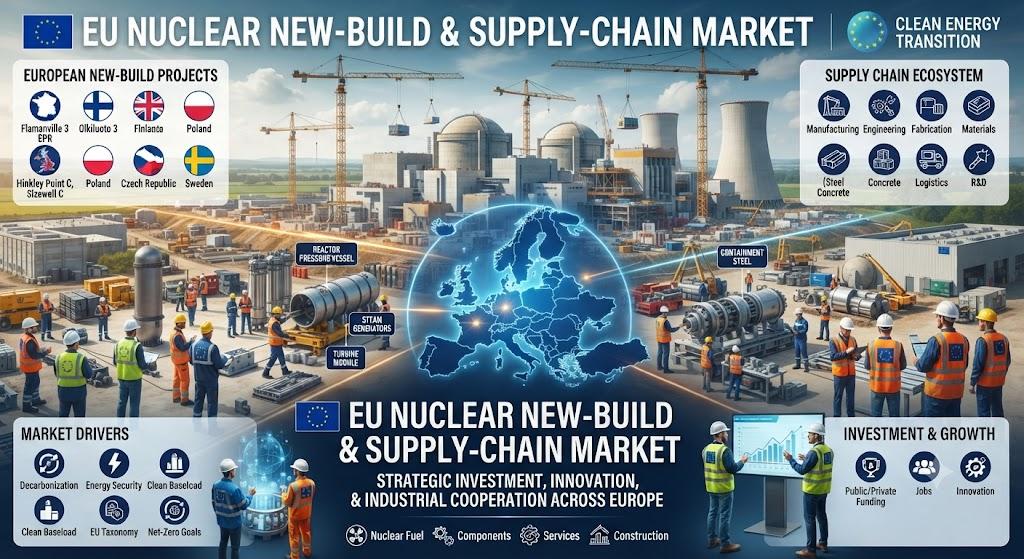
The EU Nuclear New-Build & Supply-Chain Market Size perspective can support structured evaluation of industrial demand, project pipelines, and supplier opportunities. Assessing commercial potential requires more than counting announced reactors: analysts should examine procurement schedules, project maturity, component requirements, and the proportion of expenditure accessible to different supplier categories.
Competitive positioning also depends on technological expertise, quality performance, manufacturing flexibility, financial strength, and established customer relationships. Companies with proven nuclear delivery records may benefit from accumulated knowledge and approved processes. New entrants may offer innovative manufacturing methods or digital capabilities but must demonstrate compliance before winning relevant contracts.
A useful assessment separates addressable demand from total project investment. Civil works, equipment packages, engineering services, and commissioning contracts represent different commercial opportunities, with different barriers to entry.
Expanding Capacity Without Creating Excess Risk
Manufacturers considering expansion should align investment plans with credible demand signals. Building dedicated facilities before customers confirm project schedules can create financial exposure. Conversely, waiting until procurement reaches its busiest phase may leave insufficient time to install equipment, qualify processes, and recruit experienced workers.
A staged approach can balance these risks. Companies may initially invest in workforce training, quality systems, supplier partnerships, and production improvements before committing to major facility expansion. Customer discussions and long-term agreements can help clarify expected volumes, specifications, and delivery requirements.
Capacity planning should also consider resilience. Reliance on a single subcontractor, specialist material source, or inspection facility may create vulnerabilities that remain hidden during normal operating conditions.
Skills, Innovation, and Productivity
Workforce development remains central to industrial readiness. Nuclear manufacturing needs experienced engineers, technicians, inspectors, project managers, and specialists who understand regulated production environments. Apprenticeships, professional training, and collaboration with universities can help address shortages.
Digital manufacturing systems, advanced inspection techniques, and integrated engineering platforms may improve documentation, traceability, and production visibility. Automation can support repeatability, but technology must be validated against applicable quality and safety requirements.
Outlook for Industrial Decision-Makers
European nuclear construction presents opportunities for established suppliers and carefully prepared new entrants. However, commercial success depends on verified technical capability, disciplined investment, and a realistic understanding of procurement timing.
Businesses should monitor supplier qualification programmes, manufacturing investments, tender notices, licensing milestones, and workforce initiatives. These indicators can reveal whether anticipated demand is translating into practical industrial requirements.
A resilient supply ecosystem will require cooperation between developers, manufacturers, policymakers, and training institutions. Companies that build capacity in line with credible project needs can improve competitiveness while reducing the risk of costly underutilised assets.

 English
 Arabic
 French
 Spanish
 Portuguese
 Deutsch
 Turkish
 Dutch
Dutch
 Italiano
 Romaian
 Portuguese (Brazil)
 Greek
Greek
