


Eicosapentaenoic Acid (EPA) Market: Omega-3 Demand and Sustainable Innovation Drive Growth
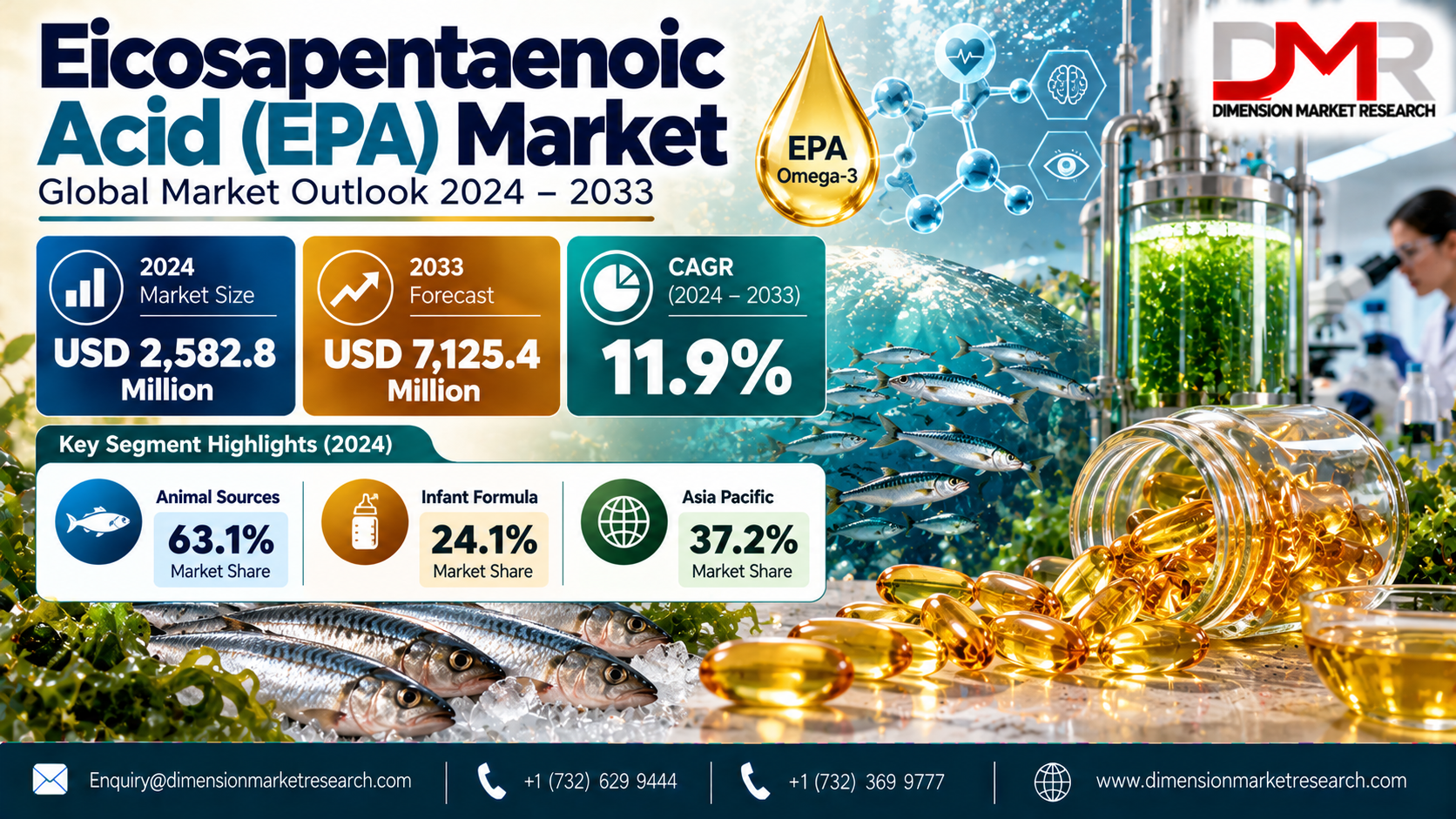
The global Eicosapentaenoic Acid (EPA) Market is expanding as manufacturers respond to increasing demand for omega-3 ingredients in dietary supplements, pharmaceuticals, functional foods, and specialized nutrition products. According to Dimension Market Research, the market is estimated at USD 2,582.8 million in 2024 and projected to reach USD 7,125.4 million by 2033, registering a CAGR of 11.9%.
Growing consumer awareness of cardiovascular health, healthy aging, and nutritional supplementation is encouraging manufacturers to develop EPA-rich formulations. Fish oils remain an established source, while algae-derived alternatives are attracting interest among consumers seeking plant-based and sustainable ingredients.
Advances in microalgae cultivation, extraction technologies, and high-concentration formulations are creating opportunities for omega-3 ingredient suppliers, pharmaceutical companies, and nutritional product manufacturers.
What Is the Eicosapentaenoic Acid (EPA) Market?
The Eicosapentaenoic Acid (EPA) Market includes the production, processing, and commercial application of EPA, a long-chain omega-3 polyunsaturated fatty acid commonly obtained from marine oils and certain microalgae.
EPA is used in dietary supplements, prescription pharmaceutical formulations, functional foods, and other nutritional products.
The market covers animal-derived and algae-derived sources, different chemical forms, and products with varying EPA concentrations.
Its commercial development is closely associated with nutritional research, pharmaceutical applications, ingredient quality, and growing interest in preventive health.
Why Is the Eicosapentaenoic Acid (EPA) Market Growing?
Increasing awareness of omega-3 fatty acids is an important growth driver. Consumers are exploring EPA-containing supplements as part of broader cardiovascular wellness and nutritional routines.
An aging population is also influencing demand for specialized nutritional products, particularly across North America, Europe, and developed Asian economies.
Growing interest in vegan and vegetarian ingredients is encouraging investment in algae-derived EPA. These alternatives offer manufacturers opportunities to diversify sourcing while addressing concerns about marine resource sustainability.
However, high production costs for microalgae-derived ingredients and strict requirements governing health claims remain important commercialization challenges.
Get a Free Sample of the Eicosapentaenoic Acid (EPA) Market Report
Explore detailed market forecasts, source and concentration analysis, application trends, regional opportunities, and competitive developments through Dimension Market Research's sample report. These insights can support ingredient sourcing, product development, and strategic investment decisions.
https://dimensionmarketresearch.com/request-sample/eicosapentaenoic-acid-market/
Eicosapentaenoic Acid (EPA) Market Size and Key Statistics
● 2024 Market Size: USD 2,582.8 Million
● 2033 Forecast Revenue: USD 7,125.4 Million
● Forecast CAGR: 11.9%
● U.S. Market Size (2024): USD 651.6 Million
● U.S. Forecast (2033): USD 1,690.2 Million
● U.S. CAGR: 11.2%
● Leading Region: Asia Pacific, 37.2% share in 2024
● Leading Source: Animal Sources, 63.1% share in 2024
● Leading Application: Infant Formula
Market Segmentation: Marine Sources and Infant Formula Lead
Animal-derived sources lead the market with a 63.1% share in 2024, supported by established marine oil extraction infrastructure and widespread availability of fish-derived raw materials.
Anchovy, sardine, salmon, tuna, cod liver, and krill oils represent important marine sources. Their established supply networks help manufacturers serve supplement and specialty nutrition applications.
Triglycerides are identified as the leading form, while medium EPA concentrates containing 20% to 50% EPA are expected to dominate concentration segmentation.
Infant formula is identified as the leading application. The report discusses EPA alongside DHA in specialized infant nutrition formulations, although the specific benefits of each fatty acid should be evaluated separately.
Other applications include dietary supplements, fortified foods, pharmaceuticals, animal feed, and personal care products.
How Algae-Based EPA and AI Are Transforming Production
Plant-based EPA production represents an important emerging opportunity as manufacturers seek alternatives to conventional fish oil supply chains.
Microalgae cultivation enables producers to obtain omega-3 ingredients without depending exclusively on wild-caught marine resources.
Advanced extraction processes and encapsulation technologies are being developed to improve ingredient purity, stability, and formulation flexibility.
Artificial intelligence can also support production efficiency. Predictive models may optimize algae cultivation conditions, while automated quality monitoring can help identify inconsistencies in ingredient processing.
These developments are particularly relevant to manufacturers seeking scalable, sustainable, and high-quality EPA production.
Regional Outlook: Asia Pacific Leads the Market
Asia Pacific is projected to lead the global Eicosapentaenoic Acid (EPA) Market with 37.2% revenue share in 2024.
China, Japan, and South Korea benefit from established marine ingredient supply chains, fish oil processing capabilities, and demand for omega-3 nutritional products.
Increasing awareness of dietary supplementation and expanding consumer purchasing power in China and India create additional opportunities.
North America represents another important market, supported by demand for omega-3 supplements and pharmaceutical applications.
The United States market is estimated at USD 651.6 million in 2024 and projected to reach USD 1,690.2 million by 2033.
Europe also offers opportunities through plant-based nutrition, premium supplements, and increasing interest in sustainably sourced ingredients.
Competitive Landscape and Strategic Opportunities
Major companies identified in the report include DSM, BASF SE, Lonza, Glanbia, Farbest Brands, SternVitamin, Adisseo, BTSA Biotecnologías Aplicadas, Epax, BioProcess Algae, and Croda International.
Competition focuses on ingredient purity, concentration, production capacity, formulation capabilities, sustainable sourcing, and regulatory compliance.
Established suppliers are investing in product innovation, research partnerships, and specialized omega-3 formulations.
The DMR report also discusses developments involving high-concentration EPA products and expanded algae-derived ingredient production, reflecting growing interest in differentiated nutrition solutions.
Future Outlook for the Eicosapentaenoic Acid (EPA) Market
Through 2033, market opportunities are expected to expand across dietary supplements, specialized pharmaceuticals, functional nutrition, and algae-derived omega-3 ingredients.
Improved extraction efficiency, high-concentration formulations, and sustainable sourcing may help manufacturers address changing customer requirements.
Long-term competitiveness will depend on production economics, regulatory compliance, ingredient quality, and scientifically supported product positioning.
Explore the Complete Eicosapentaenoic Acid (EPA) Market Analysis
Access the comprehensive Dimension Market Research report for detailed market projections, source segmentation, concentration analysis, application trends, regional comparisons, and competitive intelligence supporting omega-3 industry decisions.
https://dimensionmarketresearch.com/checkout/eicosapentaenoic-acid-market/
Frequently Asked Questions
1. What is the global Eicosapentaenoic Acid (EPA) Market size?
The market is estimated at USD 2,582.8 million in 2024 and projected to reach USD 7,125.4 million by 2033.
2. What is the expected CAGR of the Eicosapentaenoic Acid (EPA) Market?
The market is forecast to expand at a CAGR of 11.9% through 2033.
3. Which source segment leads the market?
Animal-derived EPA sources lead with a projected 63.1% market share in 2024.
4. Which region dominates the Eicosapentaenoic Acid (EPA) Market?
Asia Pacific leads with an estimated 37.2% revenue share in 2024.
5. What are the major growth opportunities for EPA manufacturers?
Algae-derived EPA, high-concentration formulations, specialized nutrition, advanced extraction technologies, and sustainable ingredient production offer important opportunities.
Conclusion
The Eicosapentaenoic Acid (EPA) Market is evolving as omega-3 ingredient manufacturers respond to growing demand for nutritional products, sustainable sourcing, and specialized formulations.
Marine-derived EPA continues to dominate supply, while algae-based production creates opportunities for ingredient diversification.
Advances in extraction technology, formulation quality, and production efficiency will play important roles in market development through 2033.

 English
 Arabic
 Spanish
 Portuguese
 Deutsch
 Turkish
 Dutch
 Italiano
 Russian
 Romaian
 Portuguese (Brazil)
 Greek
