


How Foreign Companies Can Obtain GST Registration Without a Physical Office in India
India offers attractive opportunities for foreign companies looking to expand their international operations, sell products, provide digital services, and reach Indian customers. However, many overseas businesses want to enter the Indian market without establishing a traditional office or physical business premises.
Understanding GST Registration for Foreign Companies is essential for determining whether an overseas business must register for Goods and Services Tax (GST), even when it operates from another country. The applicable requirements depend on the nature of the business, the type of supply, the location of customers, and the relevant provisions of Indian GST law.
Some foreign companies may be covered by special registration rules for non-residents or overseas digital service providers. Others may have different obligations depending on their commercial arrangements. This guide explains how foreign companies can assess and obtain GST registration without maintaining a conventional physical office in India.
1. Can Foreign Companies Obtain GST Registration Without an Indian Office?
Yes, a foreign company may be required or permitted to obtain GST registration without maintaining a conventional physical office in India, depending on its activities and the applicable registration provisions.
For example, certain overseas suppliers providing specified digital services to non-taxable online recipients in India are covered by special GST registration rules. Eligible non-residents making occasional taxable supplies may also need to register under the Non-Resident Taxable Person framework.
However, the absence of a physical office does not automatically make a company eligible for every registration category. Businesses must first determine which statutory provisions apply to their transactions.
Foreign companies should assess their supply arrangements, customer locations, and business structure before submitting an application.
2. Understanding GST Registration Requirements for Overseas Businesses
GST registration requirements vary according to the type of business activity performed by a foreign company.
Important factors include:
-
Nature of supply: Whether the company sells goods, provides professional services, or supplies digital products.
-
Place of supply: Whether the transaction is treated as a supply in India under the relevant rules.
-
Customer category: Whether the recipient is an individual consumer, a registered business, or another type of customer.
-
Business structure: Whether the company operates directly from overseas or through an Indian subsidiary, branch, or other establishment.
-
Applicable exemptions: Whether a specific exemption or special registration provision applies.
A foreign company should not assume that all sales to Indian customers require registration. The legal position depends on the facts and the applicable GST provisions.
3. Types of GST Registration Available to Foreign Companies
Before applying, an overseas business should identify the appropriate registration category.
Regular GST Registration
This may be relevant to a business operating through an eligible Indian establishment or undertaking activities covered by the regular GST framework. The applicable requirements depend on the legal structure and taxable supplies.
Non-Resident Taxable Person Registration
A Non-Resident Taxable Person (NRTP) is generally a person who occasionally undertakes transactions involving taxable supplies in India without having a fixed place of business or residence in the country.
This category may be suitable for qualifying foreign businesses undertaking temporary commercial activities, subject to the statutory requirements.
Special Registration for Certain Digital Services
Certain overseas suppliers of online information and database access or retrieval services to non-taxable online recipients in India are subject to specific registration provisions.
The correct category should be established before beginning the application process.
4. Documents Required for GST Registration Without a Physical Office
Foreign companies should prepare the relevant documentation before applying. The precise requirements depend on the registration category and the applicable GST portal procedure.
Common documents and details may include:
-
Certificate of incorporation or equivalent business registration document.
-
Proof of the company's registered address in its home country.
-
Passport or prescribed identification of the authorised signatory.
-
Details of an authorised representative in India, where required.
-
Authorisation letter, board resolution, or power of attorney.
-
Information about the proposed taxable activities in India.
-
Banking information and other prescribed financial details.
-
Foreign tax identification details, where applicable.
Some documents issued overseas may require translation, authentication, or other formalities.
Companies should confirm the latest requirements for their specific registration category instead of relying on a general checklist.
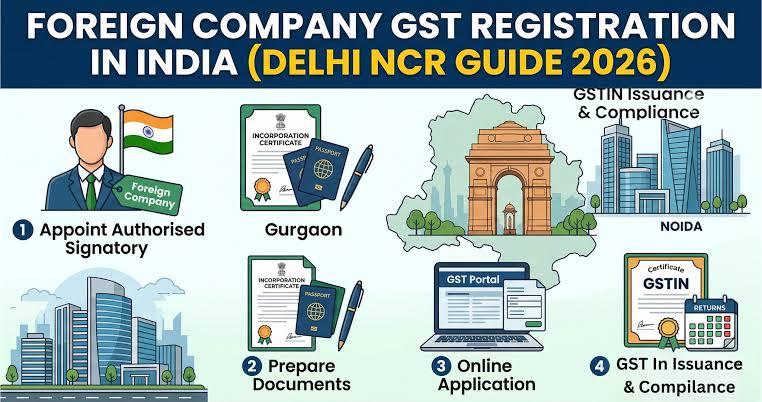
5. Step-by-Step GST Registration Process
Foreign companies can approach the registration process systematically by following the applicable procedure.
Step 1: Assess the Business Model
Identify the goods or services being supplied, the location of customers, and whether the company has any business establishment in India.
This assessment helps determine whether registration is necessary and which category applies.
Step 2: Identify the Correct Registration Category
Determine whether regular GST registration, NRTP registration, or a special provision for specified overseas digital services is relevant.
Choosing the wrong category may lead to application delays or incorrect compliance arrangements.
Step 3: Prepare the Supporting Documents
Collect the incorporation certificate, identity documents, address information, authorisations, and other records prescribed for the relevant category.
Ensure that all details are accurate and consistent.
Step 4: Submit the Application Through the GST Portal
Complete the appropriate application and provide the required information. Certain categories have specific procedures and additional conditions.
For NRTP registration, the application should generally be submitted at least five days before commencing business.
Step 5: Complete Verification
Respond to any requests for clarification or additional documents within the prescribed time.
Once registration is approved, review the registration details and establish the procedures needed for tax payments and return filing.
6. Is an Indian Authorised Representative Necessary?
An authorised representative may be required depending on the registration category and the applicable rules.
The representative can help the foreign company with application formalities, communications with tax authorities, and other authorised compliance responsibilities.
The company may need to provide the representative's identity details and a formal authorisation document.
Before appointing a representative, the foreign business should define the person's responsibilities and confirm the documentation required under the relevant GST procedure.
It is also useful to establish a clear process for receiving tax notices, maintaining records, and tracking statutory deadlines.
7. GST Registration for Foreign Digital Service Providers
Foreign companies providing digital services to Indian customers should carefully assess their GST responsibilities.
Examples of digital business models include online subscriptions, digital content platforms, software-based services, and other electronically supplied services. The applicable treatment depends on the precise nature of the service and the recipient.
Certain overseas suppliers of online information and database access or retrieval services to non-taxable online recipients in India are covered by special registration provisions.
Other services may be subject to different rules, including provisions that place the tax liability on an Indian recipient under the reverse charge mechanism where the relevant conditions are satisfied.
Foreign companies should review the nature of their services, customer status, place-of-supply rules, and applicable exemptions before determining their registration obligations.
8. GST Registration for Foreign Companies Selling Goods in India
Foreign companies selling goods to Indian customers must consider how their products enter India and how subsequent sales are structured.
When goods are imported into India, customs procedures and import IGST may apply. The importer is generally responsible for the relevant import formalities.
A foreign supplier selling directly to an Indian importer may have different obligations from a company holding inventory in India and making domestic sales.
Businesses should review distribution arrangements, ownership of inventory, contractual terms, invoicing, and the identity of the importer to establish the correct tax treatment.
GST registration should be assessed alongside customs and import-export compliance requirements.
9. GST Registration Costs and Advance Tax Deposits
Foreign companies should distinguish between professional fees, document preparation expenses, and any applicable tax deposits.
GST registration itself generally does not carry a standard government application fee for ordinary registration. However, companies should verify the current requirements for their particular registration category.
Professional service providers may charge fees for eligibility assessments, document preparation, application support, and ongoing compliance services.
For a Non-Resident Taxable Person, an advance deposit of estimated tax liability is generally required under the applicable rules. This deposit is not a professional fee and should be calculated according to the relevant requirements.
Additional expenses may arise from translation, notarisation, authentication, or other documentation formalities.
10. GST Compliance After Registration
After obtaining GST registration, a foreign company must comply with the requirements applicable to its registration category.
These responsibilities may include:
-
Issuing appropriate tax invoices.
-
Paying GST where required.
-
Filing prescribed GST returns.
-
Maintaining transaction and accounting records.
-
Reconciling invoices, payments, and tax deposits.
-
Reviewing input tax credit eligibility where applicable.
-
Monitoring regulatory changes and filing deadlines.
Non-Resident Taxable Persons have specific compliance requirements that may differ from those of regular registrants.
A compliance calendar and reliable accounting procedures can help foreign companies manage their obligations efficiently.
11. Common Challenges and How to Avoid Them
Foreign businesses without an Indian office may face uncertainty about registration eligibility, representative requirements, documentation, and the tax treatment of cross-border transactions.
Common mistakes include selecting the wrong registration category, assuming that having no physical office eliminates GST obligations, submitting incomplete documents, and overlooking special rules for digital services.
To avoid these problems, companies should assess their business model before applying, confirm the applicable statutory requirements, and maintain accurate transaction records.
Professional advice can be particularly useful when a business operates across several countries or supplies multiple types of goods and services to Indian customers.
12. Benefits of Professional GST Registration Assistance
Professional support can help foreign companies understand the Indian GST framework and manage the registration process.
An experienced adviser may assist with determining eligibility, selecting the appropriate category, reviewing overseas documents, coordinating authorised representatives, and explaining ongoing compliance obligations.
Professional assistance may also help businesses coordinate GST responsibilities with accounting, customs, and international tax requirements.
Before hiring a service provider, companies should confirm the provider's experience with foreign entities, the scope of services, the applicable fees, and the availability of post-registration support.
Conclusion
GST Registration for Foreign Companies does not always require maintaining a conventional physical office in India. However, the applicable registration requirements depend on the company's activities, customer base, transaction structure, and the relevant GST provisions.
By selecting the correct registration category, preparing the required documents, and understanding the applicable tax and filing obligations, overseas businesses can manage their Indian compliance responsibilities more effectively.
Foreign companies should review their business arrangements before entering the Indian market and seek qualified Indian GST advice when their registration status is uncertain. A well-planned approach can help reduce administrative difficulties and support smoother business expansion into India.

 English
 Arabic
 French
 Spanish
 Portuguese
 Turkish
 Dutch
 Italiano
 Russian
 Romaian
 Portuguese (Brazil)
 Greek
