


Why Does Nag Champa Smell Sweet, Woody, and Smoky?
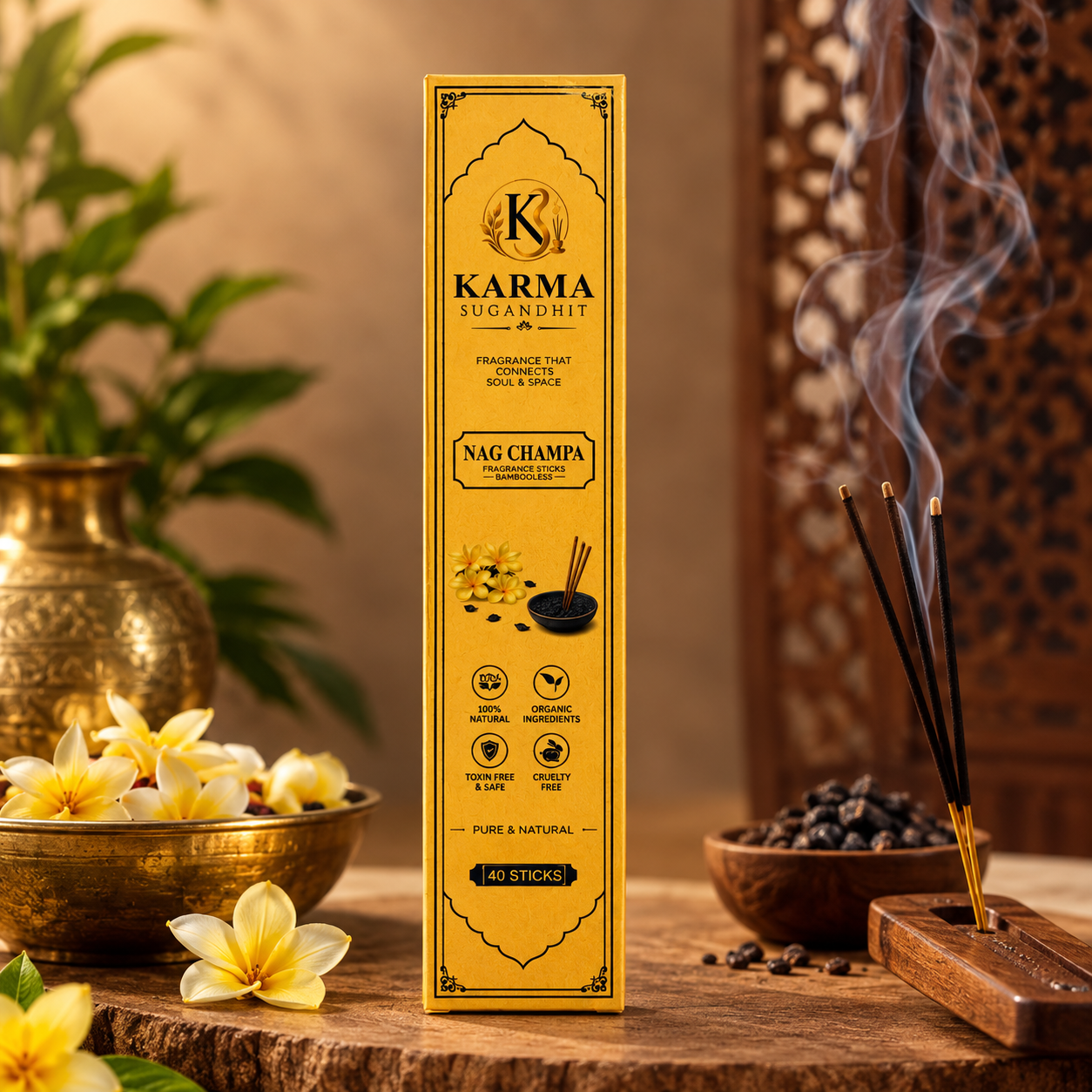
Smell a stick of nag champa before it's lit and you mostly get flowers. Light it, and something else turns up — resin, warmth, a faint ashy edge that wasn't in the box.
That shift is the whole answer, really. The nag champa smell isn't one ingredient doing something clever. It's three or four materials stacked on top of each other, and one of them only fully arrives once there's a flame.
The three parts, roughly
A traditional nag champa stick is a masala incense. That means the aromatic materials are ground and mixed into a paste, rolled onto a bamboo core, and left to dry — not dipped in a fragrance oil like the cheap perfumed sticks.
The paste usually contains a flower note, a wood, and a resin. Which part you notice first depends on the stick, and on whether it's lit.
The flower: champa
"Champa" in India is a loose name. It covers plumeria — the frangipani you see in gardens across the south — and also champaca, a related tree with yellow-orange blossoms. Both are intensely fragrant, and both smell like the sweet part of nag champa before anything is burned.
Champaca absolute, the extracted oil, is floral but not airy. There's a slightly fruity, tea-like quality to it, and a creaminess underneath. It reads as sweet without being sugary, which is a distinction that matters — the sweetness in nag champa isn't the sweetness of vanilla cake. It's closer to the sweetness of a flower that's slightly past its best, richer for it.
The wood: sandalwood
The base note. Traditional nag champa used Mysore sandalwood, which is now heavily restricted and extremely expensive, so most manufacturers use Australian sandalwood, a related species, or a synthetic reconstruction.
Sandalwood is creamy rather than sharp. It's woody in the way a sawn plank is woody, but with a milky, slightly balsamic softness that holds the floral note in place. Without it, the flower would float off on its own and the whole thing would smell thin.
That's the woody part of the description accounted for. It's also the part most people underrate, because it doesn't announce itself. It just makes everything else sit properly.
The resin: halmaddi
Here's the one worth knowing about.
Halmaddi is a soft, sticky resin tapped from a tree, and it's the ingredient that gives classic nag champa its distinctive honeyed, slightly medicinal, faintly smoky sweetness. It's also why good masala incense feels soft and slightly tacky in the wrapper rather than dry and brittle.
Halmaddi isn't a fragrance in the usual sense. It's a texture and a weight. It slows the burn, holds the other materials together, and contributes that resinous warmth that sits underneath the flowers. When people say nag champa smells "golden," this is the ingredient they're describing, whether they know it or not.
Harvesting it is seasonal and regulated, and it's one reason the classic formula has become harder to source. Many modern sticks substitute benzoin, labdanum, or a synthetic resin accord. Good ones get close. None of them quite land the same way.
Then you light it, and the smoke arrives
The smoky note isn't in the box. It's created.
Burning plant material produces a family of compounds — guaiacol, syringol, cresols, phenols — and these are the same compounds responsible for the smell of woodsmoke, smoked food, and a fireplace. Your nose recognises them instantly as "something is burning," which is exactly what's happening.
There's a nice detail hiding in this. When wood burns, its lignin breaks down and releases vanillin — the same molecule as vanilla. So woodsmoke is genuinely, chemically sweet as well as smoky. That's why a bonfire smells pleasant rather than acrid, and it's part of why nag champa's smoke reads as warm rather than harsh.
Heat does the rest. The resins volatilise all at once, so the honeyed quality of the halmaddi arrives alongside the smoke rather than before it. The sandalwood, which was quiet and creamy when cold, gets pushed forward. And the flower note, which was the whole story unlit, drops back into the middle where it belongs.
Which is why the lit smell is rounder and heavier than the unlit one. Same materials, different chemistry.
Why one nag champa can smell nothing like another
There's no fixed formula. "Nag champa" is a style, not a recipe, and manufacturers vary wildly.
Some lean floral and light. Some are heavy on sandalwood and smell almost like a temple. Some are sweet to the point of cloying because they've been built on synthetic vanillin rather than resin. And a fair number of cheap sticks labelled nag champa contain no champaca, no sandalwood and no halmaddi at all — just fragrance oil on a charcoal-coated blank, which burns sharp and leaves a headache behind.
Price is a rough guide but not a reliable one. A better test is the stick itself. Masala incense is soft, slightly uneven, and often has a visible coating of powder. The dipped kind is uniform, glossy, and sits on a black core. They behave differently in the air, too — masala burns slower and produces more visible smoke.
And a bit of it is you
Worth admitting: nag champa is one of those smells that's tangled up with memory. It's been in incense boxes, ashrams, record shops and student flats for decades. If you encountered it early, some of that sweetness is association rather than chemistry — your brain filing the smell under a particular time and place.
That's not a reason to distrust the description. It's the reason the description is so consistent across people who've never met. The flower, the wood, the resin and the smoke are real. The warmth you attach to them is yours.

 English
 Arabic
 French
 Spanish
 Portuguese
 Turkish
 Dutch
 Italiano
 Russian
 Romaian
 Portuguese (Brazil)
 Greek
