


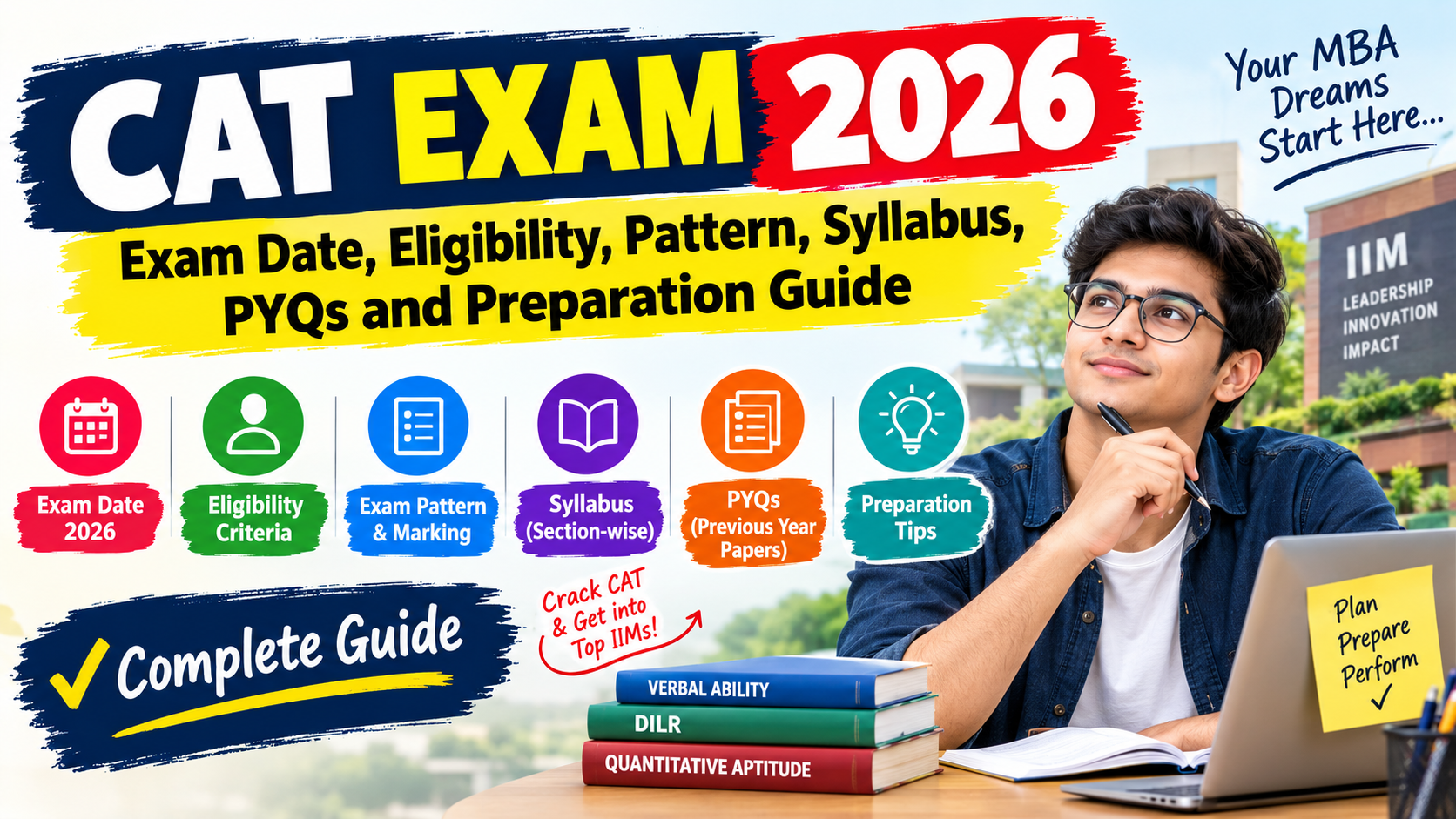
CAT Exam 2026: Exam Date, Eligibility, Pattern, Syllabus, PYQs and Preparation Guide
Meta Title: CAT Exam 2026: Date, Syllabus, Pattern & PYQs
Meta Description: Get complete details about CAT Exam 2026, including exam date, eligibility, exam pattern, syllabus, marking scheme, previous year question papers, and preparation tips.
URL Slug: cat-exam-2026-date-syllabus-pattern-pyqs
Focus Keyword: CAT Exam 2026
Introduction
The Common Admission Test (CAT) is one of the most popular management entrance examinations in India. It is conducted by the Indian Institutes of Management (IIMs) for admission to MBA and other postgraduate management programmes offered by IIMs and numerous other business schools.
Every year, thousands of students and working professionals prepare for CAT to pursue management education and develop careers in finance, marketing, consulting, human resources, business analytics, and entrepreneurship.
If you are planning to appear for the CAT exam, understanding the examination date, eligibility criteria, syllabus, paper pattern, and previous year question papers is essential. A well-planned preparation strategy can help you improve your accuracy, speed, and overall performance.
In this guide, we cover everything you need to know about CAT Exam 2026, including important dates, section-wise syllabus, marking scheme, PYQs, and preparation tips.
CAT Exam 2026: Important Highlights
Here is an overview of the CAT examination.
|
Particulars |
Details |
|
Exam name |
Common Admission Test (CAT) |
|
Exam year |
2026 |
|
Conducting body |
IIM Indore |
|
Exam level |
National level |
|
Exam mode |
Computer-based test |
|
Exam date |
29 November 2026 |
|
Duration |
120 minutes |
|
Number of sections |
3 |
|
Main sections |
VARC, DILR, Quantitative Aptitude |
The CAT 2026 examination is scheduled for 29 November 2026. Candidates should check the official CAT website for the latest announcements, examination instructions, and admit card updates.
CAT Exam Date 2026 and Important Dates
Knowing the examination schedule helps candidates organise their preparation and complete the required formalities on time.
|
Event |
Date or status |
|
CAT 2026 notification |
Released in July 2026 |
|
Registration began |
3 August 2026 |
|
Registration deadline |
September 2026; the official schedule was updated during the application period |
|
Admit card release |
Scheduled for 4 November 2026 |
|
CAT 2026 exam |
29 November 2026 |
|
Result |
Expected after the examination; check the official announcement |
The CAT 2026 registration period has ended. Candidates who have already registered should monitor the official website for admit card availability and examination-day instructions. <Cite refs={["turn637635search0","turn637635search1"]}/>
Always verify dates through the official portal because schedules and announcements can change.
What Is the CAT Exam?
CAT stands for Common Admission Test. It is a computer-based entrance examination used by IIMs and other participating management institutions to assess candidates' aptitude for postgraduate management education.
The exam evaluates three major skill areas:
-
Verbal Ability and Reading Comprehension (VARC)
-
Data Interpretation and Logical Reasoning (DILR)
-
Quantitative Aptitude (QA)
A CAT score is an important part of the MBA admission process, but it does not guarantee admission. IIMs and other business schools may also consider academic performance, work experience, diversity factors, interviews, written assessments, and other selection criteria.
CAT Exam Eligibility Criteria 2026
Before applying for CAT, candidates should understand the basic eligibility requirements.
Educational Qualification
Candidates generally need a bachelor's degree from a recognised university or an equivalent qualification.
Minimum Marks
The usual minimum graduation marks or equivalent CGPA are:
-
General, EWS, and NC-OBC candidates: 50%.
-
SC, ST, and PwD candidates: 45%.
Candidates should consult the current official CAT notification for the precise eligibility and category rules.
Final-Year Students
Students in the final year of their bachelor's degree, or those awaiting results, may apply if they satisfy the conditions specified in the official notification.
Age Limit
CAT generally has no upper age limit.
Work Experience
Work experience is not compulsory for appearing in CAT. However, some MBA programmes may consider professional experience during their admission process.
CAT Exam Pattern 2026
Understanding the exam pattern is important because CAT requires candidates to manage both accuracy and time.
The published CAT 2026 structure follows a two-hour examination divided into three sections. The reported pattern contains 68 questions, although candidates should verify the final instructions on the official website. <Cite refs={["turn637635search0","turn637635search2"]}/>
|
Section |
Number of questions |
Time limit |
|
VARC |
24 |
40 minutes |
|
DILR |
22 |
40 minutes |
|
Quantitative Aptitude |
22 |
40 minutes |
|
Total |
68 |
120 minutes |
1. Verbal Ability and Reading Comprehension (VARC)
This section tests reading comprehension, verbal reasoning, and the ability to understand and interpret written information.
2. Data Interpretation and Logical Reasoning (DILR)
This section measures analytical thinking, logical reasoning, and the ability to interpret information presented through tables, graphs, charts, and caselets.
3. Quantitative Aptitude (QA)
This section assesses mathematical concepts and numerical problem-solving skills, including arithmetic, algebra, geometry, and related topics.
Candidates generally cannot move freely between sections during their allotted sectional time. Check the current examination instructions for the applicable rules.
CAT Exam Marking Scheme
Candidates should understand the marking scheme before attempting mock tests or the actual examination.
The reported CAT 2026 marking structure is:
-
Correct answer: +3 marks.
-
Incorrect MCQ answer: −1 mark.
-
Incorrect TITA answer: Generally no negative marking.
-
Unanswered question: No marks awarded or deducted.
TITA stands for “Type In The Answer,” where candidates enter their response instead of selecting from multiple-choice options.
The marking rules should be confirmed against the official examination instructions before the test.
CAT Exam Syllabus 2026: Section-Wise Details
CAT does not prescribe a single exhaustive topic-by-topic syllabus in the same way as some other entrance exams. The following topics are commonly used as a preparation guide based on the examination's established structure and previous papers.
1. CAT VARC Syllabus
The VARC section focuses on English comprehension and verbal reasoning.
Important topics include:
-
Reading comprehension passages
-
Para jumbles
-
Para summary
-
Odd sentence out
-
Sentence placement
-
Verbal reasoning
-
Inference-based questions
-
Main idea and author's purpose
-
Tone and argument analysis
Preparation tip: Read editorials, essays, and long-form articles regularly. Practise identifying the main argument, tone, supporting evidence, and implied meaning of a passage.
2. CAT DILR Syllabus
DILR tests the ability to analyse information and solve logical problems.
Important topics include:
-
Tables and charts
-
Bar graphs and line graphs
-
Pie charts
-
Data caselets
-
Seating arrangements
-
Scheduling and grouping
-
Games and tournaments
-
Routes and networks
-
Logical conditions
-
Venn diagrams
-
Distribution and selection problems
Preparation tip: Practise different types of sets and learn to identify which ones are worth attempting first. Accuracy and set selection are important for effective time management.
3. CAT Quantitative Aptitude Syllabus
Quantitative Aptitude focuses on mathematical concepts and numerical reasoning.
Important topics include:
-
Arithmetic
-
Percentages
-
Profit, loss, and discount
-
Ratio and proportion
-
Averages
-
Simple and compound interest
-
Time, speed, and distance
-
Time and work
-
Algebra
-
Linear and quadratic equations
-
Number systems
-
Geometry
-
Mensuration
-
Permutation and combination
-
Probability
-
Basic set theory
Preparation tip: Build a strong foundation in arithmetic and algebra, then practise mixed-topic questions. Focus on understanding concepts rather than memorising formulas alone.
CAT Previous Year Question Papers (PYQs)
Previous year question papers, commonly known as PYQs, are among the most useful resources for CAT preparation.
Solving past papers helps candidates understand question formats, recurring topic areas, difficulty levels, and the time management skills needed for the examination.
Benefits of Solving CAT PYQs
1. Understand the Exam Pattern
Previous papers help you become familiar with the three sections and the different types of questions asked.
2. Identify Important Topics
Reviewing multiple papers can help you identify topics that appear regularly, although no topic is guaranteed to appear in the next examination.
3. Improve Time Management
Attempting a paper under timed conditions teaches you to allocate time carefully and avoid spending too long on a single question.
4. Evaluate Your Performance
Reviewing your answers helps you identify strengths, weaknesses, and areas requiring revision.
5. Improve Accuracy
By analysing mistakes and practising similar questions, you can improve your problem-solving approach.
Where Can You Find CAT Previous Year Papers?
You can look for CAT question papers, memory-based papers, and practice sets through:
-
The official CAT website:
-
Official mock tests and sample materials, when available.
-
Reputable educational platforms that provide CAT practice papers and explanations.
-
Trusted MBA preparation books and study resources.
Important: Check whether a paper is an official released paper or a memory-based reconstruction. The official CAT website may provide mock tests and examination information rather than a complete archive of every previous year's question paper.
How to Practise CAT PYQs Effectively
Follow this simple method:
-
Choose a previous paper or a reliable practice set.
-
Attempt it under timed conditions.
-
Avoid checking answers while solving.
-
Calculate your score using the relevant marking scheme.
-
Analyse every incorrect or unanswered question.
-
Revise the underlying concept.
-
Reattempt difficult questions after a few days.
Do not focus only on the number of papers completed. The quality of your analysis is equally important.
CAT Mock Tests: Why Are They Important?
Mock tests simulate the examination experience and help candidates understand their preparation level.
Regular mock tests can help you:
-
Improve speed and accuracy.
-
Practise under sectional time limits.
-
Identify weak topics.
-
Develop a question-selection strategy.
-
Reduce exam-day anxiety.
-
Track improvement over time.
Start with topic-wise tests when learning the basics, then gradually move to sectional tests and full-length mock examinations.
After every mock, review your accuracy, time spent per question, mistakes, and missed opportunities.
CAT Exam Preparation Strategy
A structured preparation plan can help you prepare for CAT more effectively.
Step 1: Understand the Syllabus
Review the major topics in VARC, DILR, and Quantitative Aptitude. Make a checklist of topics you have mastered and those that require more practice.
Step 2: Create a Study Timetable
Divide your study time between the three sections. Include time for learning concepts, solving questions, revision, and mock-test analysis.
Step 3: Strengthen Basic Concepts
Begin with fundamentals before moving to advanced questions. A strong conceptual foundation is especially useful in Quantitative Aptitude and DILR.
Step 4: Practise Daily
Regular practice helps build consistency. Read English passages, solve quantitative problems, and attempt logical reasoning sets as part of your routine.
Step 5: Solve Previous Year Papers
Use PYQs to become familiar with the examination style and evaluate your readiness.
Step 6: Take Full-Length Mock Tests
As the examination approaches, practise full-length tests under realistic conditions. Use the results to refine your strategy.
Step 7: Revise and Analyse
Review formulas, reading strategies, common errors, and difficult questions. Avoid repeatedly making the same mistakes.
CAT Preparation Timetable for Students
Here is an example of a daily study timetable that you can customise according to your schedule.
|
Activity |
Suggested time |
|
Quantitative Aptitude concepts and practice |
1 hour |
|
VARC reading and questions |
1 hour |
|
DILR practice sets |
1 hour |
|
Revision and error analysis |
30 minutes |
|
Mock test or additional practice, as scheduled |
30–60 minutes |
Candidates with limited preparation time can adjust the schedule, but consistent study and detailed analysis are more useful than irregular, intensive sessions.
Best Books and Resources for CAT Preparation
Students can use standard aptitude books, practice materials, and online resources to prepare for CAT.
Useful resource categories include:
-
Quantitative Aptitude concept and practice books.
-
Reading comprehension and verbal reasoning practice books.
-
Logical reasoning and data interpretation workbooks.
-
CAT previous year question collections.
-
Full-length mock tests and sectional tests.
-
Official CAT notifications and examination instructions.
Before purchasing a book or course, review its syllabus coverage, answer explanations, and relevance to the current exam pattern.
Common Mistakes to Avoid During CAT Preparation
MBA aspirants should avoid these common preparation mistakes:
-
Starting preparation without understanding the exam pattern.
-
Ignoring one of the three sections.
-
Solving questions without reviewing mistakes.
-
Taking mock tests without analysing performance.
-
Memorising formulas without understanding concepts.
-
Spending too much time on a difficult question.
-
Depending entirely on memory-based questions without checking their reliability.
-
Using outdated information about exam dates and marking rules.
A balanced strategy that combines conceptual learning, practice, revision, and performance analysis can help candidates prepare more effectively.
Frequently Asked Questions (FAQs)
1. What is the CAT exam date for 2026?
CAT 2026 is scheduled for 29 November 2026. Candidates should verify the latest information on the official CAT website.
2. What is the duration of the CAT exam?
The published examination structure provides a total duration of 120 minutes, with 40 minutes allotted to each of the three sections.
3. What is the CAT exam syllabus?
CAT preparation generally covers VARC, DILR, and Quantitative Aptitude. Common topics include reading comprehension, logical reasoning, data interpretation, arithmetic, algebra, and geometry.
4. Where can I find CAT previous year question papers?
You can check the official CAT website for available examination materials and use reputable educational platforms, practice books, and memory-based papers for additional preparation.
5. Is there negative marking in CAT?
The established marking structure awards three marks for a correct answer and deducts one mark for an incorrect MCQ answer. TITA questions generally do not carry negative marking for incorrect responses. Confirm the current instructions before the exam.
6. Can final-year students apply for CAT?
Yes, final-year undergraduate students may apply if they satisfy the conditions specified in the official CAT notification.
7. How many months are required to prepare for CAT?
Preparation time depends on your current skills, target score, and available study hours. Many candidates plan several months for concept building, question practice, mock tests, and revision.
8. Does a good CAT score guarantee admission to an IIM?
No. IIMs follow their individual admission policies and may consider academic records, interviews, work experience, diversity factors, and other criteria in addition to CAT scores.
Conclusion
CAT is an important entrance examination for students aspiring to pursue an MBA from IIMs and other leading management institutions in India. Understanding the exam date, eligibility criteria, paper pattern, syllabus, and marking scheme is the first step toward effective preparation.
Regularly practising previous year question papers, taking mock tests, revising concepts, and analysing mistakes can help candidates build confidence and improve their performance.
For the latest exam updates, MBA admission information, preparation resources, and education guidance, visit MyCampusReview and continue working toward your management career goals.

 English
 Arabic
 French
 Portuguese
 Deutsch
 Turkish
 Dutch
 Italiano
 Russian
 Romaian
 Portuguese (Brazil)
 Greek
