


Why Thales Key Management Is Important for Protecting Sensitive Enterprise Workloads
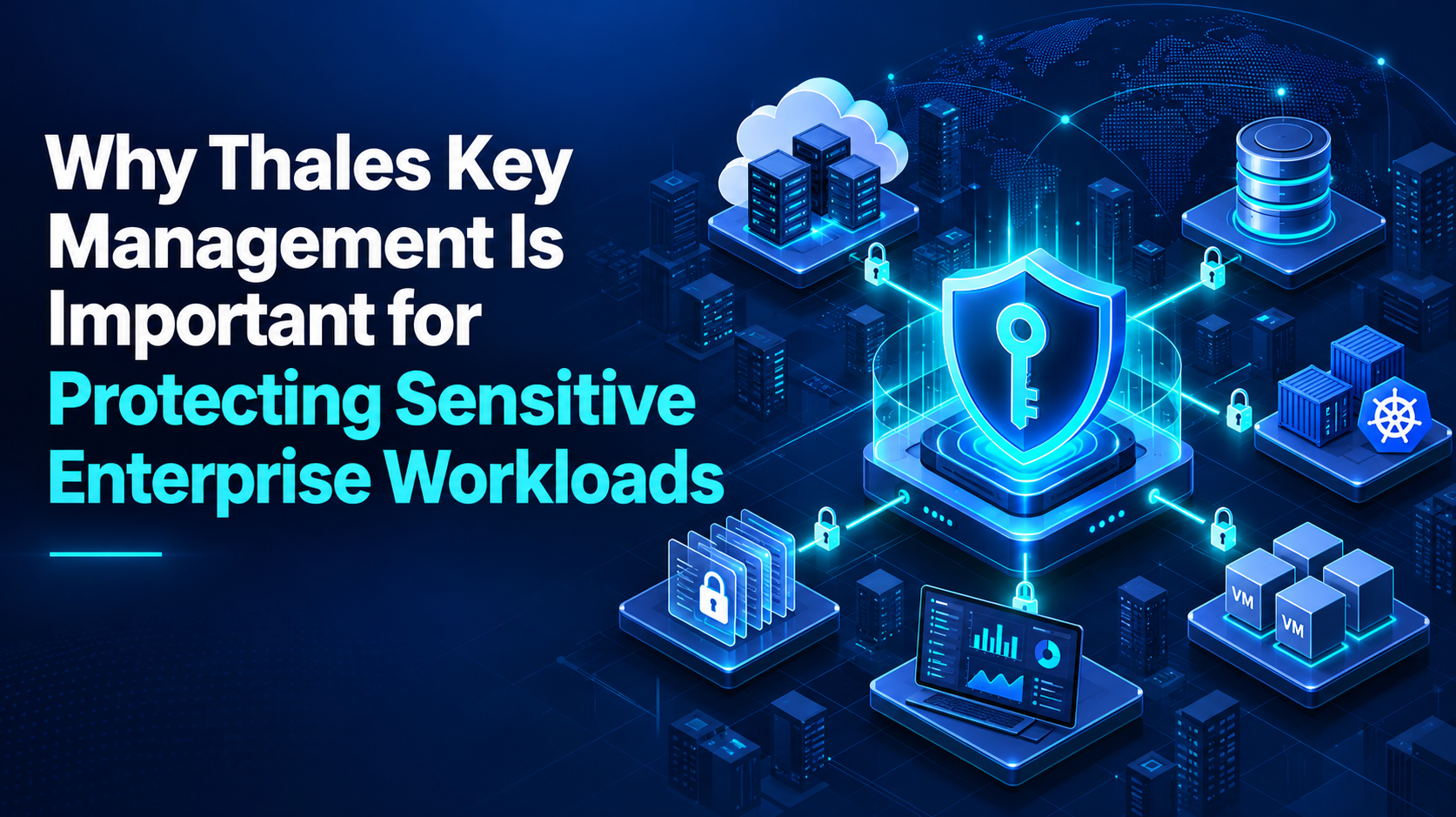
Excerpt:
Enterprise workloads process sensitive information across applications, databases, cloud platforms, and hybrid infrastructure.
Thales key management can help organizations establish centralized control over the cryptographic keys that protect these workloads.
Strong Key management supports encryption, access control, lifecycle management, and consistent protection across critical enterprise systems.
Introduction
Enterprise workloads increasingly operate across complex technology environments.
Organizations run applications in cloud platforms, on-premises data centers, private clouds, virtual infrastructure, and hybrid environments. These workloads may process customer information, financial records, employee data, intellectual property, business documents, and other sensitive information.
Encryption provides an important layer of protection for this information.
However, encryption depends on cryptographic keys.
The security of encrypted information therefore depends not only on the encryption algorithm but also on how organizations generate, store, access, rotate, recover, and retire the associated keys.
This makes Key management a critical part of enterprise workload security.
Thales key management can support organizations that need centralized capabilities for managing cryptographic keys across distributed infrastructure.
What Are Enterprise Workloads?
An enterprise workload refers to an application, service, database, process, or collection of computing resources that performs a specific business function.
Examples include:
-
Customer applications
-
Payment systems
-
Enterprise databases
-
Business analytics
-
ERP applications
-
Cloud workloads
-
Backup systems
-
Internal services
These workloads may process highly sensitive information.
Why Workloads Need Encryption
Enterprise workloads often store and exchange sensitive information.
Encryption can protect data:
-
At rest
-
In transit
-
During specific processing workflows
However, the encryption keys require their own security controls.
An attacker who gains unauthorized access to an encryption key may potentially weaken the protection provided by encrypted information.
Understanding Key Management in Cryptography
Key management in cryptography refers to the complete lifecycle management of cryptographic keys.
This includes:
-
Generation
-
Storage
-
Distribution
-
Access
-
Usage
-
Rotation
-
Backup
-
Recovery
-
Retirement
-
Destruction
Enterprises should define policies for each stage.
Thales Key Management
Thales key management can support centralized management of cryptographic keys across enterprise environments.
Centralized management can help organizations establish common policies for:
-
Key access
-
Key ownership
-
Key lifecycle
-
Rotation
-
Monitoring
-
Recovery
This approach can become particularly valuable when workloads operate across multiple infrastructure environments.
Protecting Cloud Workloads
Cloud workloads may rely on encryption for databases, storage, application data, backups, and communications.
Organizations should maintain visibility into the keys protecting these resources.
Security teams should understand:
-
Which keys exist
-
What they protect
-
Which applications use them
-
Who can access them
-
When they require rotation
Centralized Key management can help improve this visibility.
Protecting On-Premises Workloads
On-premises infrastructure continues to support critical enterprise workloads.
Organizations may encrypt databases, files, backups, and application data.
These keys should follow enterprise-wide Key management policies.
Using consistent lifecycle processes can help reduce gaps between cloud and on-premises environments.
Protecting Hybrid Workloads
Hybrid infrastructure combines cloud and on-premises systems.
For example, an organization may host its database on-premises while running its customer-facing application in the cloud.
Both systems may depend on cryptographic keys.
Centralized management can help security teams maintain appropriate control across the hybrid environment.
Access Control
Sensitive workload keys should receive strict access controls.
Organizations should apply least privilege.
An application should access only the cryptographic resources necessary for its function.
Administrative access should also receive stronger authentication and authorization.
Key Rotation
Enterprise workloads can remain operational for years.
Organizations should establish key rotation policies based on their security requirements.
Rotation can reduce the period during which a particular key remains active.
However, security teams should identify application dependencies before rotating keys.
Key Backup and Recovery
Critical workloads may depend on specific encryption keys.
If those keys become unavailable, applications may lose access to protected data.
Organizations should establish secure backup and recovery procedures.
They should also test recovery regularly.
Protecting Database Workloads
Enterprise databases often store sensitive information.
Organizations may encrypt:
-
Customer records
-
Financial information
-
Employee data
-
Transaction records
The associated keys require appropriate protection.
Key management should therefore form part of the database security architecture.
Protecting Application Workloads
Applications may use cryptographic keys for:
-
Data encryption
-
Authentication
-
API security
-
Digital signatures
-
Secure communication
Developers should avoid storing sensitive keys directly within application code.
Applications should instead use controlled mechanisms to access cryptographic services.
Protecting Backup Workloads
Backups can contain large amounts of sensitive information.
Organizations may encrypt backup data to protect it.
The encryption keys protecting these backups should receive the same level of security attention as production keys.
Monitoring Key Activity
Security teams should monitor important cryptographic events.
These can include:
-
Key access
-
Key creation
-
Key rotation
-
Failed access attempts
-
Administrative changes
-
Key retirement
Monitoring can help identify unusual activity.
Key Sprawl Across Enterprise Workloads
Large enterprises may create separate keys for different workloads.
Over time, this can result in key sprawl.
Organizations should maintain an inventory of cryptographic assets and review it regularly.
They should identify obsolete or unused keys and retire them according to policy.
Supporting Security Governance
Centralized Key management can also support governance.
Organizations can maintain records related to:
-
Key ownership
-
Access permissions
-
Lifecycle status
-
Rotation history
-
Administrative activity
This information can support internal security reviews.
Common Challenges
Distributed Infrastructure
Workloads may operate across multiple environments.
Large Key Volumes
Enterprises may manage thousands of cryptographic keys.
Legacy Systems
Older workloads may create integration challenges.
Excessive Access
Applications may receive unnecessary key permissions.
Manual Processes
Manual rotation and administration can increase operational risk.
Best Practices
Organizations should:
-
Inventory workload-related cryptographic keys
-
Assign key ownership
-
Apply least privilege
-
Separate keys from protected data
-
Establish rotation policies
-
Automate suitable lifecycle processes
-
Monitor key activity
-
Protect backups
-
Test recovery
-
Retire obsolete keys
-
Review permissions regularly
-
Integrate Key management with enterprise security policies
Conclusion
Enterprise workloads increasingly operate across cloud, on-premises, and hybrid infrastructure.
These workloads depend on encryption and other cryptographic technologies to protect sensitive information.
Thales key management can support centralized control over cryptographic keys across distributed enterprise environments.
Key management in cryptography provides the lifecycle framework needed to manage keys from generation through retirement.
Effective Key management can improve visibility, access control, rotation, recovery, monitoring, and governance.
By integrating centralized cryptographic controls with workload security, identity management, encryption, and monitoring, enterprises can strengthen protection for the sensitive workloads that support their most important business operations.

 English
 Arabic
 French
 Portuguese
 Deutsch
 Turkish
 Dutch
 Italiano
 Russian
 Romaian
 Portuguese (Brazil)
 Greek
