


India–New Zealand Free Trade Agreement: Benefits and Export Opportunities for Indian Businesses
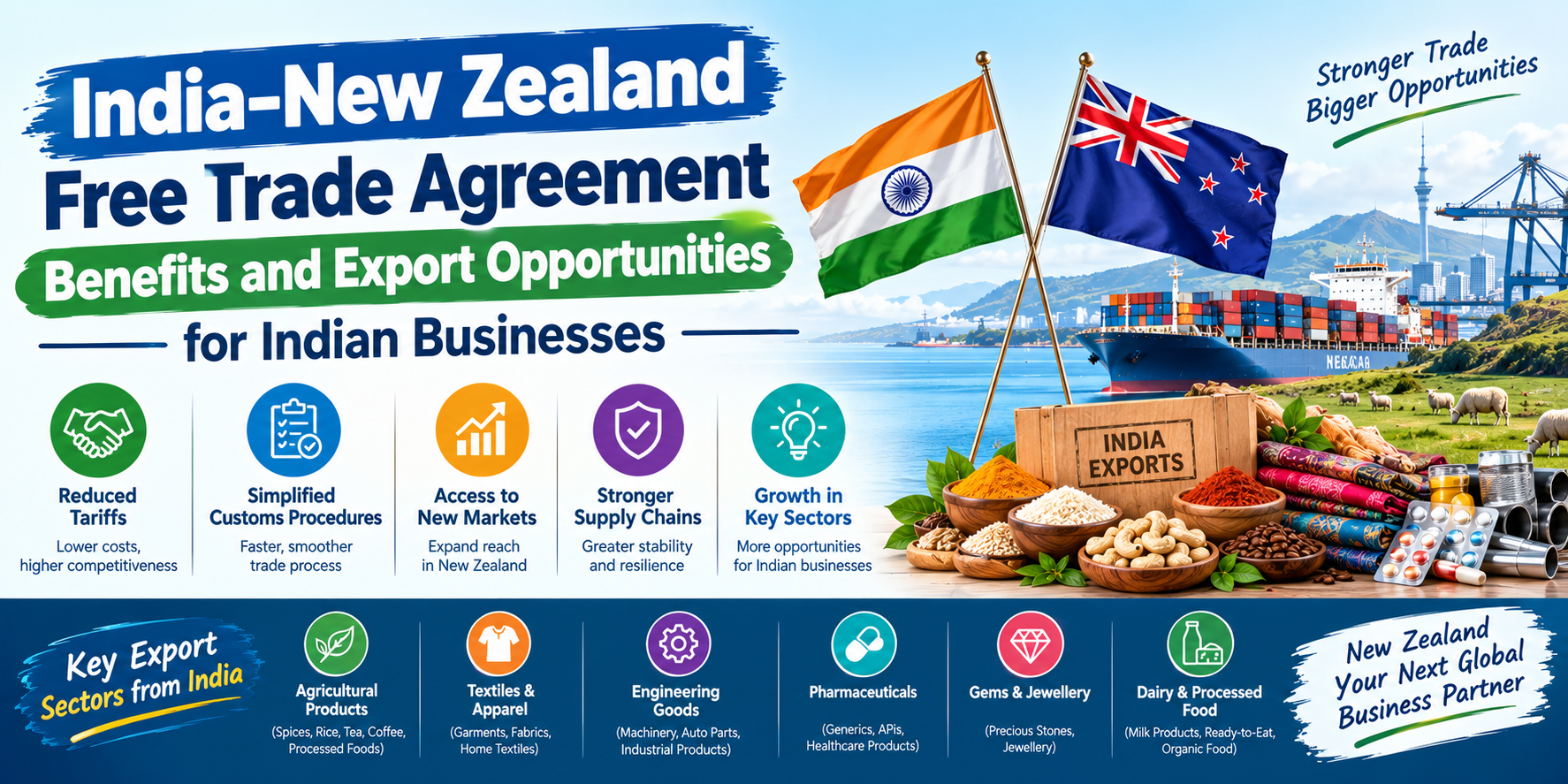
India–New Zealand Free Trade Agreement: Benefits and Export Opportunities for Indian Businesses
Introduction
The India–New Zealand Free Trade Agreement (FTA) creates new opportunities for Indian manufacturers, exporters, suppliers, farmers, and Micro, Small and Medium Enterprises (MSMEs) to expand into the New Zealand market. The agreement aims to reduce trade barriers, improve market access, encourage investment, and strengthen commercial relations between the two countries.
Signed on 27 April 2026, the agreement officially entered into force on 20 October 2026. Under its terms, New Zealand provides zero-duty access across all tariff lines for Indian exports, subject to the agreement's applicable rules and procedures. This can help Indian businesses compete more effectively by reducing import tariff costs.
For businesses listed on B2B marketplaces, the agreement also creates opportunities to connect with overseas buyers, explore new product categories, and build long-term export partnerships.
What Is the India–New Zealand Free Trade Agreement?
The India–New Zealand Free Trade Agreement is a bilateral trade pact designed to make trade between the two countries easier and more competitive. It covers goods, services, investment, and other areas of economic cooperation.
The agreement was signed after negotiations concluded on 22 December 2025. Following ratification by both countries, it came into force on 20 October 2026.
Its key objectives include:
-
Reducing or eliminating customs duties on eligible trade.
-
Improving access for Indian products in New Zealand.
-
Supporting exporters, manufacturers, and MSMEs.
-
Encouraging investment and business collaboration.
-
Creating opportunities for skilled professionals and service providers.
-
Strengthening supply chains and bilateral economic relations.
For Indian businesses, the agreement is particularly relevant because it can improve the price competitiveness of products that previously faced import tariffs in New Zealand.
What Are the Main Benefits of the India–New Zealand FTA for Indian Businesses?
The main benefits include zero-duty access for Indian exports to New Zealand, potentially lower landed costs, wider market access, and opportunities for MSMEs to develop international business relationships. Actual savings depend on the product, applicable customs requirements, and the exporter's costs.
1. Zero-Duty Access to the New Zealand Market
New Zealand's commitment to provide zero-duty access across all tariff lines for Indian exports can make eligible Indian products more competitive.
For example, an Indian textile exporter whose product previously attracted an import tariff may be able to offer a more competitive price after the applicable duty is removed. The final price will still depend on freight, insurance, customs procedures, and other expenses.
2. More Opportunities for MSMEs
Small and medium-sized businesses can use the FTA to explore international demand without relying exclusively on the domestic market.
Potential advantages include:
-
Reaching new overseas buyers.
-
Building relationships with importers and distributors.
-
Exploring private-label and bulk supply contracts.
-
Developing repeat export orders.
-
Expanding production when demand supports it.
3. Better Export Price Competitiveness
Removing import duties can reduce the tariff component of a product's landed cost. Exporters may use this advantage to offer competitive quotations, improve their margins, or negotiate more attractive commercial terms.
However, tariff removal does not guarantee higher sales. Product quality, demand, delivery reliability, and competition remain important.
4. Investment and Business Collaboration
The agreement includes a commitment by New Zealand to facilitate US$20 billion in investment into India over 15 years. This is an investment facilitation commitment, not a guarantee that every business or sector will receive funding.
Indian manufacturers and suppliers can explore potential partnerships in manufacturing, technology, skills development, and other areas relevant to their operations.
Which Indian Products Have Export Opportunities Under the India–New Zealand FTA?
Indian exporters can explore opportunities in textiles, apparel, leather goods, footwear, engineering products, pharmaceuticals, chemicals, and processed food. The agreement's duty-free access can improve their market position, although demand and product-specific compliance must be assessed before exporting.
The following table highlights potential product categories.
|
Product category |
Examples |
Business opportunity |
|---|---|---|
|
Textiles and apparel |
Garments, cotton clothing, home textiles |
Wholesale supply and retail distribution |
|
Leather and footwear |
Leather accessories, shoes, finished leather goods |
Importers, retailers, and distributors |
|
Engineering goods |
Machinery, components, industrial products |
Industrial buyers and equipment distributors |
|
Pharmaceuticals and chemicals |
Eligible medicines and chemical products |
Regulated distributors and industrial customers |
|
Spices and processed foods |
Turmeric, chilli, pickles, sauces, packaged foods |
Food importers and ethnic grocery suppliers |
|
Handicrafts and traditional products |
Decorative products, artisan-made goods |
Specialty retailers and gift distributors |
Note: These are potential export categories, not a guarantee of demand. Product-specific import rules, labelling, safety standards, and other applicable requirements must still be met.
How Can Indian MSMEs Use the India–New Zealand FTA to Grow Their Business?
Indian MSMEs can use the agreement to identify New Zealand buyers, prepare competitive quotations, improve export readiness, and establish long-term supply relationships. The FTA also provides for trade-related information sharing and cooperation between small-business ecosystems.
Practical steps for manufacturers and suppliers include:
-
Research market demand: Identify products that New Zealand importers already purchase and compare competing suppliers.
-
Prepare export-ready products: Ensure packaging, product specifications, labelling, and quality documentation meet buyer and regulatory requirements.
-
Connect with verified buyers: Use B2B marketplaces, trade events, industry associations, and direct business outreach.
-
Calculate export prices: Include production, packaging, freight, insurance, customs handling, and other applicable costs.
-
Verify tariff eligibility: Check the relevant product classification and import requirements before quoting duty-free prices.
-
Build reliable supply capacity: Confirm production volumes, delivery schedules, payment terms, and after-sales support.
For example, an Indian spice manufacturer could approach New Zealand food distributors with a product catalogue, ingredient specifications, packaging options, and a bulk quotation. The agreement may improve price competitiveness, but the manufacturer must still meet New Zealand's food import requirements.
What Should Exporters Check Before Using the India–New Zealand FTA?
Exporters should verify the product's tariff classification, applicable import rules, documentation, and commercial costs before claiming FTA benefits. Zero customs duty does not mean that every other import requirement is waived.
Use this checklist before accepting an export order:
-
HS code: Identify the correct Harmonized System classification for the product.
-
Tariff treatment: Confirm the applicable duty rate for the product and shipment date.
-
Rules of origin: Ensure the product qualifies as originating under the agreement's rules.
-
Export documentation: Prepare the commercial invoice, packing list, shipping documents, and other required records.
-
Product compliance: Check relevant food safety, labelling, technical, environmental, and product-specific requirements.
-
Shipping costs: Obtain freight quotations and calculate the final landed cost.
-
Buyer verification: Review the buyer's business credentials, payment arrangements, and contractual terms.
Exporters should consult the official agreement and relevant customs guidance when confirming product eligibility. The Indian Department of Commerce provides the agreement's official factsheet and FAQs for reference.
India–New Zealand FTA vs Traditional Export Trade
The FTA changes the tariff environment for Indian goods entering New Zealand. However, it does not remove every commercial barrier or guarantee a successful export transaction.
|
Factor |
General export trade without a preferential FTA benefit |
India–New Zealand FTA |
|---|---|---|
|
Customs duty |
Depends on the applicable tariff |
Zero duty across New Zealand's tariff lines for Indian exports |
|
Pricing |
Import duties may increase landed costs |
Removal of customs duties can improve price competitiveness |
|
Market access |
Depends on normal trade rules |
Preferential framework with wider opportunities |
|
Product compliance |
Required where applicable |
Still required |
|
Export success |
Depends on demand and execution |
Still depends on demand, pricing, quality, and execution |
The key distinction is that duty-free access is a trade advantage, not a guarantee of sales or profit.
Frequently Asked Questions About the India–New Zealand Free Trade Agreement
1. When did the India–New Zealand Free Trade Agreement come into force?
The agreement entered into force on 20 October 2026, following ratification by both countries.
2. What is the main benefit of the India–New Zealand FTA?
Its main goods-trade benefit for Indian exporters is zero-duty access across New Zealand's tariff lines, helping eligible products compete on price.
3. Which Indian products can benefit from the FTA?
Textiles, apparel, leather goods, footwear, engineering products, pharmaceuticals, chemicals, agricultural products, and processed foods are among the product categories identified as potential beneficiaries.
4. Can small Indian businesses export to New Zealand under the FTA?
Yes. MSMEs can explore export opportunities, provided they meet applicable legal, product, documentation, and commercial requirements.
5. Does the FTA eliminate all export costs?
No. It removes customs duties on Indian goods entering New Zealand under the agreement's tariff commitments, but freight, insurance, packaging, handling, and other costs may still apply.
6. Do Indian exporters need an Importer Exporter Code (IEC)?
Most Indian businesses exporting goods commercially need an IEC, subject to applicable exemptions. Exporters should verify their requirements with the Directorate General of Foreign Trade (DGFT).
7. Does every Indian product automatically qualify for duty-free access?
The agreement provides zero-duty access across New Zealand's tariff lines for Indian exports. Exporters must still verify the correct classification, rules of origin, documentation, and any applicable product-specific conditions.
8. How can Indian manufacturers find buyers in New Zealand?
They can use B2B marketplaces, export promotion councils, trade fairs, industry networks, distributors, and direct outreach to verified importers.
9. Will the FTA benefit Indian service providers?
Yes. It includes services-related commitments and provisions concerning professional mobility, subject to the relevant conditions and visa requirements.
10. Where can businesses check official FTA information?
Businesses can consult the Indian Department of Commerce and New Zealand's Ministry of Foreign Affairs and Trade for agreement details, implementation information, and official guidance.
Conclusion
The India–New Zealand Free Trade Agreement creates a new framework for Indian exporters, manufacturers, suppliers, and MSMEs seeking to expand internationally. Zero-duty access to the New Zealand market can improve price competitiveness across a broad range of Indian products, while investment and services provisions create additional avenues for business collaboration.
To make the most of these opportunities, businesses should research demand, identify reliable buyers, check product compliance, and calculate export costs carefully. Combining the FTA's market-access benefits with consistent quality and dependable delivery can help Indian businesses develop sustainable international trade relationships.

 English
 French
 Spanish
 Portuguese
 Deutsch
 Turkish
 Dutch
 Italiano
 Russian
 Romaian
 Portuguese (Brazil)
 Greek
