


Smart Fire and Smoke Detection for Kuwait Industrial Facilities
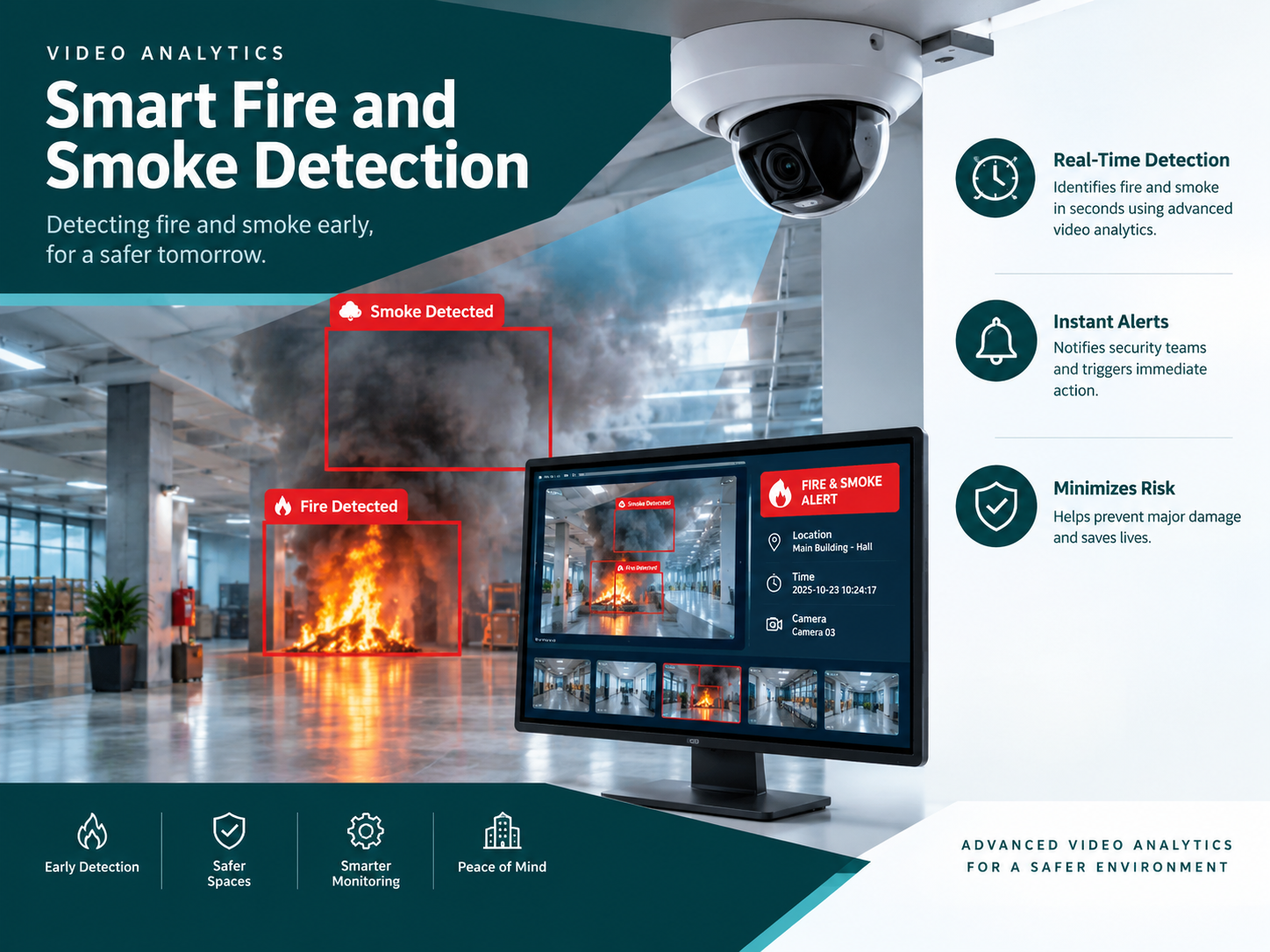
Kuwait’s industrial sector — the oil refineries of Mina Al-Ahmadi and Mina Abdullah, the petrochemical facilities of Shuaiba Industrial Area, the LNG terminals of Kuwait Oil Company, and the rapidly expanding manufacturing zones of Sabhan and Rai — handles flammable hydrocarbons, pressurised gases, and chemical inventories at a scale where a single undetected fire ignition can escalate from a small flame to a catastrophic facility-threatening event in minutes. Conventional smoke detectors and heat sensors respond only after combustion products have accumulated — minutes too late for the early intervention that prevents escalation.
Video Analytics powered by deep-learning AI changes this equation fundamentally, detecting the first visible traces of flame and smoke through existing camera infrastructure at the speed of light — giving Kuwait's industrial safety teams the early warning that saves lives, assets, and operational continuity. Expedite IoT deploys this transformative technology across Kuwait's most demanding industrial environments, delivering fire safety performance that legacy detector systems cannot match.
Kuwait's Industrial Fire Risk: Why Standard Detection Is Not Enough
Kuwait's economy remains deeply anchored in the hydrocarbon sector. Kuwait Petroleum Corporation (KPC) and its subsidiaries — Kuwait National Petroleum Company (KNPC), Kuwait Oil Company (KOC), and Petrochemical Industries Company (PIC) — collectively manage one of the highest concentrations of flammable hydrocarbon inventory per square kilometre of any industrial estate in the world. The Mina Al-Ahmadi refinery, the largest refinery in the GCC, processes over 466,000 barrels per day within a complex of interconnected processing units, storage tanks, and pipeline infrastructure where a fire event in one zone can rapidly spread to adjacent assets.
The specific fire risk factors in Kuwait's industrial environment that make conventional detection inadequate:
• High-bay process areas, tank farms, and open-air loading jetties where ceiling-height point detectors cannot accumulate sufficient combustion particles to trigger within the first 4–12 minutes of a fire event — the critical early-intervention window
• Ambient summer temperatures above 50 °C accelerating hydrocarbon vapour evaporation rates and reducing the ignition energy threshold of flammable atmospheres — making the margin between a hot surface and an ignition event dangerously narrow
• Shamal wind events dispersing smoke horizontally across wide open-air areas before it can reach ceiling-mounted detectors — rendering conventional volumetric detectors ineffective across Kuwait's coastal industrial sites
• KNPC HSE Management System and Kuwait Fire Service Directorate (KFSD) requirements for demonstrable fire detection response time improvements at Tier 1 process hazard facilities
• Continuously unmanned process areas where rotating shift schedules leave equipment zones without direct human observation for extended periods — making automated visual detection the only reliable early-warning mechanism
AI-Powered Video Analytics: How Deep Learning Detects Fire in Seconds
AI-Powered Video Analytics applies convolutional neural networks (CNNs) and temporal pattern recognition algorithms trained on millions of real fire and smoke incident video frames to identify the characteristic pixel-level signatures of combustion — colour gradients in the 520–620 nm visible spectrum associated with open flame, the luminosity flicker profile of burning hydrocarbon vapours, the expanding spatial footprint and rising trajectory of smoke plumes, and the motion vector patterns that distinguish real combustion from steam, dust, or camera lens contamination.
The AI engine processes standard IP camera streams at 15–30 frames per second, analysing each frame in under 200 milliseconds for combustion signatures. When consistent fire or smoke indicators are confirmed across multiple consecutive frames — eliminating single-frame false triggers — an alert is generated within 2–5 seconds of initial flame or smoke appearance. This response time is 3–8 minutes faster than conventional point detectors in high-bay industrial environments, a lead time that transforms the severity outcome of the event.
Real-Time Object Detection: Tracking Threats as They Develop
Real-Time Object Detection capability in Expedite IoT's platform goes beyond simply identifying that smoke or flame is present — it tracks the spatial evolution of the detected threat across consecutive frames, quantifying the rate of flame spread, the direction and velocity of smoke plume propagation, and the proximity of the developing fire to adjacent high-hazard assets such as pressurised storage vessels, electrical switchgear, and pipeline manifolds.
This spatial threat tracking intelligence — delivered in real time to the Kuwait industrial site's safety operations centre (SOC) — enables incident commanders to make informed decisions about evacuation zone scope, suppression resource deployment, and adjacent hazard isolation before firefighting teams arrive on scene. At Shuaiba Industrial Area, where process units handling different hazardous materials are in close proximity, knowing the direction and speed of fire spread provides the 90-second intervention window that prevents a single-unit fire from becoming a multi-asset catastrophe.
False Alarm Reduction: Protecting Kuwait Industrial Operations from Unnecessary Disruption
False Alarm Reduction is among the most commercially significant benefits of AI video fire detection for Kuwait industrial operators — and one of the most consistently cited pain points among safety managers operating conventional detector arrays across the Kingdom's process industry sites. Industry data from GCC petrochemical operators indicates that between 70% and 93% of all fire alarm activations are false alarms, caused by steam, dust, process exhaust, and environmental factors triggering particle-based detectors that cannot discriminate between combustion products and other airborne material.
Conclusion
Deploying deep-learning Video Analytics from Expedite IoT across major installations like the Mina Al-Ahmadi refinery complex allows operators to detect open hydrocarbon flame, dense smoke, or near-invisible LPG combustion in seconds through existing camera networks, ensuring crucial early-intervention lead times. This highly accurate AI-Powered Video Analytics system provides Real-Time Object Detection and advanced False Alarm Reduction to maintain uninterrupted operations at critical sites, delivering instant alerts and compliance with stringent KFSD, NFPA, and API safety standards throughout Kuwait's industrial sectors.

 English
 Arabic
 Spanish
 Portuguese
 Deutsch
 Turkish
 Dutch
 Italiano
 Russian
 Romaian
 Portuguese (Brazil)
 Greek
