


Synthetic Natural Gas Market Forecast, Trends and Growth Analysis
Synthetic Natural Gas Market Overview
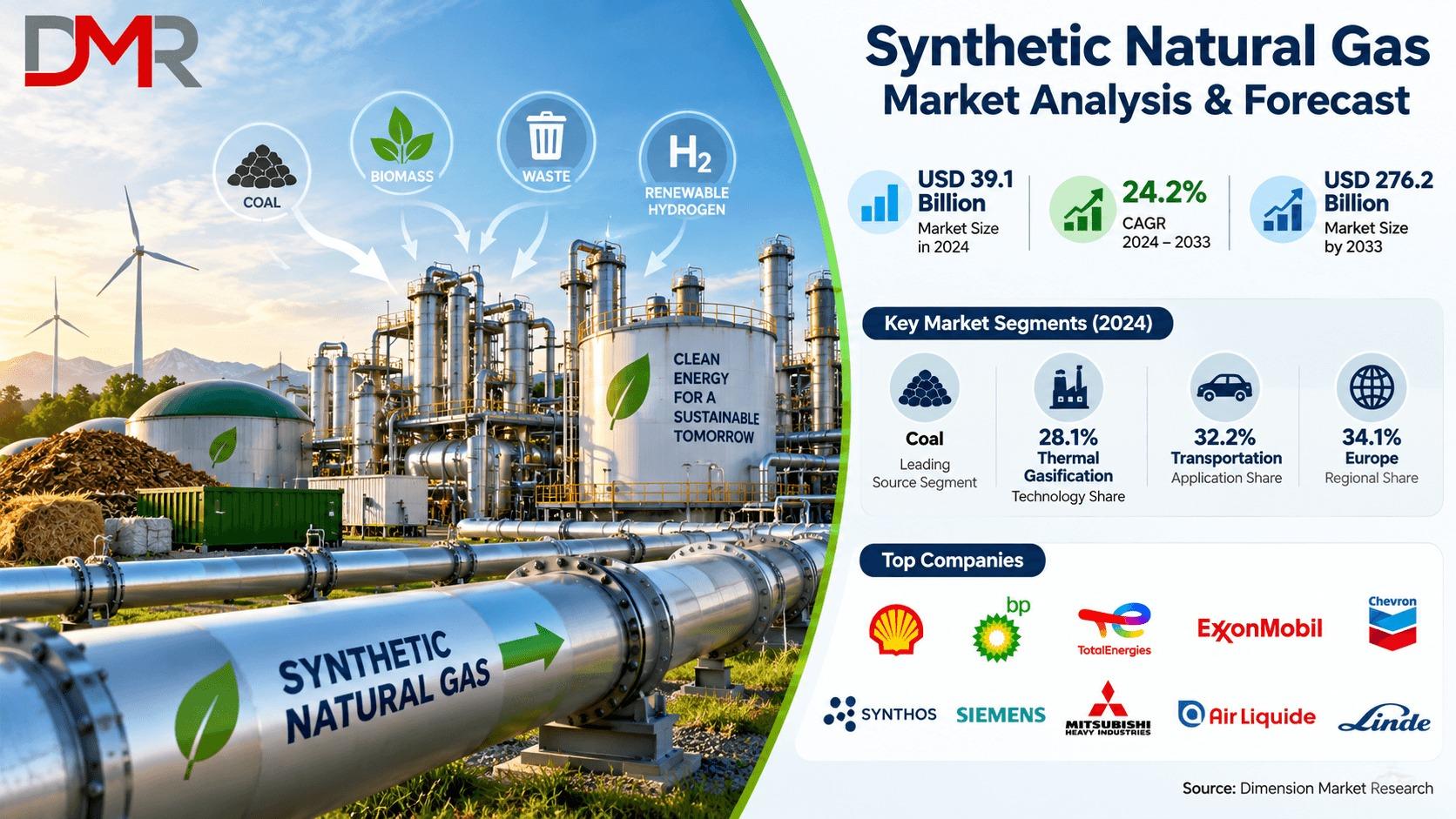
According to Dimension Market Research, the Synthetic Natural Gas Market size was valued at USD 39.1 billion in 2024 and is projected to reach USD 276.2 billion by 2033, registering a compound annual growth rate (CAGR) of 24.2% during 2024 to 2033. This growth reflects increasing interest in alternative gaseous fuels, energy security, renewable energy integration and technologies that convert carbon-containing feedstocks into usable fuel.
Synthetic natural gas (SNG) is produced by converting feedstocks such as coal, biomass and waste into synthesis gas, which can then be processed into methane-rich gas. Depending on its production pathway, SNG can support industrial heating, power generation, transportation and injection into compatible gas networks. Renewable synthetic methane can also be produced using renewable hydrogen and captured carbon dioxide. Its environmental benefits depend on feedstock selection, production efficiency, energy inputs and methane leakage control. As industries and governments explore lower-carbon energy options, the synthetic natural gas industry is attracting attention from technology providers, energy companies and infrastructure developers.
Get free sample of this report (with custom data option): https://dimensionmarketresearch.com/request-sample/synthetic-natural-gas-market/
Synthetic Natural Gas Market Snapshot
● 2024 market size: USD 39.1 billion, according to Dimension Market Research.
● 2033 forecast value: USD 276.2 billion, reflecting projected industry expansion.
● 2024 to 2033 CAGR: 24.2%, based on the report forecast.
● Historical data covers 2018 to 2023 for market context.
● Forecast period extends from 2024 through 2033.
● Europe held an estimated 34.1% market share in 2024.
● Thermal gasification accounted for a projected 28.1% share in 2024.
● Transportation represented a projected 32.2% application share in 2024.
● Coal was the leading source segment projected for 2024.
Market Research Findings
The research identifies feedstock availability, gasification technology, transportation fuel demand and regional energy policies as important factors influencing the synthetic natural gas market. Coal was projected to lead the source segment in 2024, while thermal gasification was expected to account for 28.1% of the technology segment. Transportation was projected to hold 32.2% of application demand, supported by the compatibility of methane-rich fuels with suitable existing infrastructure. Europe was expected to remain the largest regional market, with an estimated 34.1% share in 2024. The report also highlights opportunities in biomass conversion, waste-to-energy, renewable methane, industrial applications and grid injection. At the same time, high capital expenditure, feedstock variability and emissions management remain important considerations for prospective producers and investors.
Why Is the Synthetic Natural Gas Market Growing?
The synthetic natural gas market is growing as energy users seek reliable gaseous fuels and governments encourage diversification of energy supplies. SNG can use existing gas infrastructure where fuel specifications and network requirements are met, potentially reducing the need for entirely new distribution systems. Production technologies also offer ways to convert organic waste, agricultural residues and other feedstocks into useful energy products.
Renewable energy integration is another important growth factor. Power-to-gas pathways can combine renewable electricity, hydrogen production and carbon dioxide conversion to create synthetic methane. This approach may help connect electricity systems with gas storage, industrial fuel demand and transportation. However, economic viability depends on electricity prices, conversion efficiency, carbon sourcing, policy support and project scale.
Government incentives, decarbonization strategies and investments in waste management can improve the commercial outlook for selected SNG projects. Nevertheless, the benefits differ by production route. Coal-derived SNG can have substantial lifecycle emissions without effective carbon management, whereas renewable pathways may offer lower emissions when designed and operated appropriately.
Market Key Growth Drivers
● Growing demand for alternative fuels across transportation and industry.
● Investment in renewable energy and low-carbon fuel infrastructure.
● Waste-to-energy projects that convert organic residues into usable gas.
● Energy security strategies that diversify domestic fuel supplies.
● Gasification advances that improve feedstock conversion and process efficiency.
● Government incentives supporting renewable gas and sustainable transport.
● Demand for flexible energy storage and compatible gas network solutions.
Research Scope and Leading Market Segments
The report evaluates the synthetic natural gas market by source, technology and application, providing a framework for understanding where production capacity and demand may develop. The following segments are particularly relevant because of their projected market positions in 2024 and their connection to existing energy infrastructure.
Source Segment: Coal
Coal was projected to dominate the source segment in 2024. Its established supply chains, broad geographic availability and experience in large-scale gasification have supported its use as a feedstock for synthetic methane production. Coal-to-SNG facilities can benefit from existing industrial infrastructure and established conversion processes, particularly in regions with substantial coal resources.
However, the economic and environmental performance of coal-derived SNG depends on plant design, coal quality, carbon capture, energy consumption and emissions regulation. High capital requirements and carbon management costs can affect project competitiveness. Biomass and solid waste represent alternative feedstocks that may provide different environmental and commercial advantages depending on their availability and preparation requirements.
● Leading source: Coal, projected for 2024.
● Other sources: Biomass, solid waste and other feedstocks.
Technology Segment: Thermal Gasification
Thermal gasification was projected to account for 28.1% of the technology segment in 2024. The process converts carbon-based feedstocks into synthesis gas under controlled high-temperature conditions. The resulting gas can be cleaned and processed further to produce synthetic natural gas. Its ability to accommodate different feedstocks makes thermal gasification relevant to coal-based production, biomass conversion and selected waste-to-energy applications.
Gasifier configuration influences conversion efficiency, syngas composition, operating conditions and maintenance requirements. Moving-bed, fluidized-bed and entrained-flow systems serve different feedstock and scale requirements. Continued improvements in gas cleaning, process integration and methane synthesis may improve project performance, although commercial outcomes depend on feedstock costs, plant utilization and local energy prices.
● Leading technology: Thermal gasification.
● Other pathways: Anaerobic digestion, fermentation, steam reforming and partial oxidation.
Read more about this market:https://dimensionmarketresearch.com/report/synthetic-natural-gas-market/
Market Dynamics
Market Trends: Waste-to-Energy and Methane Management
Waste-to-energy is an important trend in the synthetic natural gas industry because it can turn selected organic residues into useful gaseous fuels. Agricultural waste, food-processing residues and municipal organic waste may provide feedstocks for biogas production or other conversion pathways. Where collection, treatment and gas upgrading systems are well designed, these projects can support waste management and diversify local energy supplies.
A related trend is increased attention to methane leakage throughout gas production, processing, storage and distribution. Methane has a strong warming effect, so uncontrolled releases can undermine the climate benefits of lower-carbon gas pathways. Operators are therefore encouraged to monitor leaks, improve gas handling and evaluate lifecycle emissions rather than relying on fuel labels alone.
Market Opportunities: Renewable Methane and Emerging Gasification Methods
Renewable methane presents an opportunity to connect renewable electricity, hydrogen production, captured carbon dioxide and existing gas infrastructure. Power-to-methane projects can potentially absorb surplus renewable electricity by converting it into a storable gaseous fuel. Their commercial prospects depend on the cost of renewable power, electrolyzer efficiency, carbon dioxide availability, conversion losses and the value of the final fuel.
Government support for renewable energy, industrial decarbonization and sustainable transport may help advance these projects. Underground coal gasification has also been explored as a potential feedstock access method, but environmental risks, groundwater protection, gas recovery performance and regulatory approval require careful assessment. Investment decisions should reflect site-specific technical and environmental evidence.
Market Challenges: High Capital Costs and Feedstock Constraints
High initial investment remains a major challenge for synthetic natural gas facilities. Gasification plants, gas cleaning systems, methane synthesis units and supporting infrastructure can require significant capital expenditure. Projects may also face uncertain returns when conventional natural gas prices fluctuate or when renewable methane cannot command a sufficient premium.
Feedstock quality and supply consistency create further operating challenges. Variations in moisture content, composition and contaminant levels can affect gasifier performance, syngas quality and downstream processing costs. Waste-derived projects must also account for collection logistics, competing feedstock uses and seasonal availability. Clear offtake agreements, reliable supply contracts, effective process controls and transparent lifecycle assessments can help reduce these risks.
Regional and Country Outlook
Europe was expected to lead the synthetic natural gas market in 2024, with an estimated 34.1% share. The report attributes this position to established energy infrastructure, sustainability priorities, supportive policies and international partnerships. The region's industrial demand and interest in renewable gases may also support the development of synthetic methane projects. The supplied report does not provide regional or country-specific market values and CAGRs beyond the stated global forecast, so additional figures are not inferred here.
The regional analysis covers North America, Europe, Asia-Pacific, Latin America, and the Middle East and Africa. Countries and subregions identified in the report include the United States, Canada, Germany, the United Kingdom, France, Italy, Russia, Spain, China, Japan, South Korea, India, Brazil, Mexico, Saudi Arabia, the United Arab Emirates and South Africa, among others.
Key Competitor Companies in the Synthetic Natural Gas Market
● BASF SE
● Shell
● Air Products and Chemicals, Inc.
● Air Liquide
● The Linde Group
● Synthesis Energy Systems, Inc.
● Yankuang Group
● Methanex
● Yara International
● HELM AG
● Dakota Gasification Company
● ZSW
● Basin Electric Power Cooperative
● EnviTec Biogas AG
● Verbio SE
● Kinder Morgan
Competition spans industrial gas suppliers, energy companies, biogas developers, technology providers and synthetic fuel producers. Companies pursue technology development, project expansion, partnerships and capacity investments to strengthen their market positions. Their opportunities depend on feedstock access, production costs, regulatory frameworks and customer demand for conventional or renewable gas.
Get 10% instant discount on report purchase
Explore more reports:
● Precipitated Calcium Carbonate Market
● Power Purchase Agreement Market
FAQ's
1. What is the synthetic natural gas market?
The synthetic natural gas market covers the production, processing and use of methane-rich gas made from feedstocks such as coal, biomass, waste or hydrogen and carbon dioxide.
2. What is the projected synthetic natural gas market size by 2033?
According to Dimension Market Research, the market is projected to reach USD 276.2 billion by 2033, up from USD 39.1 billion in 2024.
3. What is the expected CAGR of the synthetic natural gas market?
The report projects a CAGR of 24.2% for the global synthetic natural gas market over the 2024 to 2033 forecast period.
4. Which region dominates the synthetic natural gas market?
Europe was expected to lead the market in 2024, with an estimated 34.1% share, supported by infrastructure, sustainability policies and industrial demand.
5. Which source segment leads the synthetic natural gas market?
Coal was projected to dominate the source segment in 2024, supported by established supply chains and large-scale gasification capabilities.
6. Which technology leads the synthetic natural gas market?
Thermal gasification was projected to hold 28.1% of the technology segment in 2024, reflecting its versatility across several carbon-based feedstocks.
7. Which application leads the synthetic natural gas market?
Transportation was projected to account for 32.2% of the application segment in 2024, supported by compatible methane-fuel infrastructure and alternative fuel demand.
8. What are the key drivers of synthetic natural gas market growth?
Major drivers include demand for alternative fuels, renewable energy investment, waste-to-energy projects, energy security priorities and advances in gasification technology.
9. What challenges affect the synthetic natural gas industry?
Key challenges include high plant construction costs, feedstock variability, gas composition issues, conversion efficiency and the need to control methane leakage.
10. Which companies operate in the synthetic natural gas market?
Key companies identified in the report include Shell, BASF SE, Air Liquide, Air Products and Chemicals, Linde, Verbio SE and Dakota Gasification Company.
About Us
Dimension Market Research (DMR) is a global market intelligence and consulting firm delivering data-driven insights that help organizations make informed strategic decisions. With expertise across 12+ industries and global markets, DMR provides syndicated reports, custom research, competitive analysis, white space analysis, and business strategy consulting.
Our research solutions combine analytical rigor, industry expertise, and forward-looking intelligence to identify opportunities, reduce risks, and support sustainable growth. Trusted by clients across diverse sectors, DMR is committed to delivering accurate, actionable insights that enable businesses to navigate evolving market landscapes with confidence.
Contact Us
Phone USA: +17323699777
Phone India: +919310023843
E-mail: enquiry@dimensionmarketresearch.com
Address USA: 957 Route 33, Suite 12 #308, Hamilton Square, NJ-08690
Address India: D44, Sector 6, Noida 201301, India

 English
 Arabic
 French
 Portuguese
 Deutsch
 Turkish
 Dutch
 Italiano
 Russian
 Romaian
 Portuguese (Brazil)
 Greek
