


ERP Checklist for a Steel Fabricator: 20 Questions to Ask Before You Buy
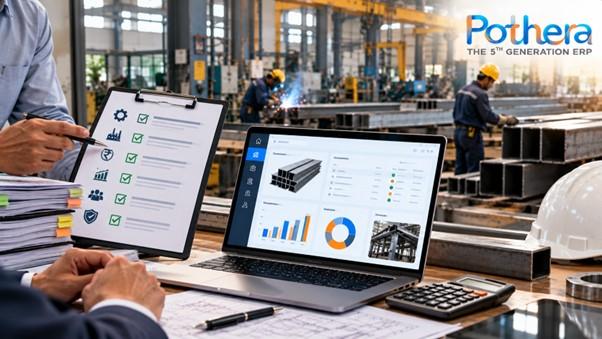
Before buying ERP, a steel fabricator should ask 20 questions across five areas: whether the system handles steel’s weight-based stock and traceability, whether it costs each job including scrap and yield, whether it covers compliance and certificates, how migration and implementation will run, and what the full price and support terms are. Score each answer 0 to 2, and ask the vendor to demonstrate it on your own job, not just describe it.
Bsquare Solutions builds Pothera ERP for manufacturers and has served them since 1999. This checklist applies whichever vendor you evaluate, including us.
Why do steel fabricators need their own ERP checklist?
Generic ERP checklists ask about modules and users. A fabricator’s real risks sit elsewhere: steel bought by weight but cut by length, offcuts that return to stock, jobs that change when a drawing is revised, and outside processes like galvanising or painting. A system that handles none of this will still look fine in a standard demo.
Bsquare’s 2026 survey of 500 Indian factory owners found that only 28% of metals and fabrication firms in the sample (n=35) had a fully deployed ERP, and payback in that group was the slowest at a median of 26 months. Small samples need care, but the pattern suggests many fabricators buy ERP that does not fit how steel jobs run. See the full research report.
How should you use this checklist?
- Score each question: 0 = cannot do it, 1 = possible with customisation or a workaround, 2 = standard and demonstrated live.
- Demand a demo on your data. Give each vendor one real job: a drawing, a bill of quantities and a purchase order.
- Add up the score (maximum 40). A suggested reading: 32 or more is a strong fit, 24 to 31 is workable with gaps you must price in, and below 24 means keep looking.
- Get answers in writing, especially on anything scored 1.
Part 1: Steel operations (Questions 1–7)
|
Question to ask |
Why it matters |
A good answer |
|
1. Can stock be held in kg, tonnes, sections and pieces, including offcut and remnant stock? |
Steel is bought by weight and used by length. |
Multiple units with conversion, and remnants returned to stock. |
|
2. Can each coil, plate or section be tracked by heat number with its mill test certificate attached? |
Customers and inspectors ask for traceability. |
Heat number captured at receipt and visible at dispatch. |
|
3. Can material be issued against a job, with returns and balance visible? |
Unissued or unreturned steel is hidden loss. |
Job-wise issue, return and balance reports. |
|
4. What happens when a drawing or BOM changes mid-job? |
Rework from outdated drawings is common. |
Revision control, with the shop floor seeing only the current version. |
|
5. Can it handle multi-level BOMs, routings and a mix of make-to-order and make-to-stock? |
Fabrication is mostly project-based. |
User-defined stages and order-wise progress tracking. |
|
6. How does it track material sent outside for galvanising, painting or machining? |
This is a classic blind spot. |
Challan-based issue, party-wise pending quantities and process-loss accounting. |
|
7. Does it record output, rejection and scrap by machine, shift and operator as they happen? |
Loss found at month-end cannot be corrected. |
Same-day shop-floor entry with machine, shift and operator analysis. |
Read more: ERP software for the steel industry | ERP for metal fabrication | Job work and sub-contract management
Part 2: Costing and finance (Questions 8–11)
|
Question to ask |
Why it matters |
A good answer |
|
8. Does job cost include material, labour, overheads, scrap and yield, and update as work happens? |
You cannot price or protect margin on guesses. |
Cost builds from real transactions, with scrap and substitute items accounted for. |
|
9. Can I compare the quoted cost with actual cost for each job? |
Shows which quotes under-price. |
Quote-vs-actual report per job and customer. |
|
10. Can it handle advances, milestone billing and retention on projects? |
Project cash flow rarely follows delivery. |
Billing stages and retention tracked against each project. |
|
11. Can I see receivables ageing and credit control by customer? |
Slow collections hurt fabricators badly. |
Ageing dashboards, alerts and credit limits. |
Related: how to calculate ERP cost and payback for a manufacturer
Part 3: Quality and compliance (Questions 12–14)
|
Question to ask |
Why it matters |
A good answer |
|
12. Can quality checks be set at incoming material, in-process and final inspection, and do accepted, rejected and rework quantities update stock? |
Defects caught late are the most expensive. |
Configurable checkpoints with automatic stock updates and a recorded inspection trail. |
|
13. Are GST e-invoicing, e-way bills and job-work challans handled inside the system? |
Manual compliance adds effort and risk. |
E-invoicing through API integration, with documents generated in the normal workflow. |
|
14. Does the system keep an audit trail (edit log) that cannot be switched off, plus approvals and role-based access? |
Under Rule 3(1) of the Companies (Accounts) Rules, 2014, companies using accounting software must keep an edit log that cannot be disabled, from the financial year beginning 1 April 2023. |
Demonstrated live, with multi-level approvals and field-level access control. |
Part 4: Implementation and data (Questions 15–17)
|
Question to ask |
Why it matters |
A good answer |
|
15. How will you migrate masters, opening stock and open orders from Tally or Excel, and who cleans the data? |
Poor migration is a leading failure cause. |
A written migration plan with scope, volume and responsibilities. |
|
16. What is the implementation timeline, and who is on the team? |
In Bsquare’s survey, successful projects averaged 4.7 months and failed ones 9.4 months. |
A time-boxed plan, such as Pothera’s typical 8 to 12 weeks for 10 to 100 users. |
|
17. How will stores and shop-floor staff enter data, and how will they be trained? |
Systems fail when the floor does not use them. |
A training plan by role, plus simple entry methods such as QR codes. |
Related: how to choose ERP software for manufacturing companies in India | Tally to ERP: how a ₹15–20 crore manufacturer should choose
Part 5: Commercials and support (Questions 18–20)
|
Question to ask |
Why it matters |
A good answer |
|
18. What exactly does the quote include: licences, implementation, migration, training, hosting and AMC? |
61% of implementations in Bsquare’s survey ran over budget, by 34% on average. |
A written breakdown marking each item included, excluded or chargeable. |
|
19. What support follows go-live: response times, updates and who fixes issues? |
34% of failed projects cited a vendor that went unresponsive after the sale. |
A defined support scope and a named team. |
|
20. Can the system grow with me: a second plant, a new company, exports, cloud or on-premise? |
Switching systems later is costly. |
Multi-plant, multi-company and multi-currency support, with a deployment choice. |
Related: Pothera ERP Cost Estimator | ERP pricing
What are the red flags in an ERP demo for steel?
● The vendor shows only a generic manufacturing demo and avoids your sample drawing.
● Heat numbers, remnants or outside processes are “a customisation” with no price.
● Costing runs as a month-end journal instead of from live transactions.
● Migration is described as “your team’s job”.
● The quote shows only a licence line.
● There is no named support contact after go-live.
A simple scorecard (editable text)
|
Area |
Questions |
Maximum score |
|
Steel operations |
1–7 |
14 |
|
Costing and finance |
8–11 |
8 |
|
Quality and compliance |
12–14 |
6 |
|
Implementation and data |
15–17 |
6 |
|
Commercials and support |
18–20 |
6 |
|
Total |
1–20 |
40 |
How does Pothera ERP answer these questions?
Pothera ERP covers production and planning, procurement and MRP, inventory, quality, job work, finance, CRM and HR in one platform. For the checklist above, it offers:
● Multi-level BOMs, routings and user-defined stages, with make-to-order, make-to-stock and mixed scenarios
● Job work management with challans, party-wise pending quantities and process-loss accounting
● Shop-floor recording of output, rejection, scrap and loss, with machine, shift and operator analysis
● Configurable quality checks at incoming material, in process and at final inspection
● Costing with BOM overheads, scrap and substitute items
● E-invoicing through API integration, QR code and digital signature integration
● Multi-level approvals and field-level authorisation
● Multi-plant, multi-company and multi-currency operation, in the cloud or on-premise
● Typical go-live of 8 to 12 weeks, with implementation and support from one team
For heat-number and mill-certificate handling, remnant stock and your specific job flow, ask us to show it on your sample drawing and bill of quantities. Smaller fabricators can also look at Pothera Lite, and you can read how other manufacturers use the system in our case studies, including Jagdev Engineering.
Frequently asked questions
What should a steel fabricator look for in ERP?
Weight-based stock with offcut handling, heat-number and certificate traceability, job-wise costing with scrap and yield, outside-process tracking, quality checkpoints, GST compliance and a clear implementation and support plan.
How many vendors should I shortlist?
Three is practical. Give each the same drawing, bill of quantities and purchase order, and score the demos against this checklist.
How long does ERP implementation take for a steel fabricator?
With Pothera ERP, typically 8 to 12 weeks for 10 to 100 users, depending on scope, sites and data readiness.
Is a generic ERP enough for a steel fabrication business?
It may handle accounts and basic stock, but steel-specific needs such as remnants, heat numbers, revision control and outside processes often need customisation. Price that work before you decide.
Should I move from Tally to ERP?
When stock, production and finance need to connect, many fabricators do. Read our guide on Tally to ERP for how to decide.
What does steel fabrication ERP cost?
It depends on users, modules, sites and implementation scope, plus an annual AMC. Use the cost estimator for an indicative range.
What is the biggest mistake fabricators make when buying ERP?
Judging the system from a generic demo. Always test it on one of your own jobs.
Put this checklist to work
Take your next real job to a Pothera ERP demo and score it against these 20 questions. You can also estimate your investment and payback before you speak to us, or explore our ERP software for the steel industry.

 English
 Arabic
 French
 Spanish
 Portuguese
 Deutsch
 Dutch
 Italiano
 Russian
 Romaian
 Portuguese (Brazil)
 Greek
