


Microscope Solutions for Laboratory, Biological and Research Applications
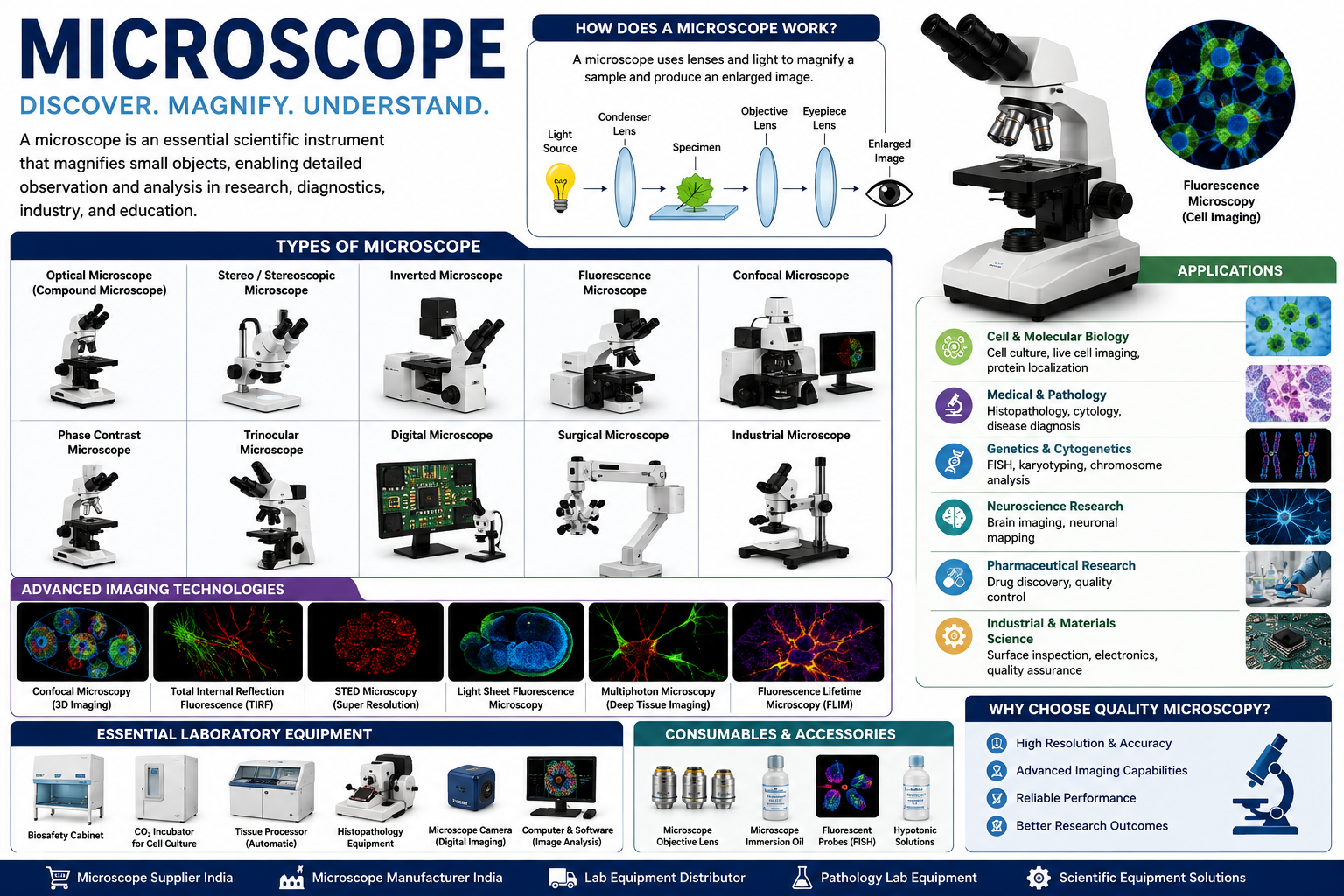
A microscope is an essential scientific instrument for observing structures that are too small to be examined clearly with the naked eye. Microscopes are widely used in educational laboratories, life science research, clinical investigations and biomedical studies.
Different microscope types provide different levels of magnification, contrast, resolution and imaging capability. Selecting the right microscope depends on the specimen, intended application, required image detail and laboratory workflow.
DSS Imagetech offers microscopy-related technologies for laboratories and research institutions seeking solutions for scientific observation and imaging.
What Is a Microscope?
A microscope is an optical or imaging instrument that makes small objects and structures easier to observe. Optical microscopes use lenses and visible light to form an image, while advanced systems may incorporate specialised illumination, fluorescence detection, digital imaging or other imaging technologies.
Microscopes are used to study cells, tissues, microorganisms, materials and a wide range of scientific specimens.
Types of Laboratory Microscopes
1. Compound Microscope
A compound microscope uses multiple optical elements to magnify specimens. It is commonly used to examine thin samples, stained preparations and biological specimens.
Compound microscopes are suitable for many teaching, routine laboratory and biological observation tasks. The appropriate configuration depends on magnification requirements, illumination, objective lenses and specimen preparation.
2. Biological Microscope
A biological microscope is designed for observing biological samples such as cells, tissues and microorganisms. Depending on its configuration, it may support brightfield, phase contrast or other microscopy methods.
Biological microscopes are used in educational settings, research laboratories and selected clinical or laboratory workflows.
3. Optical Microscope
An optical microscope uses light and optical components to form a magnified image. This broad category includes compound microscopes and specialised systems designed for different contrast and imaging requirements.
The choice of optical microscope depends on the sample, desired contrast, resolution, illumination and working distance.
4. Research Microscope
A research microscope is configured to meet more specialised imaging or experimental requirements. Depending on the application, research systems may support fluorescence imaging, advanced contrast techniques, digital image acquisition or integration with analytical software.
Researchers should assess the imaging technique, sample compatibility, automation requirements and data-analysis needs before choosing a system.
5. Advanced Microscopy Systems
Advanced microscopy techniques help researchers investigate specimens that require more specialised imaging capabilities.
-
Confocal microscopy: Supports optical sectioning and improved contrast in suitable specimens.
-
Super-resolution microscopy: Enables selected structures to be resolved beyond the conventional diffraction limit.
-
Widefield microscopy: Captures light across a field of view and is useful for many routine imaging applications.
-
Light-sheet microscopy: Supports volumetric imaging of suitable samples using a sheet of illumination.
-
Scientific imaging: Combines imaging hardware and software for image acquisition, processing and analysis.
Explore Microscopy Applications to learn about different microscopy technologies and their research uses.
Applications of Microscopes in Laboratories
Life Science Research
Microscopes help researchers observe cells, tissues and biological structures. They support investigations into cellular morphology, biological processes and specimen characteristics.
Clinical and Diagnostic Workflows
Microscopy can support selected diagnostic workflows involving the examination of biological specimens. The appropriate method and instrument depend on the test, validated procedure and laboratory requirements.
Biotechnology
Biotechnology laboratories use microscopy to investigate biological materials and support selected cell-based and molecular research workflows.
Education and Training
Educational microscopes help students observe biological structures and develop practical laboratory skills. Ease of use, durability, optical performance and maintenance are important selection factors.
Biomedical Research
Research microscopes support investigations into disease-related changes, tissue structure and cellular processes. Advanced imaging techniques may be required when standard optical microscopy cannot provide the necessary detail.
How to Choose the Right Microscope
Before selecting a microscope, consider:
-
Specimen type: Determine whether you will examine cells, tissues, microorganisms or other materials.
-
Magnification and resolution: Match the optical system to the level of detail required.
-
Contrast method: Consider brightfield, phase contrast, fluorescence or other suitable techniques.
-
Illumination: Check transmitted light, reflected light or fluorescence requirements.
-
Digital imaging: Determine whether a camera and image-analysis software are needed.
-
Ergonomics: Evaluate working distance, viewing comfort and ease of operation.
-
Future applications: Consider whether the microscope can accommodate additional imaging methods or accessories.
Magnification alone does not determine image quality. Resolution, optics, specimen preparation and contrast also influence the details that can be distinguished.
Microscope Cameras and Imaging Integration
A compatible microscope camera enables users to capture, document and analyse microscopic observations digitally. Camera selection should account for the microscope's optical configuration, sensor specifications, software and intended imaging application.
Explore Scientific Cameras for camera technologies that can support suitable microscopy systems.
For more specialised research, laboratories can also investigate Confocal Microscopy and Super-Resolution Microscopy.
Explore Microscopes at DSS Imagetech
DSS Imagetech offers microscopy-related technologies for scientific, laboratory and research applications. Its product portfolio helps users explore suitable options according to their observation, imaging and experimental needs.
Visit the Microscopes category to review the available range and identify a suitable solution for your laboratory.
Frequently Asked Questions
What is a microscope used for?
A microscope magnifies small objects and structures for examination. Common applications include biological research, education, laboratory analysis and scientific imaging.
What is the difference between a compound and a biological microscope?
A compound microscope describes an optical arrangement using multiple lenses. A biological microscope describes a microscope intended for biological specimen observation. These categories can overlap.
Which microscope is suitable for laboratory use?
The appropriate microscope depends on the specimen, required magnification and resolution, contrast method, illumination and intended application.
What is a research microscope?
A research microscope is a system configured for scientific investigations that may require specialised imaging techniques, digital acquisition or integration with analysis software.
Can a microscope be connected to a digital camera?
Yes, many microscopes can be connected to compatible digital cameras using suitable ports, adapters and software. Compatibility should be checked for the specific system.
Where can I explore laboratory microscopes?
Visit the DSS Imagetech Microscopes category to explore microscopy-related technologies.

 Arabic
 French
 Spanish
 Portuguese
 Deutsch
 Turkish
 Dutch
 Italiano
 Russian
 Romaian
 Portuguese (Brazil)
 Greek
