


Precision Gear Components for Linear Motion Systems
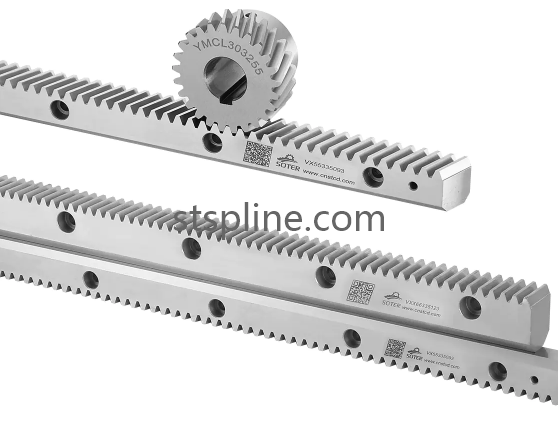
Precision gear racks are important components in mechanical transmission systems that require controlled linear movement and consistent engagement. A well-manufactured Precision Gear Rack works with a compatible pinion to convert rotary motion into straight-line travel, supporting CNC machine tools, laser cutting systems, gantry equipment, industrial robots, and automated manufacturing lines. In these applications, transmission quality depends not only on the rack itself but also on the interaction between tooth geometry, material properties, machining accuracy, installation alignment, and the wider motion control system.
Material selection establishes the foundation for a reliable gear rack. Carbon steel is frequently used in industrial transmission because it offers good machinability and practical mechanical strength. Alloy steel may be considered where the component must withstand higher loads or repeated tooth contact. Heat treatment and surface hardening can improve wear resistance when required by the application. Engineers should evaluate operating loads, movement cycles, lubrication, and environmental conditions before choosing a material and finishing process.
Tooth geometry is central to precision transmission. Module, pressure angle, tooth profile, pitch consistency, and dimensional tolerances must be compatible with the mating pinion. Variations in these characteristics can affect contact patterns and lead to backlash, vibration, noise, or uneven wear. For equipment that requires repeatable positioning, gear accuracy should be considered alongside guide rail alignment, bearing stiffness, motor control, and the rigidity of the machine structure. A complete system approach helps ensure that component accuracy translates into dependable machine movement.
Manufacturing processes influence the final tooth profile and dimensional quality. Depending on the product design, production may include material cutting, blank preparation, gear cutting, milling, heat treatment, grinding, deburring, and inspection. Each operation must be controlled to maintain the intended geometry. Machine stability, tool wear, cutting conditions, and workpiece positioning can affect tooth spacing and surface finish. Where higher precision is required, additional finishing operations may help improve dimensional consistency and contact quality.
Straightness is another important consideration, especially for long-travel equipment. A rack may meet its local tooth specifications yet still require careful checking of overall straightness, mounting-hole positions, and interface dimensions. When multiple rack sections are installed together, their joints should be aligned to maintain consistent pinion engagement across the travel path. Incorrect alignment can create localized resistance and uneven loading, potentially affecting positioning repeatability and component life.
Precision gear racks are used in many industrial applications. CNC machining centers use rack drives to move machine axes, while laser cutting equipment relies on coordinated motion to follow programmed paths. Automated storage systems, gantry manipulators, and robotic handling equipment use linear transmission to position tools and workpieces. In battery manufacturing and automated assembly lines, controlled movement supports repeatable transfer between stations. The required rack design varies according to travel length, operating speed, load, positioning tolerance, and installation space.
Quality inspection helps confirm whether the finished rack meets the technical drawing and intended application requirements. Common inspection points include tooth profile, pitch accuracy, straightness, surface finish, mounting dimensions, and material hardness where specified. Inspection methods and acceptance limits should be agreed before production, particularly for customized components or repeat orders. Confirming the mating pinion specifications also helps prevent compatibility issues during assembly.
Installation and maintenance remain important after manufacturing is complete. A stable mounting base, correct alignment, suitable fastening, and appropriate lubrication support smooth engagement and reduce unnecessary friction. In environments with metal chips, dust, or moisture, protective covers can help prevent contamination of the gear mesh. Routine maintenance may include checking lubrication, observing tooth wear, inspecting fasteners, and monitoring changes in noise or backlash. These practices can help identify developing issues before they affect production schedules.
For buyers evaluating a Precision Gear Rack, relevant supplier capabilities include gear machining experience, material traceability, dimensional inspection, finishing options, and the ability to work from technical drawings. SOTER provides rack and pinion products for industrial machinery and automation applications. Explore straight-tooth rack options at https://www.stspline.com/product/straight-teeth-rack/ to compare available configurations with your equipment's transmission requirements.

 English
 Arabic
 French
 Spanish
 Portuguese
 Deutsch
 Dutch
 Italiano
 Russian
 Romaian
 Portuguese (Brazil)
 Greek
