


AI in Steel Fabrication ERP: Predicting Material Needs, Delays and Price Swings
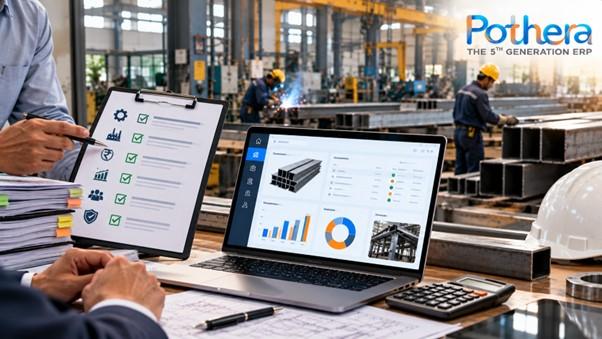
AI in steel fabrication ERP uses your own order, stock, supplier, shop-floor and rate history to forecast how much steel each job will need, flag jobs likely to run late, and show how much margin is exposed to steel price changes. It improves the inputs to planning rather than replacing it, and it only works when the underlying ERP data is accurate.
Pothera ERP, built by Bsquare Solutions, connects the modules that produce that data: production planning, procurement and MRP, inventory, quality, job work and finance. Here is what AI can and cannot do for a fabricator, and how to prepare.
What does AI in a steel fabrication ERP actually mean?
It means software that learns patterns from your past transactions and applies them to open jobs. It sits on top of standard ERP logic:
|
Question |
Traditional ERP |
AI-assisted ERP |
|
How much steel does this job need? |
Net quantity from the BOM |
Net quantity adjusted for the yield and scrap your shop actually achieves |
|
When must we order? |
Fixed lead time in the item master |
Lead time based on how each supplier has actually delivered |
|
Will this job finish on time? |
Planner checks progress by hand |
Open jobs flagged when progress, capacity or material status points to a delay |
|
What is our price risk? |
Reviewed when someone remembers |
Open quotes and stock ranked by exposure to rate changes |
MRP stays the engine. AI sharpens its assumptions, which is why MRP and procurement data quality matters first.
How does AI predict material needs in steel fabrication?
It compares what the BOM says a job needs with what past jobs actually consumed. The inputs are:
● Confirmed orders, bills of materials and drawing revisions
● Past consumption and yield by grade and section
● Scrap and reusable offcuts
● Current stock and open purchase orders
● Each supplier’s recorded delivery times
A simple example (illustrative). A job needs 10 tonnes of finished plate. Your history shows 92% yield on this kind of work. Gross requirement is 10 ÷ 0.92 = 10.87 tonnes. Ordering exactly 10 tonnes leaves the job about 0.87 tonnes short. Multiplied across a fabrication shop’s annual steel purchases, that gap is where expedited orders and idle workstations come from.
The output is a suggested quantity and order date for each grade and section. A planner reviews it before it becomes a purchase indent. For the planning side, see how ERP improves steel fabrication production planning.
How does AI predict delays on steel fabrication jobs?
It watches signals that humans notice late and turns them into an early warning with a reason.
|
Signal in the ERP |
What it can indicate |
Useful response |
|
Work order behind its routing |
The job will miss dispatch |
Re-sequence or add a shift |
|
Material not yet received or issued |
A cutting start will slip |
Chase the supplier or substitute |
|
Outside process (galvanising, painting) running longer than usual |
A return delay |
Escalate with the vendor |
|
Repeated rejections at a stage |
Rework will consume capacity |
Investigate the cause and address rework |
|
Drawing revision or approval pending |
The shop may build to the wrong version |
Confirm the approved drawing revision |
|
A machine overloaded in the coming week |
A bottleneck is forming |
Review capacity and re-sequence work |
These signals come from production and planning, quality management and job work and sub-contract management data. Related reading: manufacturing scheduling ERP software and how ERP improves quality control in steel fabrication.
Can AI predict steel price swings?
Not reliably, and be wary of any vendor that says it can. Steel prices depend on global and domestic factors no fabricator’s ERP sees. What AI can do is show how exposed your business is:
● Which open quotations have steel priced but not yet purchased
● How much stock sits at an older rate than the replacement cost
● How each customer’s margin changes if the steel rate moves by a set percentage
● Where your purchase rate history diverges from the basis used in recent quotes
Exposure example (illustrative). A job is quoted at ₹50 lakh, with steel making up 60% of the price, or ₹30 lakh. If the rate rises 5% before you buy, material cost rises by ₹1.5 lakh, which takes 3 percentage points off the contract value in margin. A dashboard that lists all such open jobs lets you buy early, add price-variation clauses or requote before you lose margin. Related: stop revenue leaks with steel ERP software.
What data does a fabricator need before AI helps?
AI cannot fix bad records. In Bsquare’s 2026 survey of 500 Indian manufacturers, 71% named inventory inaccuracy as a top pain point before ERP and 63% named a lack of real-time production visibility. A prediction built on inaccurate stock or delayed entries will be wrong.
|
Data to get right |
Why AI needs it |
|
Item masters by grade, section and size |
So similar materials are grouped correctly |
|
Accurate stock, including offcuts |
So requirements net off real availability |
|
Clean BOMs with revision control |
So forecasts reflect the current drawing |
|
Yield and scrap recorded per job |
So estimates use real performance |
|
Supplier order and delivery dates |
So lead times are measured, not assumed |
|
Actual job costs and closed-job history |
So the model learns from outcomes |
|
Same-day shop-floor entries |
So delays surface in time |
Read more: ERP inventory management and ERP for metal fabrication and the steel industry.
What are the limits and risks of AI in ERP?
● Small data sets. A shop with few jobs may not have enough history for reliable patterns. Simple rules and alerts work better first.
● No explanations. Insist that every alert shows its reason, so planners can judge it.
● Changing conditions. A model trained on last year’s suppliers may mislead after a vendor change.
● Human control. Predictions should suggest, not place orders automatically, until you trust them.
● Data security. Confirm where your data is processed and who can see it.
In the same survey, 29% of manufacturers said they were actively planning AI or predictive analytics investments, so expect the topic to appear in vendor evaluations. Our ERP checklist for steel fabricators can help you ask the right questions.
How can a steel fabricator get AI-ready in five steps?
- Put everything on one system. Connect sales, purchase, stores, production, quality and accounts so jobs carry their data from enquiry to invoice.
- Fix inventory accuracy. Count stock, record offcuts and keep issues and returns up to date.
- Record yield and delivery performance for every job and supplier.
- Start with alerts and dashboards. Low stock, late jobs and price exposure reports deliver value before any forecasting.
- Pilot forecasting on one product family, compare predictions with actuals for a few months, then widen.
How does Pothera ERP support this?
Pothera ERP is an integrated platform in which purchasing, inventory, production and quality, job work, accounts and finance, sales and CRM and HR share one database. For steel fabricators, that gives the following foundations:
● MRP-driven procurement that works from confirmed demand, bills of materials and current stock
● Production planning with multi-level BOMs, routings and order-wise progress
● Shop-floor recording of output, rejection, scrap and loss, with machine, shift and operator analysis
● Job work tracking with challans and party-wise pending quantities
● Costing with BOM overheads, scrap and substitute items
● Dashboards and instant alerts by email and WhatsApp for approvals and exceptions
● Cloud or on-premise deployment and typical go-live of 8 to 12 weeks
The platform is designed so AI, IoT and data-driven automation can run on the same data. Read about the direction in the future of intelligent ERP for manufacturing, or see the full feature list and industry solutions. Related: ERP software for the steel industry.
Frequently asked questions
What is AI in steel fabrication ERP?
It is the use of machine learning and analytics on your ERP data to forecast material needs, flag jobs at risk of delay and show price exposure, on top of standard planning and MRP.
Can AI predict steel prices?
Not reliably. AI can show how exposed your open quotes and stock are to price changes, so you can act early, but it cannot forecast the market.
Does AI replace MRP in steel fabrication?
No. MRP still calculates requirements. AI improves its assumptions, such as yield and supplier lead time.
How much data do I need before AI is useful?
Enough completed jobs, accurate stock and recorded supplier deliveries to show patterns. Without that, start with alerts and dashboards.
What should I fix first?
Inventory accuracy, offcut records, BOM and drawing revisions, and same-day shop-floor entry.
Is AI in ERP expensive for a small fabricator?
It depends on scope. Start with the core modules and add AI features once data quality is good. Use the ERP Cost Estimator for an indicative range.
How long does Pothera ERP take to implement?
Typically 8 to 12 weeks for 10 to 100 users, depending on scope, sites and data readiness.
See how your steel jobs would run in Pothera ERP
Book a demo of Pothera ERP and bring one real job, with its drawing, bill of quantities and purchase order, to see planning, material requirements and delay alerts on your own data. Or estimate your investment and payback first.

 English
 Arabic
 French
 Spanish
 Portuguese
 Deutsch
 Turkish
 Dutch
 Italiano
 Russian
 Romaian
 Portuguese (Brazil)
