


The Difficulties of Bending Stainless Steel Tubes with a Manual Tube Bender
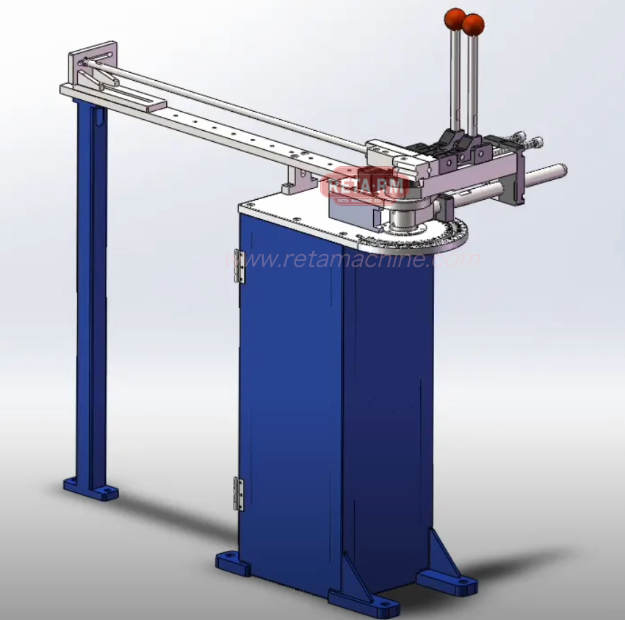
Manual tube benders are economical and portable tools widely used for small-batch and on-site tube forming work. While they perform well with soft copper and mild steel tubes, they face obvious limitations when processing stainless steel tubes, especially the common 304 and 316 grades. Stainless steel is harder, stronger and more elastic than ordinary steel, and manual equipment lacks the servo or hydraulic power of automatic machines. As a result, achieving high-quality bends in stainless steel becomes a demanding task that requires considerable skill and experience from the operator.
The first and most prominent challenge is springback. Stainless steel has high tensile strength and strong elastic recovery. After the operator applies manual force and releases the tube, the bent angle rebounds by several degrees, which ruins the intended geometry. CNC benders can calculate and compensate for springback automatically, but manual bending relies entirely on the worker's judgment to over-bend in advance. The springback value also changes with tube diameter, wall thickness and material hardness, so stable angle accuracy is difficult to guarantee. Repeated trial bending is often needed, which creates waste pieces and consumes extra time on every job. For tubes that must fit into precise assemblies, even a two-degree deviation can cause alignment problems during installation.
Work hardening is another major obstacle. Stainless steel hardens rapidly under cold deformation. As the bending process continues, the bent zone becomes harder and less ductile, and further forming demands greater force. If the operator pushes unevenly or too suddenly, the outer wall of the bend may become excessively thin and even crack, while the inner wall is prone to wrinkling and collapse. Manual benders cannot maintain stable, continuous pressure the way hydraulic or servo-driven machines do. A slight pause or a jerky push leaves stress marks on the surface and increases the risk of premature failure when the tube is put into service. For thin-walled tubes, this combination of thinning and wrinkling can quickly turn a simple bend into a rejected part.
Shape control is also difficult. Most automatic benders use an internal mandrel to support the tube wall, but manual bending usually works without such support. Thin-walled stainless steel tubes therefore easily flatten or kink during the operation, and the cross-section is no longer round, which reduces flow capacity and structural strength. In addition, stainless steel tends to gall against the bending die. Friction scratches the tube surface, damaging corrosion resistance and appearance. While proper lubrication can reduce friction, it cannot fully eliminate surface damage under manual operation, so the finished bend often requires additional polishing or reworking.
In summary, manual tube benders are only suitable for small-diameter, thick-wall stainless steel tubes with generous bend radii. For precision, thin-wall or tight-radius bending, manual tools struggle with springback, work hardening and section deformation. Operators need rich experience and careful, consistent operation to reduce defects, but the scrap rate and dimensional consistency still cannot match powered bending machines. For industrial production that demands stable quality, investing in hydraulic or CNC benders is usually a more reliable choice.

 English
 Arabic
 French
 Spanish
 Portuguese
 Deutsch
 Turkish
 Dutch
 Italiano
 Romaian
 Portuguese (Brazil)
 Greek
