


Log Periodic Dipole Antenna: How Its Design Actually Works
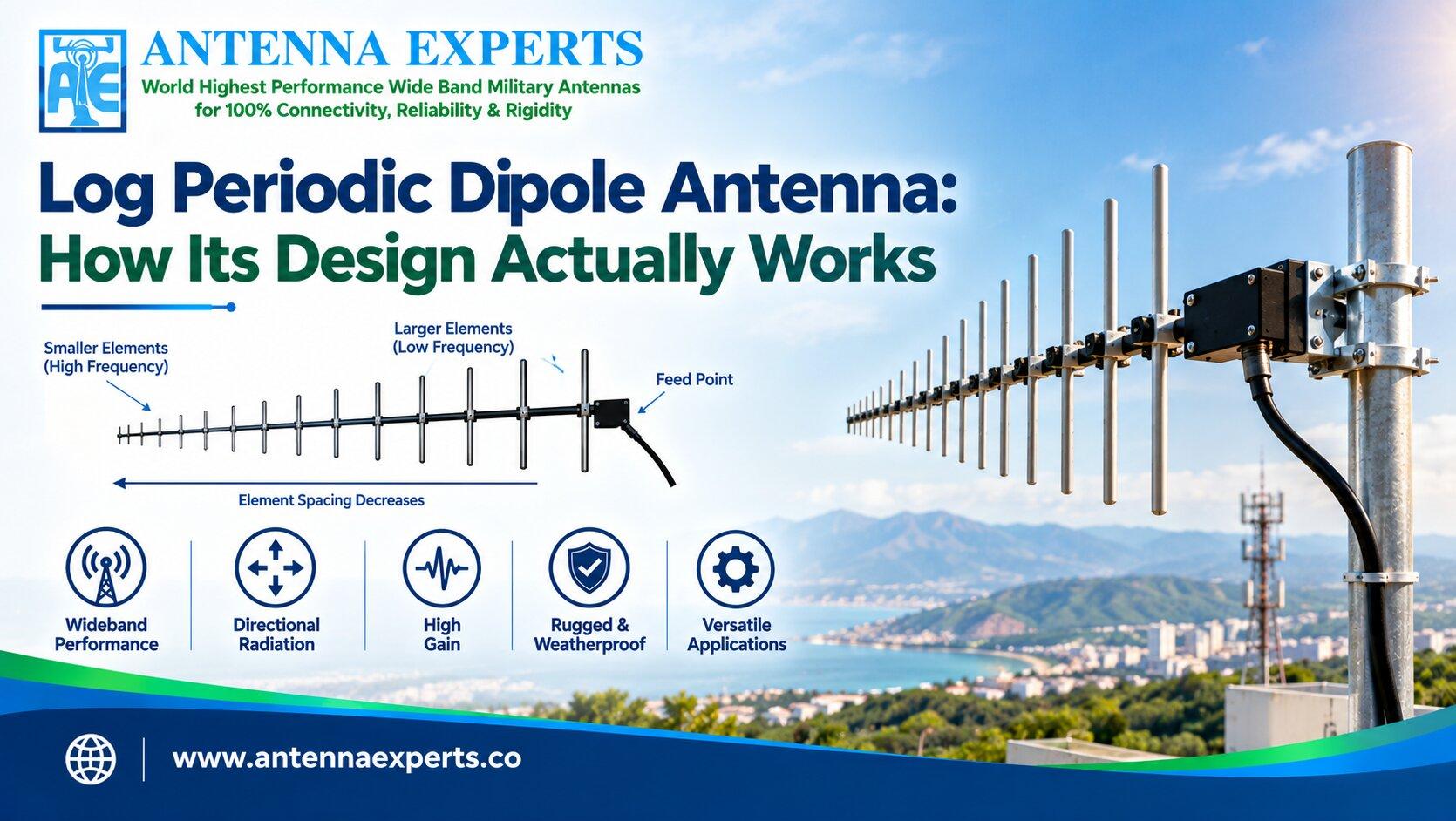
A log periodic dipole antenna consists of dipole elements arranged along a boom, with each element increasing in length. The elements account for each part of the band. This is how a single antenna can be directional and cover a large range of frequencies. They have a sort of pattern to them. Each is longer than the adjacent one by a set ratio. Same spacing rule. With a change of frequency, the part of the array doing the work changes with it. This guide takes you through the geometry, the feed line and the terms you will see on a datasheet. Every component of a log periodic dipole antenna has one task. Once you see those jobs, the whole design is working.
How a Log Periodic Dipole Antenna Works
At any given frequency, only some parts of the array radiate strongly. Most of the work is done by dipoles almost half a wavelength long. The working section moves to the short end with increasing frequency. When it falls, the section goes to the long end. The beam is directional because working parts are acting together. It is pointed to the short-element end of the array.
Log Periodic Antenna Design
The geometry of an LPDA antenna is defined by a pair of numbers.
· Scale Factor (Tau)
Tau is the ratio of one element to the next. A tau of 0.9 would mean each element is 90 percent the length of the previous element. A value closer to 1 means smaller steps and usually more elements.
· Spacing Factor (Sigma)
Sigma bridges the gap with their length between elements. Designers use it together with tau to balance gain, boom length and pattern shape.
Why the Elements Have Different Sizes
For a dipole, the antenna should be approximately half a wavelength long. Lower frequencies suit long elements. The higher ones are for short elements.
Identical dipoles would work well in just one narrow band. Grading provides a ladder of working points up the boom. Check the product page for the frequency range of each model.
· The Transposed Feed Line
The boom has a feed line along it. It connects every dipole. The connection is made from one element to another. That flip is the transposition.
It changes the phase by half a cycle between the neighbors. The signals from the working elements add up to the front with the right spacing. Connector details and feed impedance are model dependent. View them in the product page.
· Active Region of the Array
At any frequency, think of the array in three groups. The active region consists of elements close to half a wavelength. The longer elements behind it reflect energy forward. It is led by shorter elements ahead of it.
Not all elements are created equal. When the frequency is varied the active region slides along the array. This is the main reason why an LPDA shows useful performance over a large band.
· Directional Performance and Front-to-Back Ratio
An LPDA is a broadband directional antenna. Strong forward radiation, less to the rear side.
The ratio of the front signal to the rear signal in decibels is the front-to-back ratio. A higher number means better rejection from the rear. This is useful if you are getting interference or reflections from behind. No value provided here. Look at the product page of each model.
· Gain Flatness Across the Band
Gain flatness is the amount of gain variation over the operating range. One gain number can hide troughs and crests. Check the gain across your bandwidth.
LPDA Antenna Models from Antenna Experts
The range comprises the LP-30-512 log-periodic antenna and the LP-400-6000. Each LPDA antenna has published specifications. No figures are given here. Read the frequency range, gain, VSWR and polarization on the product page before you compare.
Military and High-Gain Log Periodic Antennas
The same design concept takes different forms. One type is a military log periodic dipole antenna
Another is a high-gain log periodic antenna. Each balances band, gain and size in its own fashion. Look at the specs written down for each.
What to Check Before Choosing an LPDA
Compare these with your system:
1. Required frequency range
2. Gain across the required band
3. Front-to-back ratio
4. Polarization
5. VSWR across the required frequency band, if published
6. Power handling, if it is relevant for your use
7. Physical size and installation needs
8. Environmental requirements, if specified
9. Product documentation
All the Indian antenna manufacturers should publish these details for each model. Match the published numbers to your needs.
Why Choose Antenna Experts?
Antenna Experts is a dedicated best antenna manufacturer company in India. We have several LPDA designs. These include military and high gain log periodic antennas. Each model has its own product page. Where published, the frequency range, gain and polarization are shown.
The information is still model specific. Buyers can compare designs and look cross-reference each figure with their system. We state when a value is not published. No performance claim is made other than the documentation. This specification-based approach helps technical buyers compare models using documented information rather than unsupported claims.
FAQs
1. Why does a log periodic dipole antenna keep nearly constant gain?
The active region traverses the array with frequency. Over the band, different elements contribute. That keeps the gain pretty constant. It is not an exact constant.
2. How many elements does an LPDA need?
There is no set number. Depends on the frequency range and design parameters. Performance needs are also important.
3. What frequency range can one log periodic dipole antenna cover?
That depends on the design and model of the antenna. Check the published frequency range of the antenna in question. Not all LPDAs cover the same bands.
4. Can a log periodic dipole antenna be used for high power transmission?
It depends on the published power-handling spec and on what you need in your system. Do not assume a high power capability without a documented rating.
About the Author
Gurleen Nayar is a marketing manager at Antenna Experts. Gurleen writes about antennas and technical products. Gurleen also supports the company's marketing work. The aim is to make technical product information easier to understand. This helps buyers compare antenna options and understand key specifications before making a choice.

 Arabic
 French
 Spanish
 Portuguese
 Deutsch
 Turkish
 Dutch
 Italiano
 Russian
 Romaian
 Portuguese (Brazil)
 Greek
