


Complete Traffic Survey Solutions for Urban Development in the UAE
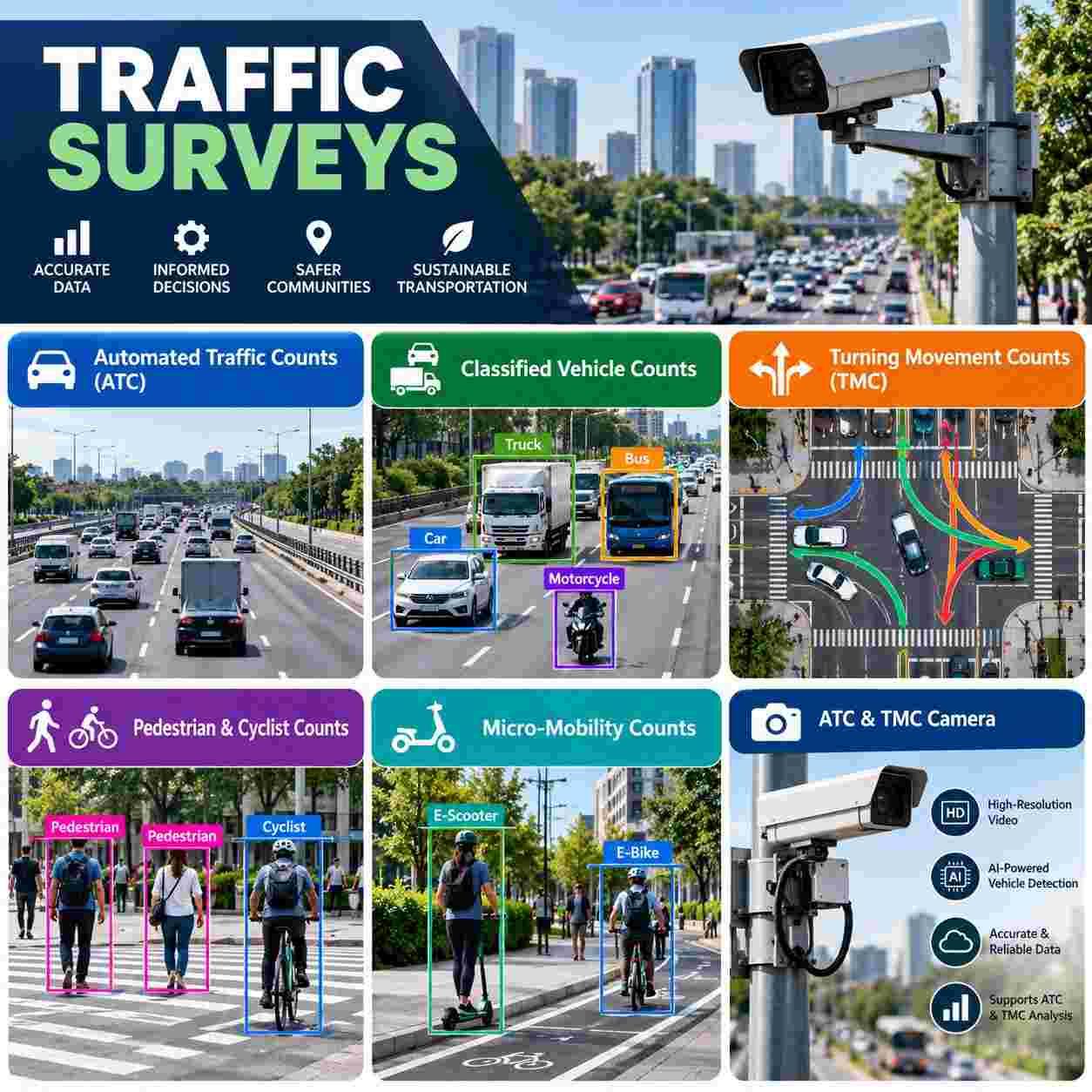
Traffic Surveys give master developers, consultants, and planning authorities the evidence they need to design new communities that move well from the first day of occupation, and this guide shows how each survey type supports a development project from site selection through opening and after.
New Communities Need Proof, Not Assumptions
Every new district, tower cluster, retail destination, or logistics park adds trips to nearby roads. Approving authorities such as the Roads and Transport Authority in Dubai and the Department of Municipalities and Transport in Abu Dhabi expect developers to show how those trips will be absorbed, usually through a traffic impact study built on measured data.
Studies that rest on old or borrowed numbers invite questions and delays, while studies that rest on fresh local counts move through review more smoothly.
The Survey Journey of a Development
A development passes through several stages, and each stage has its own data needs: site selection and feasibility, concept design, approval submission, construction, opening, and operation. Planning surveys around these stages avoids paying twice or discovering too late that a key count is missing.
One Plan, Several Purposes
A single well-designed survey programme can serve the feasibility report, the approval submission, and the later monitoring, as long as the method and locations are documented consistently.
Measuring the Existing Network
Automated Traffic Counts (ATC) record every vehicle at roadside locations for days or weeks, giving a reliable picture of daily volumes, peak hours, weekday and weekend patterns, and seasonal swings on the roads surrounding a site. This baseline is the starting point for every forecast.
Choose count locations on the main access routes, on likely rat runs, and at boundaries where new traffic will join existing flows.
Understanding Who Uses the Roads
Classified Vehicle Counts separate cars, vans, buses, rigid trucks, and articulated trucks, which matters when a development brings deliveries, school buses, or construction traffic. Heavy vehicle numbers affect junction design, pavement strength, and the hours in which construction deliveries should be allowed.
Construction Traffic Planning
Knowing the existing truck share helps planners schedule deliveries outside peak hours and avoid disruption to nearby residents and businesses.
Testing the Junctions Around the Site
Turning Movement Counts (TMC) record how many vehicles turn left, go straight, or turn right from every approach, usually in short intervals through peak periods. Models built on these counts show whether nearby junctions can handle the new trips and which improvements, such as extra lanes or signal changes, are needed.
Junction data often shapes the developer's contribution to road works, so accuracy protects both budgets and approvals. Learn how traffic survey solutions for urban development support these decisions.
Designing Streets for People
Pedestrian & Cyclist Counts show how many people walk and ride around a site, where they cross, and when they gather. This evidence guides footpath widths, crossings, shade, cycle tracks, and links to metro and bus stops, which many UAE masterplans now treat as essential features.
Measuring Existing Patterns
Counts near comparable districts show how many trips are made on foot or by bike in similar settings, which supports realistic targets for the new community.
Planning for New Ways to Travel
Electric scooters, shared bikes, and other small vehicles are part of daily travel in many districts. Micro-Mobility Counts record these users separately, so designers can decide where lanes, parking bays, and docking points belong instead of discovering the need after opening.
Early evidence also helps authorities and operators agree rules and service areas for the new community.
Learning from Comparable Developments
Standard trip rates from other countries do not always match UAE habits, such as high car ownership, strong evening peaks, and heavy use of delivery services. Surveying similar existing developments gives local trip rates and parking demand that make a traffic study more convincing.
Parking and Access Points
Entry and exit counts and parking occupancy surveys at comparable sites show how many spaces are really used and how queues form at access points.
Cameras That Make Surveys Faster
An ATC & TMC Camera records video of traffic that software or trained reviewers convert into counts by vehicle class and movement. A permanent recording lets the team check figures later, and one deployment can answer several questions for different parts of the project.
Privacy is part of professional practice. Footage should be used only for the study, stored securely, and processed so faces and number plates are protected under the federal Personal Data Protection Law. See how a camera-based traffic data team manages this responsibly.
Traffic Surveys UAE: Methods Reviewers Trust
Reliable Traffic Surveys UAE developers commission follow clear methods: calibrated equipment, trained staff, validation checks, neutral survey weeks, and complete records of weather and events. Reports usually follow guidance from the Institute of Transportation Engineers and the Highway Capacity Manual so that consultants and reviewers can use them directly.
Avoiding Misleading Periods
Counts taken in school holidays, during Ramadan, at major events, or near roadworks can mislead, so record unusual conditions and choose representative weeks.
Traffic Surveys Dubai: Dense and Fast Changing
Traffic Surveys Dubai projects often sit within dense corridors and rapidly changing districts, with review by the Roads and Transport Authority and Dubai Municipality and alignment with the Dubai 2040 Urban Master Plan. Areas such as Business Bay, Dubai South, Dubai Creek Harbour, and Jebel Ali each show very different patterns, so data must be site specific.
Traffic Surveys Abu Dhabi: Planned Growth
Traffic Surveys Abu Dhabi studies follow the expectations of the Department of Municipalities and Transport and the Integrated Transport Centre, with reference to Plan Abu Dhabi 2030. They cover island developments such as Saadiyat and Yas, industrial areas like ICAD and KEZAD, and growth along highways, where heat and long distances influence equipment placement.
Al Ain and the Western Region add further variety, with long rural corridors and different traffic mixes.
After Opening: Checking Predictions
Surveys repeated after a development opens show whether forecasts were right, whether access points work, and where small fixes can help. These results build trust with authorities and improve the next project.
Reports That Authorities Can Use
Look for clear tables, peak hour summaries, charts, maps, site photographs, a short statement of method, and data files in common formats.
Proof Points That Build Trust
When choosing a survey partner, look for experienced engineers, documented development projects, calibrated equipment, clear quality checks, safe working procedures near live traffic, and honest advice about limits. References from consultants and authorities are the strongest evidence.
Conclusion
Dependable Traffic Surveys help every UAE development move from concept to opening with confidence, using Automated Traffic Counts (ATC), Classified Vehicle Counts, and Turning Movement Counts (TMC). Pedestrian & Cyclist Counts and Micro-Mobility Counts shape streets for people, while an ATC & TMC Camera keeps a permanent record. Strong Traffic Surveys UAE practice meets authority expectations at every stage. Traffic Surveys Dubai and Traffic Surveys Abu Dhabi projects each need locally informed planning. Contact Top Precision today to plan your development survey.
FAQs
1. Where should Automated Traffic Counts (ATC) be placed for a new development?
Place them on the main access routes, likely shortcuts, and boundary roads where new traffic will join existing flows.
2. Why do developers need Classified Vehicle Counts?
Vehicle mix affects junction design, pavement strength, and construction delivery planning, so reviewers want proof it is understood.
3. How do Turning Movement Counts (TMC) support a traffic impact study?
They show how junction movements behave in peak periods, so models can test whether nearby junctions can handle the new trips.
4. Why add Micro-Mobility Counts to a development study?
Scooters and shared bikes are a growing share of trips, and early figures help place lanes, parking bays, and docking points correctly.
5. Can an ATC & TMC Camera record public road for a survey?
Yes, for surveys, provided footage is used only for the study, stored securely, and processed to protect faces and number plates.

 English
 Arabic
 French
 Spanish
 Portuguese
 Turkish
 Dutch
 Italiano
 Russian
 Romaian
 Portuguese (Brazil)
 Greek
