


How Key Management in Cryptography Supports Secure Digital Certificates and Authentication
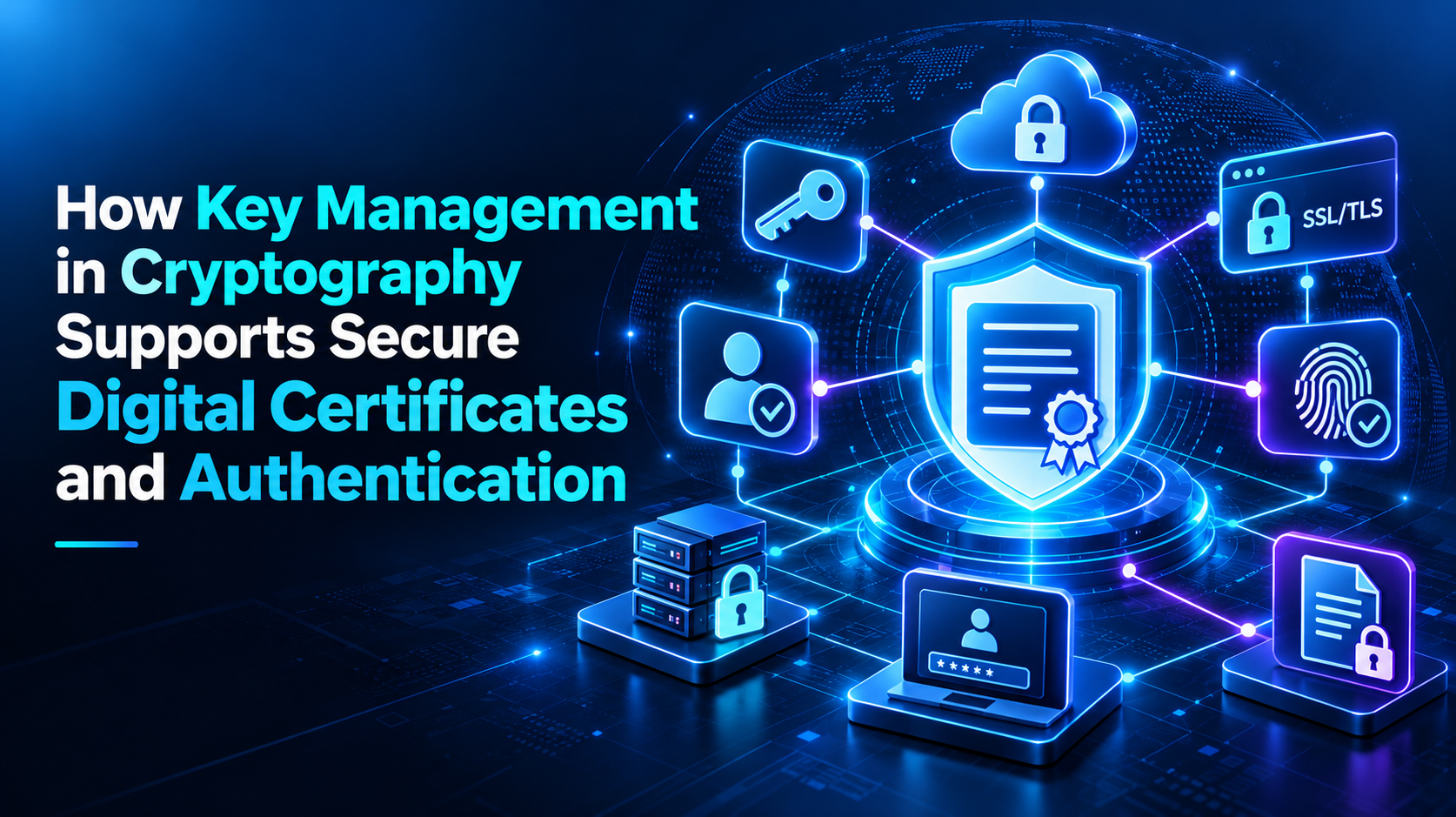
Excerpt:
Digital certificates and authentication systems depend on cryptographic keys to establish trust between users, applications, devices, and services.
Key management in cryptography helps organizations protect these keys throughout their lifecycle and control how they are accessed.
Effective Key management supports certificate security, authentication, renewal, revocation, and secure digital communication.
Introduction
Digital identities have become fundamental to modern enterprise operations. Employees access applications remotely, customers use online services, APIs connect business systems, and automated workloads communicate with each other.
Organizations need reliable ways to verify these identities and protect their communications.
Digital certificates and cryptographic authentication mechanisms provide important security controls. They help establish trust between systems, secure communications, and verify the identity of applications, servers, users, and devices.
However, digital certificates depend on cryptographic keys, particularly private keys.
If organizations fail to protect these keys, attackers may potentially impersonate trusted systems or interfere with secure communications.
This makes key management in cryptography an important part of certificate and authentication security.
What Are Digital Certificates?
A digital certificate is a cryptographic credential used to establish the identity of a person, system, device, application, or service.
Certificates can support:
-
Website security
-
API authentication
-
Application communication
-
Device authentication
-
Internal enterprise services
-
Secure remote connections
Certificates typically contain information about the identity they represent and are associated with cryptographic key pairs.
Why Private Keys Need Protection
A certificate may be publicly available, but the associated private key requires strong protection.
The private key can be used to authenticate the associated identity or perform cryptographic operations.
If an unauthorized party obtains a private key, the organization may face serious security risks.
Therefore, businesses must treat private keys as sensitive security assets.
Understanding Key Management in Cryptography
Key management in cryptography refers to the processes and technologies used to manage cryptographic keys throughout their lifecycle.
The lifecycle includes:
-
Generation
-
Storage
-
Distribution
-
Access
-
Usage
-
Rotation
-
Backup
-
Recovery
-
Expiration
-
Renewal
-
Revocation
-
Destruction
Digital certificate management should align with these lifecycle principles.
Protecting Certificate Private Keys
Organizations should avoid storing private keys in easily accessible locations.
For example, security teams should carefully evaluate the risks associated with storing sensitive keys in:
-
Application source code
-
Unprotected configuration files
-
Shared folders
-
Developer environments
-
General-purpose storage
A strong Key management architecture provides controlled access to sensitive cryptographic material.
Certificate Lifecycle Management
Digital certificates have a lifecycle of their own.
Organizations need to:
-
Discover certificates
-
Identify ownership
-
Track expiration
-
Renew certificates
-
Replace compromised certificates
-
Revoke unnecessary certificates
-
Retire associated keys
Without proper management, organizations may experience both security and availability issues.
Key Expiration
Cryptographic credentials should not remain active indefinitely without review.
Expiration provides an opportunity to assess whether a certificate or key remains necessary.
Security teams should monitor upcoming expiration dates and initiate renewal processes before certificates become invalid.
Key Renewal
Renewal replaces an expiring certificate or cryptographic credential.
Organizations should plan renewal carefully because applications may depend on the certificate.
Before renewal, security teams should identify:
-
Applications using the certificate
-
Associated private keys
-
Certificate owners
-
Renewal requirements
-
Deployment dependencies
This reduces the possibility of unexpected service disruption.
Authentication and Cryptographic Keys
Authentication systems need reliable mechanisms for verifying identities.
Cryptographic keys can support authentication through certificates, digital signatures, and other cryptographic processes.
For example, a service can use a private key to demonstrate control over a particular identity.
The security of this process depends on protecting the private key.
Key Management for APIs
APIs often communicate between applications and services.
Organizations may use certificates or signing keys to authenticate API clients and services.
Security teams should manage these credentials throughout their lifecycle.
They should know:
-
Which application uses the key
-
Who owns it
-
What permissions it provides
-
When it expires
-
When it should rotate
-
How it can be revoked
Authentication in Cloud Environments
Cloud infrastructure introduces large numbers of digital identities.
Organizations may manage:
-
Cloud workloads
-
Virtual machines
-
Containers
-
Applications
-
APIs
-
Service accounts
These identities can use cryptographic credentials.
Centralized Key management can help organizations establish consistent policies across cloud and on-premises environments.
Protecting Service Identities
Modern applications frequently use service-to-service communication.
A service may authenticate another service through certificates or cryptographic credentials.
Organizations should avoid giving services unnecessary access to keys.
Least privilege should apply to machine identities as well as human users.
Key Rotation
Organizations should establish policies for rotating cryptographic keys.
Rotation can depend on:
-
Key age
-
Security requirements
-
Risk
-
Application architecture
-
Certificate lifecycle
-
Suspected compromise
Security teams should test rotation procedures before applying them to production systems.
Revocation
Organizations must also be able to revoke certificates or credentials when necessary.
Revocation may become necessary when:
-
A private key is compromised
-
A certificate is no longer required
-
A system is retired
-
An identity changes
-
Security policy requires replacement
Key management processes should integrate with certificate revocation procedures.
Monitoring Certificate and Key Activity
Organizations should monitor:
-
Certificate creation
-
Certificate renewal
-
Certificate expiration
-
Key access
-
Key rotation
-
Failed authentication attempts
-
Administrative changes
-
Revocation events
Monitoring helps security teams detect unusual activity and maintain visibility.
Key Backup and Recovery
Critical authentication systems may depend on cryptographic keys.
Organizations should maintain secure backups where recovery is required.
Recovery procedures should include strong authorization and monitoring.
Businesses should also test recovery to verify that the process works as expected.
Common Challenges
Certificate Sprawl
Large enterprises may have thousands of certificates across different systems.
Unknown Ownership
Teams may not know who manages a particular certificate.
Missed Expiration
Expired certificates can cause service outages.
Poor Private Key Protection
Insecure storage can expose sensitive credentials.
Manual Renewal
Manual processes can create delays and errors.
Best Practices
Organizations should:
-
Maintain a complete certificate and key inventory.
-
Assign ownership.
-
Protect private keys independently.
-
Apply least privilege.
-
Monitor expiration dates.
-
Establish renewal procedures.
-
Rotate keys according to policy.
-
Maintain revocation procedures.
-
Monitor cryptographic activity.
-
Protect backups.
-
Test recovery.
-
Retire obsolete certificates and keys.
Conclusion
Digital certificates and authentication systems depend heavily on cryptographic keys.
Organizations must therefore protect these keys throughout their lifecycle.
Key management in cryptography provides the framework for managing cryptographic keys from generation and storage through rotation, renewal, revocation, and retirement.
Effective Key management helps enterprises protect private keys, control authentication credentials, monitor certificate lifecycles, and reduce unnecessary cryptographic exposure.
By integrating certificate management, authentication, access control, monitoring, and cryptographic key management, organizations can establish stronger trust relationships across applications, APIs, users, devices, and digital services.

 English
 Arabic
 Spanish
 Portuguese
 Deutsch
 Turkish
 Dutch
 Italiano
 Russian
 Romaian
 Portuguese (Brazil)
 Greek
