


Can Cybersecurity Determine the Future of China’s Military Autonomous Systems?
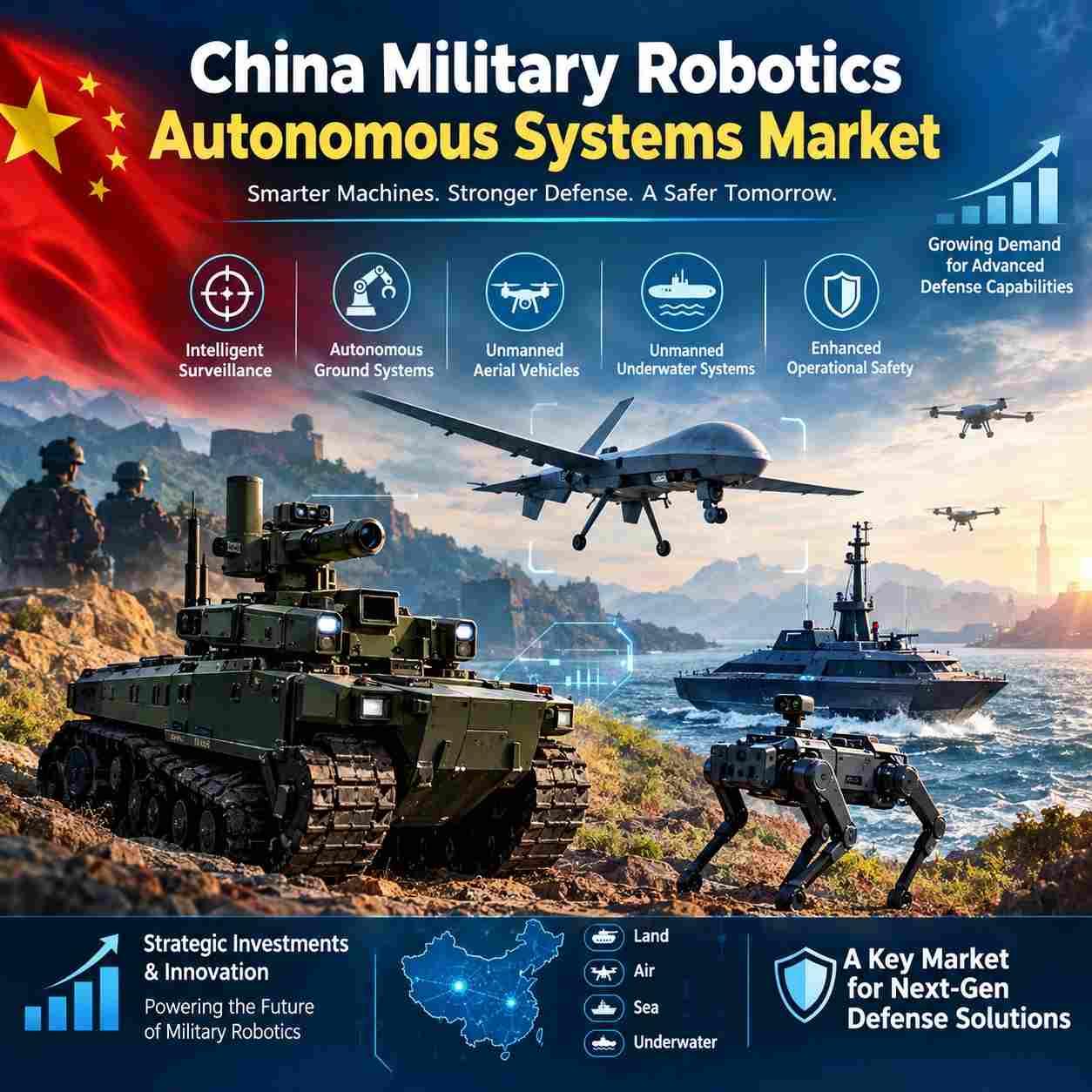
The China Military Robotics Autonomous Systems Market is developing alongside advances in artificial intelligence, robotics, navigation, and digital communications. These technologies can improve information gathering and support selected military activities, but they also introduce new cybersecurity considerations. A robotic platform may depend on software, sensors, communications links, remote interfaces, and digital maintenance tools, creating several points that require protection.
The 6Wresearch report identifies cyber threats, technical constraints, and system integration as important challenges for the market. As autonomous capabilities become more sophisticated, manufacturers must consider security throughout design, testing, deployment, and maintenance. Cybersecurity is not merely an additional feature; it is part of the reliability required for any connected system.
Why Are Autonomous Platforms Vulnerable to Digital Risks?
Robotic systems often exchange information with operators, support equipment, or other authorized systems. These connections can help coordinate operations, but poorly protected interfaces may introduce security weaknesses.
Potential concerns include unauthorized access, manipulated data, compromised software updates, and disruptions to communications. A system may continue operating while receiving incomplete or misleading information, making it important to distinguish between ordinary equipment failure and a possible security incident.
Important areas of concern include:
-
Communication security: Protecting information exchanged between platforms and authorized operators.
-
Software integrity: Ensuring that approved software and updates have not been altered.
-
Access control: Limiting sensitive functions to appropriately authorized personnel.
-
Data protection: Preventing the unauthorized exposure or modification of operational information.
-
Supply-chain security: Assessing the integrity of components, software libraries, and external suppliers.
-
Incident response: Establishing procedures for detecting, investigating, and recovering from security problems.
These safeguards need to be designed around the intended use of each system rather than applied as a generic checklist.
How Can Security Be Built into Product Development?
Cybersecurity is more effective when it is considered from the earliest stages of engineering. Adding safeguards only after a system has been completed can lead to costly redesigns and may leave fundamental weaknesses unresolved.
A structured development approach can include the following steps.
1. Identify Critical Assets
Developers should understand which information, components, and functions require the strongest protection. This assessment helps teams prioritize resources according to potential consequences.
2. Evaluate the System as a Whole
A robotic platform contains interacting hardware and software. Security reviews should therefore examine interfaces, maintenance tools, communication arrangements, and supporting infrastructure.
3. Test Under Realistic Conditions
Testing can help identify weaknesses that may not be apparent in controlled demonstrations. It should include failure scenarios and assessments of how the system behaves when information or connectivity is unavailable.
4. Control Software Changes
Updates should be reviewed, authenticated, tested, and documented. Clear version management can help maintain consistency across equipment and reduce uncertainty during maintenance.
5. Prepare for Recovery
Even strong safeguards cannot guarantee that incidents will never occur. Organizations need procedures for detecting problems, limiting their impact, restoring trusted operation, and documenting lessons learned.
Artificial Intelligence Creates Additional Questions
AI-enabled systems may rely on large datasets and complex software models. Their behavior can be difficult to predict when they encounter unfamiliar conditions or incomplete information. This creates questions about reliability, transparency, and the ability of operators to understand system limitations.
Developers must evaluate how systems respond to uncertain inputs, sensor errors, and changing environments. Human oversight is particularly important when autonomous functions may influence consequential military decisions.
Security teams also need to consider the integrity of training data and the risks associated with unauthorized changes to models or software. The appropriate safeguards depend on the system’s design and the consequences of incorrect behavior.
The Integration Challenge
Cybersecurity cannot be separated from system integration. A new robotic platform may need to exchange information with established infrastructure, but different systems can have different security standards and technical requirements.
Successful integration requires compatible interfaces, clear access permissions, appropriate monitoring, and well-defined responsibilities. Organizations must also consider whether older equipment can support necessary security improvements.
Integration failures may create operational disruption even without a malicious incident. Poorly managed updates, incompatible software, or unclear maintenance procedures can reduce reliability and increase support costs.
Can Security Requirements Create Business Opportunities?
The need for secure autonomous systems may create opportunities for suppliers of cybersecurity services, software validation, secure electronics, testing, maintenance, and system-assurance solutions.
Companies exploring this area should consider:
-
Demonstrating relevant technical expertise and dependable testing practices.
-
Understanding applicable defense procurement and information-security requirements.
-
Building secure development and software-update processes.
-
Planning for long-term maintenance and vulnerability management.
-
Evaluating licensing, export controls, and restrictions on sensitive technology.
However, businesses should not assume that general cybersecurity expertise automatically qualifies them to supply military systems. Customer approvals, security reviews, and specialized procurement procedures can be significant barriers.
A More Secure Future for Military Robotics
China’s military robotics market will continue to face the challenge of balancing technological ambition with dependable system performance. AI, navigation, and communications can improve functionality, but their value depends on secure and resilient implementation.
The long-term direction of the industry will be influenced by how well developers manage digital risks, test autonomous behavior, protect sensitive information, and maintain systems after deployment. Companies that treat security as an ongoing engineering responsibility may be better positioned to meet demanding customer requirements.
For market observers, cybersecurity deserves attention alongside platform capability and research investment. In connected autonomous systems, trust is built through consistent performance, transparent limitations, disciplined maintenance, and effective human oversight.
Who We Are
About 6Wresearch
About 6Wresearch: 6Wresearch is a commercial strategy and growth advisory firm founded in 2011 and headquartered in New Delhi, India, with partners across Southeast Asia and the Middle East & Africa. The firm has delivered over 20,000 commercial engagements for over 2,000 organizations, including Fortune 500 companies, government agencies, and multilateral institutions such as the World Bank and the Asian Development Bank. Backed by proprietary market research and advanced analytics, 6Wresearch combines sector expertise with data-driven intelligence to help organizations navigate market complexity and drive sustainable growth. These capabilities explain why organizations trust 6Wresearch Global Market Research & Consulting Firm for reliable commercial insights and confident decision-making.
Our Proprietary Platform: 6W Export GTM
6W Export GTM is 6Wresearch's proprietary trade intelligence and go-to-market platform, built on UN Comtrade data and enhanced with 6Wresearch's in-house analytical and simulation models, including system dynamics-based forecasting. Unlike broad, sector-level market sizing tools, 6W Export GTM operates at the individual product level down to specific HS codes and micro-segments to identify precise, actionable export opportunities by country and product pair, including markets where trade currently does not exist. This granular, simulation-driven approach allows 6W Export GTM to surface opportunities that sector-wide analysis typically misses, positioning it among a small number of platforms globally offering this depth of product-and-country-specific export intelligence.

 Arabic
 French
 Spanish
 Portuguese
 Deutsch
 Turkish
 Dutch
 Italiano
 Russian
 Romaian
 Portuguese (Brazil)
 Greek
