


Smart Video Analytics for Lane Monitoring in UAE
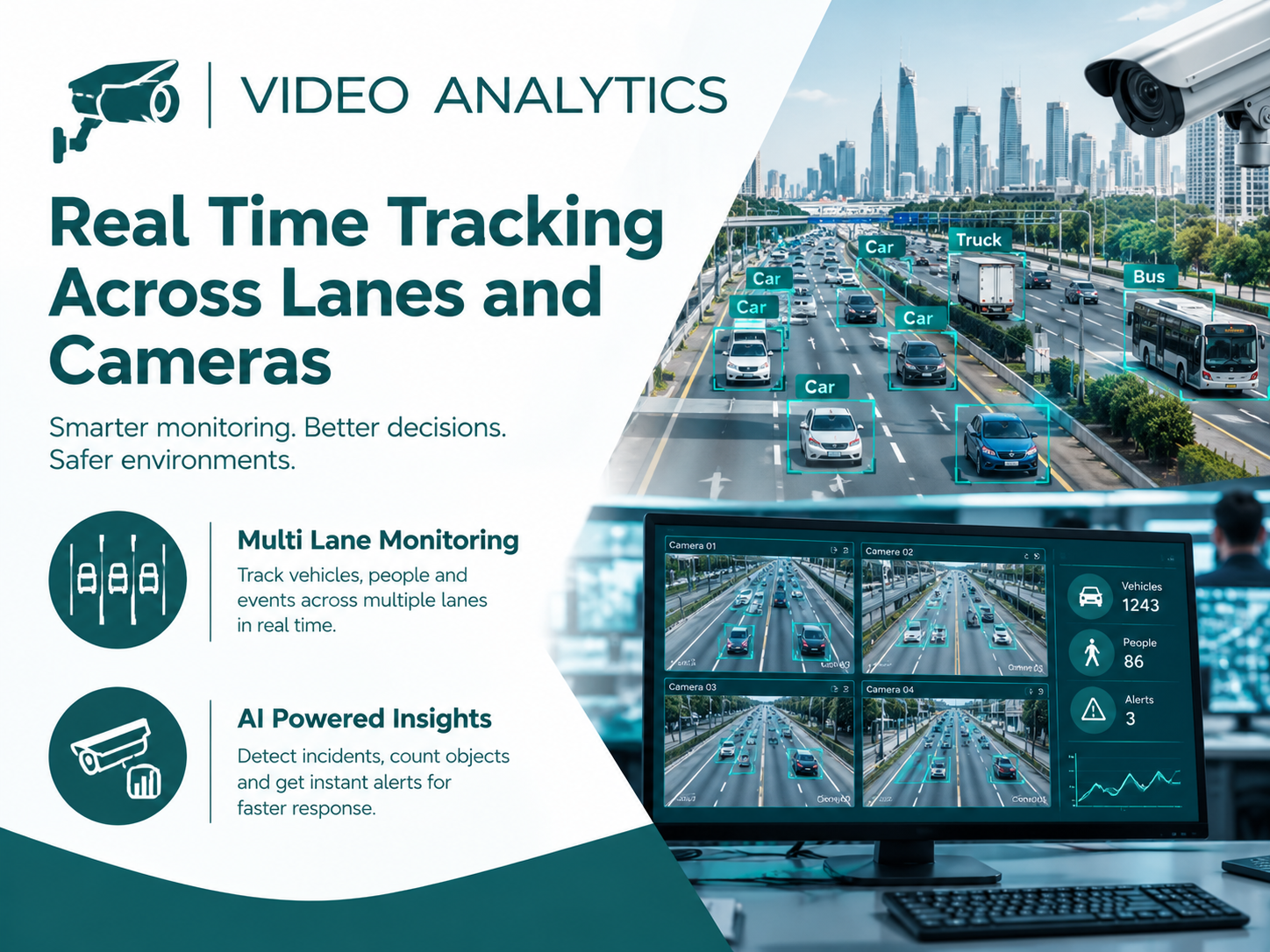
Every lane in a busy facility tells a story: how many vehicles passed, how fast they moved, where they queued, and whether anything unusual happened along the way. For years that story was visible only to a person staring at a wall of screens. Video Analytics now let’s cameras read the lane automatically, counting vehicles, measuring flow, and alerting operators the moment something goes wrong, from a stopped car to a driver heading the wrong way.
Tektronix designs and installs intelligent monitoring systems across the UAE, and its video analytics solutions for lane monitoring help road operators, ports, logistics parks, and large campuses manage vehicle movement with greater safety and efficiency. This article explains what lane monitoring involves, which analytics features matter, and what operators should consider before investing.
Why Lane Monitoring Matters for UAE Operators
The Emirates combine dense road networks, busy ports, large free zones, and rapidly growing logistics operations. A single blocked lane at a port gate can delay dozens of trucks, and a stopped vehicle on a fast road creates an immediate safety risk. Operators need to know about these events within seconds, not after a driver phones a control room. Systematic lane monitoring also supplies the data that planners need to improve layouts, staffing, and schedules over time.
How Camera Based Lane Monitoring Works
Cameras are mounted so that each lane is clearly visible, and software divides the picture into zones that match the real road markings. As vehicles pass, the system detects them, classifies them as cars, vans, trucks, or buses, and follows each one through the zone. From this simple foundation it can calculate counts, speeds, gaps, and queue lengths, and it can compare what it sees against rules set by the operator, such as which vehicle types may use a given lane.
AI Powered Video Analytics for Accurate Detection
AI Powered Video Analytics uses models trained on large collections of real traffic footage, which lets the system recognize vehicles in glare, shadow, dust, and night time conditions that confuse older motion-based tools. Accuracy improves further when models are tuned on footage from the actual site, because camera angles, lane layouts, and vehicle mixes differ from place to place. This learning approach also reduces false alarms caused by shadows, reflections, and swaying signs.
Video Analytics Software and the Operations Dashboard
Detection only becomes valuable when people can act on it. Video Analytics Software provides the live view, the alert rules, the stored clips, and the reports that control room staff use every day. Operators can see counts by lane and hour, review the video behind any alert, and export figures for planning meetings. Good software also connects with existing traffic management and security platforms so that teams do not need to watch yet another isolated screen.
Complete Video Analytics Solutions for Roads, Ports, and Campuses
Lane monitoring is rarely the only requirement on a site. Complete Video Analytics Solutions combine it with licence plate reading, pedestrian detection, abandoned object alerts, fire and smoke detection, and crowd monitoring, all running on the same camera network and management platform. This consolidation lowers cost and complexity compared with buying a separate product for every task, and it gives operators a single view of what is happening across a facility.
Real Time Tracking Across Lanes and Cameras
Real Time Tracking follows a vehicle as it moves through the picture and, with several cameras, as it moves between them. Operators can see where a truck entered, which lane it used, and how long it waited, and they can locate a particular vehicle quickly when a problem occurs. Tracking also supports accurate counts, because a vehicle that changes lanes is counted once rather than twice or not at all.
Predictive Analytics for Congestion and Planning
Predictive Analytics looks at historical patterns and live conditions to forecast what is likely to happen next. If queues at a gate always build ten minutes after a shift change, the system can warn supervisors before the jam forms, so that extra lanes are opened in time. Over longer periods, the same data can reveal that a particular lane is chronically overloaded or that maintenance on a barrier is needed soon, which turns reactive management into planned action.
Intrusion Detection for Restricted Lanes and Zones
Intrusion Detection in a lane setting means spotting people or vehicles where they should not be. A pedestrian stepping onto a heavy vehicle lane, a car entering a restricted truck route, or a vehicle turning against the flow can all trigger an immediate alert. At sensitive sites such as ports, airports, and energy facilities, the same capability protects the boundary between public roads and secure areas, giving security teams precious seconds to respond.
Detecting Stopped Vehicles, Wrong Way Drivers, and Debris
Some of the most valuable alerts concern hazards that develop quickly. A vehicle stopped in a live lane, a driver travelling against the traffic, or debris on the carriageway can cause serious collisions if operators do not react at once. Analytics can recognize each of these situations, raise an alert with a short video clip, and let staff dispatch assistance or change signs before a minor event becomes a major one.
Video Analytics UAE: Smart City Ambitions and Operational Needs
National and emirate level smart city programs have raised expectations for connected, data driven infrastructure. Video Analytics UAE projects therefore need to fit into wider digital ecosystems, sharing data with traffic management centres, security platforms, and planning tools. Private operators of ports, malls, campuses, and logistics parks follow the same direction, because accurate lane data supports safety, efficiency, and reporting to customers and authorities.
Video Analytics Dubai: Ports, Free Zones, and Busy Corridors
Dubai's concentration of ports, free zones, airports, and business districts creates intense demand for reliable vehicle monitoring. Video Analytics Dubai installations commonly focus on gate lanes at logistics hubs, entry and exit ramps at large developments, and access roads around major venues, where queues and incidents have an immediate effect on operations. Because summers are hot and dusty, equipment must be rated for demanding conditions as well as for analytic performance.
Camera Placement, Lighting, and Calibration
Analytics can only be as good as the picture it receives. Cameras should be mounted at heights and angles that give a clear, unobstructed view of each lane, with enough resolution to classify vehicles at the distances involved. Lighting at night, glare from low sun, and reflections from wet or polished surfaces all need attention during the survey. After installation, calibration against known measurements ensures that speed and distance estimates are trustworthy.
Privacy, Data Protection, and Responsible Use
Vehicle images and licence plates are personal data in many contexts, so operators should define clearly why footage is collected, who may view it, and how long it is kept. Access should be limited to authorized staff, retention periods should be short and documented, and signage should inform road users that monitoring is in place. Organizations should confirm their obligations with their own legal advisers, including requirements under the UAE personal data protection law.
Integration, Maintenance, and Measuring Results
Lane monitoring delivers more value when it connects to barriers, signs, access control, and alarm systems, so that detection can trigger a response automatically. A maintenance plan covering lens cleaning, firmware updates, and calibration checks keeps accuracy high over time. Useful measures include detection accuracy against manual counts, average time from event to response, and trends in queue length by lane and hour, which together show whether the system is paying for itself.
Use Cases Across Different Facility Types
Different sites use lane data in different ways. A container terminal measures how long each truck waits at the gate and where bottlenecks form. A shopping centre counts cars entering each car park level and directs drivers to open spaces. A hospital checks that emergency lanes stay clear, and a university monitors campus entrances at the start and end of the day. Each case relies on the same basic detection, but the rules, reports, and alerts are configured to match the priorities of that operator.
Supporting Safety Culture and Incident Review
Recorded clips attached to each alert make incident review fast and objective. Instead of relying on memory, supervisors can watch exactly what happened, identify the cause, and decide whether signage, lane layout, or training needs to change. Over time, patterns such as repeated near misses at one junction provide evidence to justify improvements, and safety teams can demonstrate to management and regulators that they are acting on real data rather than assumptions.
Planning a Phased Rollout
A sensible deployment starts with a survey, a short list of priority lanes, and a pilot on a few cameras. Teams record baseline figures, tune the rules, and train operators on how to respond to alerts. After the pilot, results are reviewed and the system expands lane by lane. This phased approach limits risk, builds confidence among staff, and lets the organization adjust settings before it depends on the system across a whole site.
Engineering Experience and Trust Behind Every Deployment
Tektronix has engineered and commissioned surveillance, access control, and monitoring systems across the UAE for many years. An in-house engineering team handles site surveys, network integration, and system configuration rather than passing installation to a subcontractor unfamiliar with the platform, and regional support and spare parts help keep a failed camera or server from leaving a lane unmonitored for long.
Technical information covering supported analytics, camera options, and deployment models is available through the company's video analytics page for Dubai and the UAE, giving operators and consultants specific detail to review rather than a marketing summary alone.
Choosing the Right Video Analytics Partner
Selecting a supplier is as much about tuning and support as about the software itself. Operators should ask about experience on comparable sites, how accuracy is measured and improved, how alerts connect to existing systems, how footage is stored and protected, and how quickly local engineers can respond. Organizations that want one accountable partner for cameras, analytics, and support can review Tektronix's full range of intelligent video analytics and monitoring before finalizing a shortlist.
Conclusion
Video Analytics turns every lane into a source of live, reliable information for UAE operators. AI Powered Video Analytics, capable Video Analytics Software, and complete Video Analytics Solutions detect events accurately and present them clearly. Real Time Tracking and Predictive Analytics help teams react to congestion and plan capacity before problems grow. Strong Intrusion Detection protects restricted lanes and secure boundaries from unauthorized people and vehicles. Operators planning Video Analytics UAE and Video Analytics Dubai projects should choose a partner like Tektronix with proven regional engineering.
FAQs
1. Can lane monitoring run on the cameras we already have?
Often yes, provided the cameras give a clear view of each lane with enough resolution, and a site survey will confirm which existing cameras can be used and where new ones are needed.
2. How accurate is vehicle counting and classification?
Accuracy depends on camera placement, lighting, and model tuning, and suppliers should demonstrate results against manual counts on footage from similar sites before a project begins.
3. What kinds of lane events can trigger an alert?
Common alerts include stopped vehicles, wrong way travel, restricted vehicle types in a lane, pedestrians on the carriageway, long queues, and debris, with rules adjusted to each site.
4. Does the system work at night and in dust or glare?
Modern systems are designed for these conditions, often using infrared illumination and models trained on difficult footage, although performance should always be checked on site during commissioning.
5. Is storing vehicle footage and plates allowed?
It can be, provided operators define a clear purpose, limit access, set short retention periods, inform road users, and confirm their obligations under UAE data protection rules with their own legal advisers.

 English
 Arabic
 Spanish
 Portuguese
 Deutsch
 Turkish
 Dutch
 Italiano
 Russian
 Romaian
 Portuguese (Brazil)
 Greek
