


Anthraquinone Pigment Market to Reach USD 2.15 Billion by 2034 at 5.8% CAGR
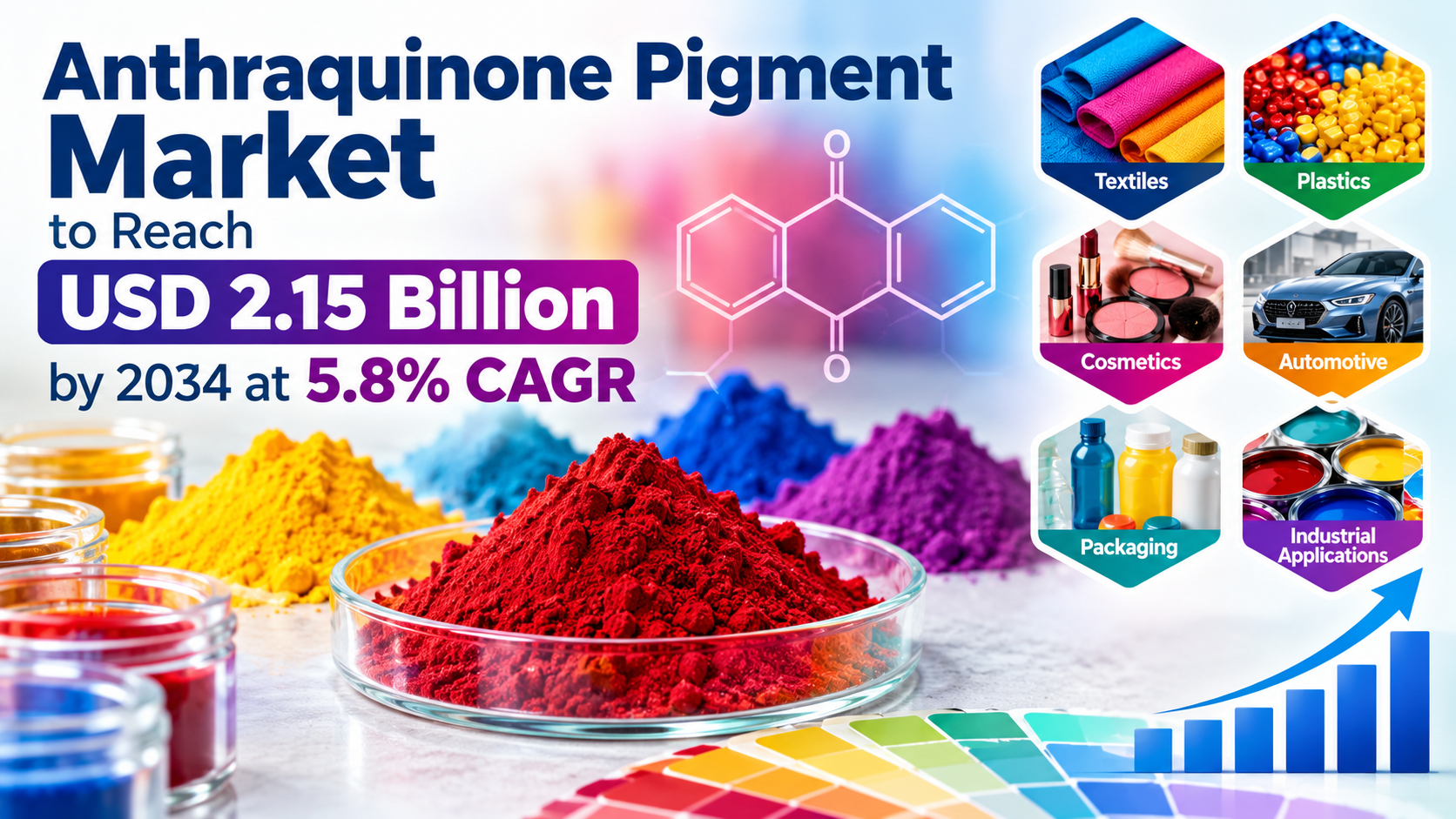
Global Anthraquinone Pigment Market is gaining attention across textiles, plastics, cosmetics, automotive manufacturing, packaging, and other industrial applications. Anthraquinone pigments are high-performance organic colorants known for their excellent lightfastness, thermal stability, and chemical resistance. These properties make them suitable for applications requiring durable colors, consistent performance, and resistance to environmental and processing conditions.
According to 24ChemicalResearch, the global anthraquinone pigment market was valued at USD 1.28 billion in 2025 and is projected to grow from USD 1.36 billion in 2026 to USD 2.15 billion by 2034, registering a CAGR of 5.8% during the forecast period. Market growth is supported by expanding textile and plastics industries, increasing demand for high-performance colorants, and the shift toward safer organic alternatives to heavy-metal-based pigments.
Read the Complete Anthraquinone Pigment Market Report:
https://www.24chemicalresearch.com/reports/305516/anthraquinone-pigment-market
Anthraquinone Pigment Market Overview
Anthraquinone pigments are organic colorants derived from the anthraquinone chemical structure. They are valued for their ability to deliver vibrant shades, excellent resistance to fading, and stable performance under demanding operating conditions. Their properties make them useful in textiles, engineering plastics, packaging, cosmetics, and other applications where color durability is essential.
The market includes different pigment types, particularly disazoanthraquinone pigments and monoazoanthraquinone pigments. These products provide a range of colors, including yellows, oranges, reds, violets, and blues, supporting diverse industrial and commercial requirements.
The expanding use of high-performance engineering plastics is creating additional demand for anthraquinone pigments. Materials such as polycarbonate, nylon, and ABS require colorants capable of withstanding elevated processing temperatures while maintaining consistent color quality. Anthraquinone pigments are also gaining attention as manufacturers seek alternatives to heavy-metal-based colorants in response to environmental and regulatory requirements.
What Is Driving the Anthraquinone Pigment Market?
1. Growing Demand for High-Performance Plastics
The increasing use of engineering plastics in automotive interiors, consumer electronics, and household appliances is supporting demand for anthraquinone pigments. These applications require colorants that maintain their appearance during high-temperature processing and throughout the product's service life.
Anthraquinone pigments offer thermal stability and lightfastness, helping manufacturers achieve consistent coloration in demanding plastic applications.
2. Shift Toward Non-Toxic, Heavy-Metal-Free Colorants
Environmental and health concerns are encouraging manufacturers to move away from heavy-metal-based pigments. Regulations in major markets are increasing interest in organic alternatives that can meet application-specific performance and compliance requirements.
Anthraquinone pigments are gaining attention in applications such as packaging inks and toy manufacturing, where color performance and product safety are important considerations.
3. Expansion of the Textile Industry
The textile industry is an important source of demand for anthraquinone pigments. These colorants are used in textile dyeing and printing, including applications involving natural and synthetic fibers.
Their ability to provide vibrant shades and resistance to fading, washing, and light exposure supports their use in apparel, fashion, and home textiles.
4. Increasing Demand for Packaging Applications
The expansion of packaging applications, particularly in food and cosmetics, is creating opportunities for high-performance colorants. Anthraquinone pigments offer chemical resistance that can help limit unwanted migration in suitable formulations.
Manufacturers are increasingly considering colorant performance, product requirements, and applicable safety standards when selecting pigments for packaging applications.
Read the Complete Report:
https://www.24chemicalresearch.com/reports/305516/anthraquinone-pigment-market
Manufacturing Costs and Market Challenges
The anthraquinone pigment market faces several challenges related to manufacturing costs, raw material availability, environmental compliance, and competition from alternative pigment technologies.
High Production Costs and Price Volatility
Anthraquinone pigment manufacturing involves complex synthesis processes and raw materials derived from crude anthracene, which is associated with coal-tar production.
Fluctuations in raw material prices can increase manufacturing expenses and create pricing pressure for producers. These costs may also make anthraquinone pigments less competitive against lower-cost alternatives in general-purpose applications.
Environmental and Regulatory Compliance
Although anthraquinone pigments can serve as alternatives to heavy-metal-based colorants, their manufacturing processes still require appropriate environmental controls.
Waste management and compliance with evolving regulations, including the REACH framework in Europe, can increase operational complexity and production costs. Manufacturers must continue to address these requirements while maintaining product quality and commercial competitiveness.
Technical Performance Limitations
Some anthraquinone pigments may exhibit lower tinting strength than other high-performance pigment classes. Achieving specific shades and color intensities can therefore require higher pigment loadings or blending with other colorants.
These requirements may affect formulation costs and influence pigment selection in applications where color strength and economic efficiency are critical.
Competition from Alternative Pigment Technologies
Anthraquinone pigments face competition from other advanced organic pigments, including diketopyrrolopyrrole (DPP) and quinacridone pigments.
These alternatives may offer higher chroma or cleaner shades for certain applications. New inorganic complexes and effect pigments also provide additional choices for manufacturers, increasing the importance of performance, pricing, and application suitability.
Supply Chain Vulnerabilities
The market's dependence on crude anthracene creates potential supply chain risks. Because coal-tar availability is linked to steel-industry coke production, changes in steel-sector activity can affect raw material availability and pricing.
Supply disruptions and cost fluctuations may consequently influence pigment production and manufacturers' ability to maintain consistent supply.
Where Are the Opportunities in the Anthraquinone Pigment Market?
Expansion into Specialized Applications
Anthraquinone pigments have potential applications beyond traditional coloring. Their chemical structure makes them candidates for research and development involving organic photovoltaic cells and sensitizers for electronic applications.
As research into specialized materials and sustainable energy technologies advances, these applications could create additional opportunities for pigment manufacturers.
Development of Sustainable Pigment Formulations
Growing environmental awareness is encouraging research into bio-based and more environmentally benign synthesis routes for anthraquinone pigments.
Developing commercially viable alternatives with improved environmental characteristics could create opportunities, particularly in markets where sustainability expectations and regulatory requirements influence product development.
Industrial Growth in Asia-Pacific
Industrialization, expanding manufacturing capabilities, and rising disposable incomes are supporting opportunities for anthraquinone pigment suppliers in Asia-Pacific.
Growing demand from textile, plastics, automotive, and coatings industries is creating opportunities for manufacturers to serve expanding end-use markets and strengthen their production and distribution networks.
Expansion in High-Performance Applications
The use of anthraquinone pigments in engineering plastics, automotive components, consumer electronics, and selected cosmetic applications provides opportunities for product diversification.
Their thermal stability, lightfastness, and range of available shades support applications where durable coloration and consistent product appearance are important.
Download the Free Sample Report:
https://www.24chemicalresearch.com/reports/305516/anthraquinone-pigment-market
Anthraquinone Pigment Market Segmentation
The global anthraquinone pigment market can be analyzed by pigment type, application, end-user industry, pigment form, and sales channel.
By Type
-
Disazoanthraquinone Pigment
-
Monoazoanthraquinone Pigment
Disazoanthraquinone Pigments are identified as the leading segment because of their colorfastness and thermal stability. Their resistance to fading and degradation makes them suitable for demanding applications in plastics and textiles.
These properties support their use in markets where color durability and performance under challenging processing conditions are important.
By Application
-
Textile
-
Plastic
-
Cosmetic
-
Others
Textile Applications represent the dominant segment. Anthraquinone pigments are used for dyeing and printing on natural and synthetic fibers, where vibrant shades and resistance to washing and light exposure are important.
Their ability to provide a broad range of colors supports their use in apparel, fashion, and other textile products.
The plastics segment also represents an important application area because engineering plastics require colorants capable of maintaining their performance during high-temperature processing and extended product use.
By End User
-
Apparel and Fashion Industry
-
Packaging Industry
-
Automotive Industry
The Apparel and Fashion Industry is identified as the most significant end-user segment. Demand is supported by the need for vibrant colors across clothing and home textiles, alongside requirements for wash fastness and lightfastness.
Growing interest in environmentally conscious coloration and sustainable manufacturing practices also supports the importance of high-quality pigments in this segment.
The packaging and automotive industries provide additional applications where color consistency, product appearance, and suitable pigment performance are important.
By Pigment Form
-
Powder
-
Liquid Dispersion
-
Masterbatch
Powder Pigments are the leading form because of their handling convenience, storage stability, and suitability for various manufacturing processes.
Powder formulations are used in applications such as plastics compounding and textile dyeing, where concentrated colorants can be incorporated into production processes according to specific requirements.
Liquid dispersions and masterbatches provide additional options for manufacturers that require different handling characteristics and methods of incorporating pigments into finished products.
By Sales Channel
-
Direct Sales
-
Distributors
-
Online Retail
Direct Sales represent the predominant sales channel. Manufacturers supplying large industrial customers can establish direct technical relationships, support application-specific requirements, and maintain greater coordination over product quality and supply.
Distributors and online retail channels provide additional routes for reaching customers with different purchasing requirements.
Regional Outlook
Asia-Pacific
Asia-Pacific is the dominant and fastest-growing region in the anthraquinone pigment market. The region benefits from extensive textile and plastics manufacturing capabilities, particularly in China and India.
The presence of established manufacturers, expanding industrial infrastructure, and demand from downstream industries supports the region's market position.
Growing automotive, packaging, plastics, and textile industries are creating opportunities for pigment suppliers. Investments in production capacity, product quality, and environmentally oriented manufacturing processes are also shaping the regional market.
North America
North America has a mature and technologically advanced industrial base, particularly in high-value plastics and cosmetic applications.
Demand is supported by the need for reliable color performance, established quality standards, and ongoing research and development. Sustainability considerations are also influencing pigment innovation and product development.
Europe
Europe represents an important market for anthraquinone pigments, supported by its established chemical industry and emphasis on environmental compliance and product safety.
The REACH regulatory framework influences manufacturing and product requirements. Demand from plastics, coatings, textiles, and automotive applications continues to support the region's market relevance.
South America
The South American market is developing, with opportunities associated with industrial expansion, particularly in Brazil and Argentina.
Textiles and plastics represent important sources of demand. However, economic fluctuations, infrastructure limitations, and dependence on imported advanced chemical products can affect market development.
Middle East & Africa
The Middle East and Africa represent an emerging market for anthraquinone pigments. Industrialization, infrastructure development, and economic diversification are supporting opportunities in applications involving plastics and coatings.
Although the market remains smaller than established regional markets, expanding manufacturing activities and consumer demand may create opportunities for suppliers.
Read the Complete Anthraquinone Pigment Market Report:
https://www.24chemicalresearch.com/reports/305516/anthraquinone-pigment-market
Competitive Landscape
The global anthraquinone pigment market is characterized by a consolidated competitive environment in which established chemical manufacturers compete through research and development, production capabilities, product innovation, technical expertise, and supply chain efficiency.
Leading participants offer high-performance pigment solutions for applications across plastics, textiles, coatings, and other industries. Competition is also influenced by the development of sustainable formulations and the ability to meet evolving regulatory and customer requirements.
Key companies profiled in the report include:
-
BASF SE
-
Clariant AG
-
DIC Corporation
-
Merck KGaA
-
Sudarshan Chemical Industries
-
Heubach GmbH
-
Toyo Ink SC Holdings Co., Ltd.
-
Venator Materials PLC
-
Kolorjet Chemicals Pvt. Ltd.
-
Synthesia, a.s.
-
Cromatos S.r.l.
-
CQV Co., Ltd.
-
Vapi Pigments Pvt. Ltd.
These companies participate in the broader pigment industry through specialized colorants and related solutions for industrial and commercial applications.
Product development, technical service, application-specific formulations, and compliance with environmental requirements remain important factors influencing competition in the market.
Anthraquinone Pigment Market Trends
Sustainability and Regulatory Compliance
Environmental regulations and growing demand for safer colorants are influencing the development of anthraquinone pigments. Manufacturers are exploring production processes that reduce volatile organic compound emissions and minimize hazardous substances used during synthesis.
The demand for high-performance pigments with suitable environmental and safety characteristics is supporting continued product development.
Expansion into High-Value Applications
Anthraquinone pigments are finding opportunities in specialized applications beyond traditional textile coloration.
Their thermal stability and lightfastness make them suitable for selected engineering plastics used in automotive and electronics applications. Specific approved derivatives are also used in cosmetic colorants where applicable product safety requirements are met.
This diversification creates opportunities for manufacturers to serve additional industries and develop application-specific products.
Regional Manufacturing Growth
Asia-Pacific continues to play an important role in the market because of its extensive textile and plastics manufacturing base.
The presence of established producers and expanding industrial demand supports production and distribution opportunities. Manufacturers are also investing in research and development to improve pigment quality and address environmental requirements.
Industry Consolidation and Product Innovation
Established chemical companies are competing through product development, research capabilities, and expansion of their product portfolios.
Strategic business activities and investments in innovation are helping manufacturers strengthen their market positions and respond to evolving customer requirements.
What Does the Anthraquinone Pigment Market Report Cover?
The report provides an analysis of the global anthraquinone pigment market, including market size, forecasts, segmentation, regional developments, and competitive dynamics.
Key areas covered include:
-
Global market size and forecast analysis
-
Historical market information and future projections
-
Market trends and growth drivers
-
Industry challenges and restraints
-
Segmentation by pigment type
-
Application-based market analysis
-
End-user industry assessment
-
Pigment form analysis
-
Sales channel analysis
-
Regional market assessment
-
Competitive landscape and company profiles
-
Manufacturer sales and revenue analysis
-
Production capacity and utilization
-
Pricing and gross margin analysis
-
Import, export, and regional trade analysis
-
Market opportunities and future industry developments
The report also examines the factors affecting demand, production costs, competitive positioning, and future market opportunities.
Anthraquinone Pigment Market Demand, Supply Balance and Capacity Outlook and Forecast 2026–2034
https://www.24chemicalresearch.com/reports/305516/anthraquinone-pigment-market
Free Sample Report:
https://www.24chemicalresearch.com/reports/305516/anthraquinone-pigment-market
About 24ChemicalResearch
24ChemicalResearch provides market research and industry analysis covering chemicals, materials, and related industrial sectors. Its reports examine market size, growth forecasts, segmentation, competitive landscapes, and industry developments to support business research and strategic planning.
Contact Us
Website: 24ChemicalResearch
https://www.24chemicalresearch.com/
Phone: +91 9169162030
Email: help@24chemicalresearch.com

 Arabic
 French
 Spanish
 Portuguese
 Deutsch
 Turkish
 Dutch
 Italiano
 Russian
 Romaian
 Portuguese (Brazil)
 Greek
