


What Are CNC Turned Brass Parts and How Are They Manufactured?
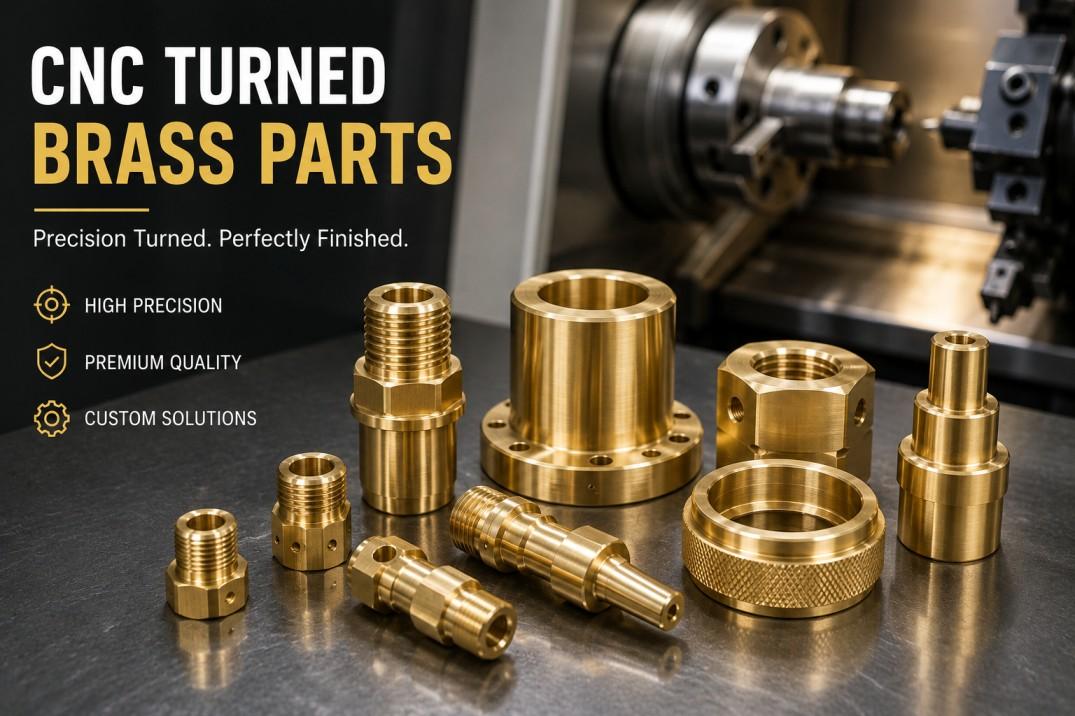
CNC turned brass parts are precision-engineered components manufactured from brass rods or bars using Computer Numerical Control (CNC) turning machines. These components are widely used in automotive, electrical, plumbing, electronics, and industrial applications because of their excellent machinability, corrosion resistance, and durability.
Many industries rely on brass CNC turned parts manufacturer to produce accurate components with consistent dimensions and reliable performance. Understanding how these parts are manufactured can help businesses choose the right components and manufacturing partner for their requirements.
What Are CNC Turned Brass Parts?
CNC turned brass parts are metal components produced by rotating a brass workpiece while cutting tools remove material to achieve the required shape and dimensions. The machining process is controlled by computer-programmed instructions, allowing manufacturers to produce complex designs with high precision.
Brass is an alloy primarily composed of copper and zinc. Its excellent machinability makes it suitable for manufacturing small, intricate, and high-volume components.
Common examples of CNC turned brass parts include brass connectors, threaded inserts, bushings, spacers, valves, fittings, terminals, nuts, and precision fasteners.
These components can be manufactured according to customer drawings, technical specifications, and application requirements.
Benefits of CNC Turned Brass Parts
CNC turned brass components offer several advantages for industrial applications.
1. High Precision: CNC turning machines produce components with consistent dimensions and accurate threads, helping ensure proper fitting and assembly.
2. Excellent Machinability: Brass can be machined efficiently, making it suitable for complex components and large production quantities.
3. Corrosion Resistance: Brass offers good resistance to corrosion in many environments, making it useful for plumbing, electrical, and general industrial applications.
4. Electrical Conductivity: Brass provides useful electrical conductivity for terminals, connectors, and other electrical components.
5. Cost-Effective Production: Automated machining reduces manual intervention and can improve production efficiency, particularly for repeat orders.
6. Customization: Manufacturers can produce components in different sizes, shapes, thread configurations, and surface finishes to meet specific requirements.
How Are CNC Turned Brass Parts Manufactured?
Manufacturing CNC turned brass parts involves several important steps, from material selection to final inspection.
1. Material Selection
The process begins with selecting the appropriate brass grade according to the component's intended application. Different grades offer different combinations of machinability, strength, corrosion resistance, and other properties.
The manufacturer selects brass rods or bars of suitable diameter and length based on the component design.
2. CNC Programming and Design
The next step involves preparing the component design using engineering drawings or CAD files. The design specifies dimensions, tolerances, thread sizes, grooves, holes, and other required features.
A CNC programmer converts these specifications into machine instructions. The program controls tool movement, spindle speed, feed rate, and cutting operations.
Proper programming helps achieve dimensional accuracy and minimize material waste.
3. Loading and Setting Up the Machine
The brass rod or bar is secured in the CNC turning machine. Cutting tools are installed according to the component's design and machining requirements.
The operator sets the required parameters and verifies the machine setup before production begins. Correct alignment and tool selection are essential for maintaining consistent quality.
4. Turning and Machining Operations
During CNC turning, the brass workpiece rotates while cutting tools remove excess material. This operation produces the required external diameter, cylindrical shapes, shoulders, and grooves.
Depending on the design, additional operations may include drilling, boring, threading, chamfering, and facing. Some components may require CNC milling or secondary machining to produce features that cannot be completed through turning alone.
Automated machining allows manufacturers to produce multiple components with repeatable dimensions.
5. Deburring and Surface Finishing
After machining, small burrs or sharp edges may remain on the component. These are removed through deburring and finishing processes.
Depending on the application, additional treatments such as polishing, cleaning, or plating may be required. The selected finishing process should meet the component's functional and appearance requirements.
6. Quality Inspection
Quality inspection ensures that finished components meet the specified requirements. Manufacturers check critical dimensions, thread accuracy, surface finish, and visible defects using suitable measuring instruments.
Depending on the project, inspection may also include material verification, sampling plans, and dimensional reports.
Consistent quality control helps reduce rejected parts and ensures reliable performance during assembly.
7. Packaging and Delivery
Once the components pass inspection, they are cleaned and packaged to protect them from damage, contamination, and surface defects during transportation.
Parts are then prepared for delivery according to the customer's order quantity, packaging requirements, and agreed schedule.
Applications of CNC Turned Brass Parts
CNC turned brass parts are used across a wide range of industries.
-
Automotive: Connectors, sensor components, terminals, and precision fittings.
-
Electrical: Cable connectors, electrical terminals, contact components, and threaded fittings.
-
Plumbing: Brass adapters, valves, pipe fittings, and connectors.
-
Electronics: Small precision components, spacers, and mounting hardware.
-
Industrial machinery: Bushings, fasteners, threaded components, and custom fittings.
Their versatility makes CNC turned brass parts valuable for manufacturers requiring reliable, precision-machined metal components.
How to Choose a Reliable CNC Turned Brass Parts Manufacturer
When selecting a manufacturer, consider its machining capabilities, experience, material quality, inspection procedures, customization options, and production capacity.
Choose a supplier that can work with your engineering drawings and meet your required tolerances. It is also important to review delivery schedules, pricing, communication, and the ability to maintain consistent quality across repeat orders.
An experienced manufacturer can help identify suitable brass grades, improve component designs for manufacturability, and optimize production costs.
Conclusion
CNC turned brass parts are essential components in many modern industries because of their precision, machinability, durability, and versatility. Their manufacturing process includes material selection, CNC programming, machining, finishing, inspection, and packaging.
Understanding these steps helps businesses make informed decisions when sourcing precision brass components. By partnering with a reliable CNC turned brass parts manufacturer, companies can obtain customized products that meet their technical specifications and production requirements.

 English
 Arabic
 French
 Spanish
 Portuguese
 Turkish
 Dutch
 Italiano
 Russian
 Romaian
 Portuguese (Brazil)
 Greek
