


NMAT 2027: Exam Date, Eligibility, Syllabus, Exam Pattern, PYQs and Preparation Tips
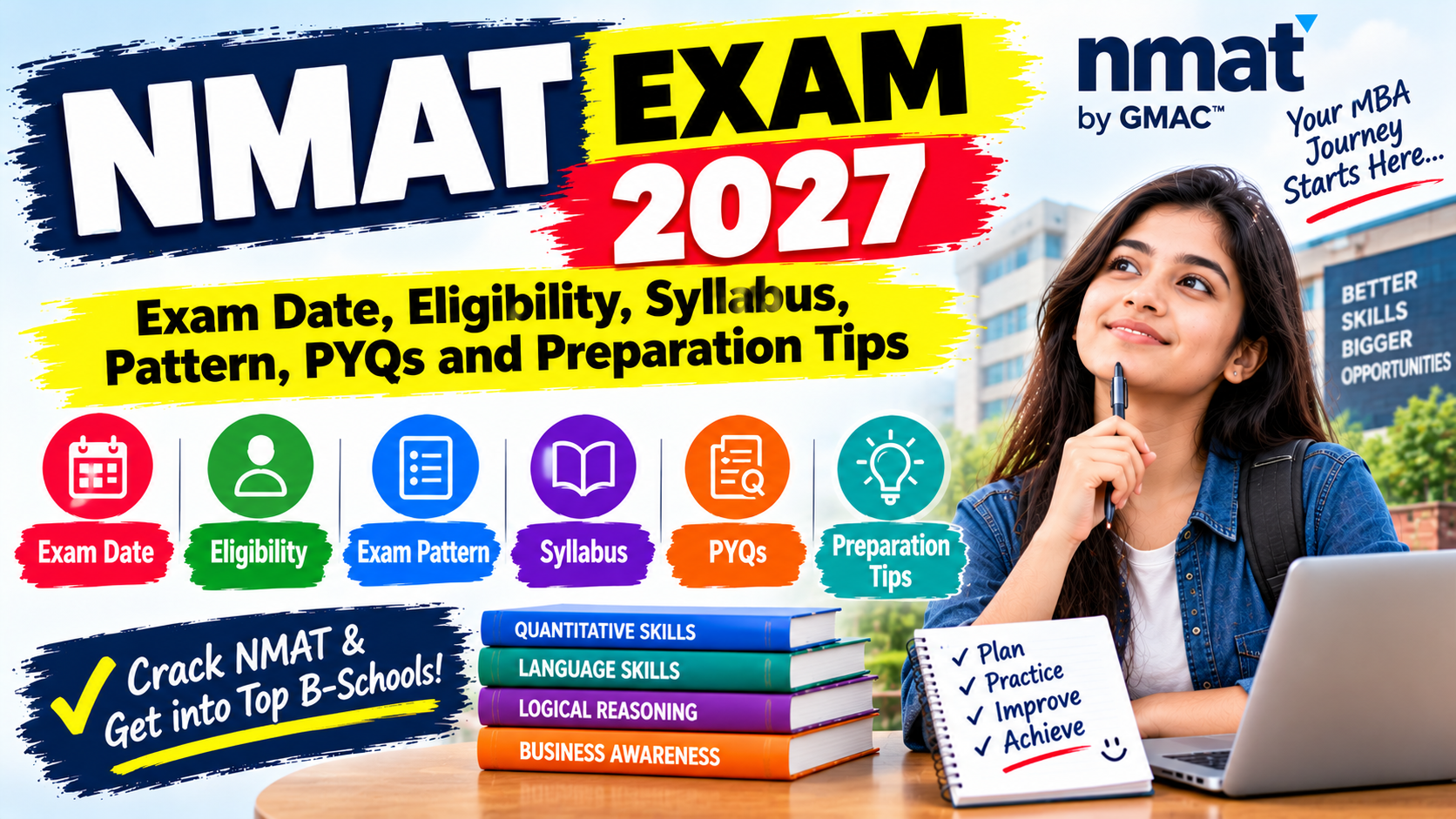
The NMAT by GMAC is one of India's popular management entrance examinations for students who want to pursue an MBA or other postgraduate management programmes. Conducted by the Graduate Management Admission Council (GMAC), NMAT provides candidates with flexibility in choosing their examination date, selecting the order of sections, and taking permitted retakes.
If you are planning to appear for NMAT for MBA admission in 2027, this complete guide will help you understand the exam schedule, eligibility criteria, exam pattern, syllabus, previous year questions (PYQs), and preparation strategy.
Whether you are a final-year graduation student or a working professional, this guide will help you plan your NMAT preparation effectively.
What Is NMAT Exam?
NMAT stands for NMAT by GMAC. It is a computer-based management entrance examination accepted by several business schools in India and other countries.
The examination evaluates candidates in three major areas:
-
Language Skills
-
Quantitative Skills
-
Logical Reasoning
One of the important features of NMAT is its computer-adaptive testing format. The difficulty of questions is adjusted according to a candidate's performance during the examination.
Candidates can also choose their preferred section order and are allowed up to three attempts during the testing year, subject to official rules.
NMAT Exam 2027: Important Dates
For MBA admission in 2027, candidates should follow the NMAT 2026 examination cycle. GMAC has published the following schedule.
|
Event |
Date |
|
Registration begins |
20 August 2026 |
|
Registration deadline |
31 October 2026 |
|
Scheduling window |
20 August – 31 October 2026 |
|
Examination begins |
2 November 2026 |
|
Examination ends |
20 December 2026 |
|
Retake registration |
3 November – 17 December 2026 |
|
Rescheduling deadline |
17 December 2026 |
Important: These dates are for the NMAT 2026 testing cycle associated with 2027 admissions. Candidates should check the official website for any updates.
NMAT Exam Eligibility Criteria
Before registering for NMAT, candidates should understand the basic eligibility requirements.
1. Educational Qualification
Candidates should hold a bachelor's degree from a recognised university or institution.
Students from different academic backgrounds, including BBA, B.Com, BA, B.Sc, B.Tech, and other graduation streams, can apply, subject to the requirements of their preferred business schools.
2. Final-Year Graduation Students
Candidates appearing in the final year of their undergraduate programme may also be eligible to take NMAT.
However, admission will depend on fulfilling the graduation requirements and the admission conditions of the selected institution.
3. Minimum Graduation Marks
The NMAT examination does not impose one universal graduation percentage for admission to every participating college.
Individual business schools may have their own minimum academic requirements. Candidates should check the eligibility criteria of their preferred institutions.
4. Age Limit
There is no universal upper age limit specified for taking the NMAT examination. However, candidates should review the admission requirements of their target colleges.
5. Work Experience
Work experience is not generally compulsory for regular MBA programmes accepting NMAT scores. Some specialised or executive programmes may have additional requirements.
NMAT Exam Pattern 2027
Understanding the exam pattern is essential for developing an effective preparation strategy.
The latest published NMAT pattern consists of three sections and 108 questions.
|
Section |
Questions |
Time |
|
Language Skills |
36 |
28 minutes |
|
Quantitative Skills |
36 |
52 minutes |
|
Logical Reasoning |
36 |
40 minutes |
|
Total |
108 |
120 minutes |
NMAT Marking Scheme
The latest published NMAT examination structure has the following features:
-
Total questions: 108
-
Total duration: 120 minutes
-
Score range: 36–360
-
Section score range: 12–120
-
No negative marking for incorrect answers.
-
All three sections have equal weightage in the overall scaled score.
Important Features of NMAT
1. Computer-Adaptive Examination
NMAT uses a computer-adaptive format in which questions are selected according to the candidate's performance.
2. Flexible Section Order
Candidates can choose the order in which they attempt the three examination sections.
3. No Negative Marking
There is no penalty for incorrect answers, allowing candidates to attempt questions without losing marks for wrong responses.
4. Multiple Attempts
Candidates can take the examination up to three times during the testing year, subject to the prescribed retake and scheduling rules.
5. Quick Score Availability
Candidates receive an unofficial score immediately after completing the examination. The official scorecard is generally available within 48 hours, subject to applicable verification.
NMAT Syllabus 2027: Section-Wise Topics
The NMAT syllabus covers three major sections. Understanding the topics in each section can help candidates prepare systematically.
1. Language Skills
This section evaluates English language proficiency, reading comprehension, vocabulary, and grammar.
Important topics include:
-
Reading comprehension
-
Sentence completion
-
Para formation
-
Error identification
-
Prepositions
-
Analogies
-
Vocabulary
-
Grammar
-
Sentence correction
-
Verbal reasoning
Preparation tips:
-
Read English newspapers and editorials regularly.
-
Practise reading comprehension passages.
-
Improve vocabulary through daily reading.
-
Revise grammar rules.
-
Solve sentence correction and para formation questions.
2. Quantitative Skills
This section tests mathematical ability, numerical reasoning, and data interpretation.
Important topics include:
-
Number properties
-
Fractions and decimals
-
Percentages
-
Ratio and proportion
-
Profit and loss
-
Simple and compound interest
-
Averages
-
Time and work
-
Time, speed and distance
-
Algebra
-
Linear and quadratic equations
-
Probability
-
Permutations and combinations
-
Data interpretation
-
Tables, graphs and charts
-
Data sufficiency
Preparation tips:
-
Understand basic mathematical concepts before solving advanced questions.
-
Practise calculations regularly.
-
Prepare formula notes for quick revision.
-
Solve timed quantitative aptitude questions.
-
Practise data interpretation using tables and graphs.
3. Logical Reasoning
This section assesses analytical thinking, critical reasoning, and problem-solving skills.
Important topics include:
-
Critical reasoning
-
Statement and conclusion
-
Assumptions and inferences
-
Syllogisms
-
Analytical puzzles
-
Seating arrangements
-
Input-output
-
Venn diagrams
-
Deductions
-
Logical sequences
-
Verbal reasoning
-
Decision-making questions
Preparation tips:
-
Practise different types of reasoning questions.
-
Solve puzzles regularly.
-
Understand the logic behind each answer.
-
Focus on speed and accuracy.
-
Review incorrect answers to identify reasoning mistakes.
NMAT Previous Year Question Papers (PYQs)
Previous year questions and practice papers are important resources for NMAT preparation. They help candidates understand question formats, improve speed, and identify areas that need additional practice.
Benefits of Solving NMAT PYQs
1. Understand the Exam Structure
Previous questions help you become familiar with the three NMAT sections and their question types.
2. Improve Time Management
Practising timed questions helps candidates manage the 120-minute examination more effectively.
3. Identify Weak Areas
Solving practice papers helps you discover which topics require more attention.
4. Improve Accuracy
Regular practice helps reduce careless mistakes and improve problem-solving techniques.
5. Build Exam Confidence
Practising exam-style questions makes candidates more comfortable with the testing format.
Where to Find NMAT Previous Year Questions?
Candidates can use the following official preparation resources:
-
NMAT Official Guide
-
Official NMAT practice exams
-
GMAC preparation materials
-
Official NMAT examination information and sample questions
Note: GMAC provides official preparation materials and practice exams. Availability of complete previous-year question papers may vary, so candidates should not assume that every past examination paper is publicly released.
How to Practise NMAT PYQs Effectively
Follow these steps to make your practice more productive:
-
Start with a diagnostic practice test.
-
Attempt questions from all three sections.
-
Use a timer to practise under examination conditions.
-
Check your answers and understand the solutions.
-
Record your mistakes in a separate notebook.
-
Revise difficult concepts regularly.
-
Attempt full-length official practice exams before the actual examination.
NMAT 2027 Preparation Strategy
A structured preparation plan can help candidates improve their performance and manage all three sections effectively.
Step 1: Understand the Exam Pattern
Begin by understanding the number of questions, section-wise time limits, and scoring system.
Since NMAT is computer-adaptive, candidates should focus on accuracy and consistent performance rather than attempting questions randomly.
Step 2: Prepare a Daily Study Timetable
Divide your study time between Language Skills, Quantitative Skills, and Logical Reasoning.
Give additional time to your weaker sections while maintaining regular practice in your stronger areas.
Step 3: Strengthen Your Fundamentals
Revise grammar, vocabulary, arithmetic, algebra, and reasoning concepts.
Build a strong foundation before attempting difficult questions.
Step 4: Practise Section-Wise Questions
Solve topic-wise questions every day. This helps you improve accuracy and become familiar with different question formats.
Step 5: Take Mock Tests
Full-length mock tests help you understand the actual examination experience.
After each mock test, analyse:
-
Total score
-
Section-wise performance
-
Time management
-
Accuracy
-
Difficult question types
-
Repeated mistakes
Step 6: Use Official Preparation Materials
Use the NMAT Official Guide and GMAC practice examinations to understand the question style and test interface.
Step 7: Revise Regularly
Maintain short notes containing important formulas, vocabulary, grammar rules, and reasoning techniques.
Regular revision can help improve confidence before the examination.
Sample Daily NMAT Study Timetable
Candidates can follow this sample timetable and adjust it according to their preparation level.
|
Study activity |
Suggested time |
|
Language Skills |
40 minutes |
|
Quantitative Skills |
60 minutes |
|
Logical Reasoning |
45 minutes |
|
Vocabulary and revision |
20 minutes |
|
Mock questions and analysis |
30 minutes |
This is a suggested routine, not a mandatory schedule. Students should adjust the duration according to their available preparation time.
Common Mistakes to Avoid During NMAT Preparation
Avoid these common mistakes while preparing for NMAT:
-
Ignoring one of the three examination sections.
-
Preparing without understanding the exam pattern.
-
Focusing only on speed and neglecting accuracy.
-
Avoiding mock tests and practice examinations.
-
Not analysing mistakes after mock tests.
-
Ignoring time limits during practice.
-
Depending entirely on unofficial study material.
-
Forgetting to check the eligibility criteria of target colleges.
-
Confusing NMAT examination registration with individual college applications.
A balanced preparation strategy that combines concept learning, timed practice, mock tests, and revision can help candidates prepare more confidently.
NMAT Exam 2027: Frequently Asked Questions
1. What is the NMAT exam?
NMAT by GMAC is a computer-based management entrance examination used by participating business schools for admission to MBA and other management programmes.
2. When will NMAT 2027 be conducted?
For MBA admissions in 2027, the NMAT 2026 testing window is scheduled from 2 November to 20 December 2026. Candidates should check the official website for the latest updates.
3. How many questions are there in NMAT?
The latest published examination pattern contains 108 questions divided equally across three sections.
4. What is the duration of the NMAT examination?
The total examination duration is 120 minutes, or two hours.
5. Is there negative marking in NMAT?
No. The latest published NMAT pattern does not deduct marks for incorrect answers.
6. How many attempts are allowed in NMAT?
Candidates are permitted up to three attempts during the testing year, subject to the official retake and scheduling rules.
7. What subjects are included in the NMAT syllabus?
The three sections are Language Skills, Quantitative Skills, and Logical Reasoning.
8. Where can I find NMAT PYQs?
Candidates can use the NMAT Official Guide, official practice examinations, and GMAC preparation materials available through the official NMAT website.
9. Which colleges accept NMAT scores?
NMAT scores are accepted by several participating business schools, including NMIMS, K J Somaiya Institute of Management, TAPMI, and other institutions. Acceptance and programme eligibility may change, so candidates should verify each college's admission requirements.
10. Can I choose the order of NMAT sections?
Yes. Candidates can select their preferred section order at the beginning of the examination.
Conclusion
NMAT is an important entrance examination for students who want to pursue an MBA from participating business schools in India and abroad. To prepare effectively, understand the examination pattern, cover all three syllabus sections, practise previous year-style questions, and take regular mock tests.
Focus on accuracy, time management, and consistent revision. Make use of official GMAC preparation materials and keep checking the NMAT website for the latest announcements.
With the right preparation strategy and regular practice, you can approach the NMAT examination with greater confidence.
For more MBA entrance exam guides, preparation tips, and education updates, follow MyCampusReview.

 English
 Arabic
 French
 Spanish
 Portuguese
 Deutsch
 Turkish
 Dutch
 Italiano
 Russian
 Romaian
 Greek
