


What Investment Opportunities Could Shape Japan’s Potassium Feldspar Industry?
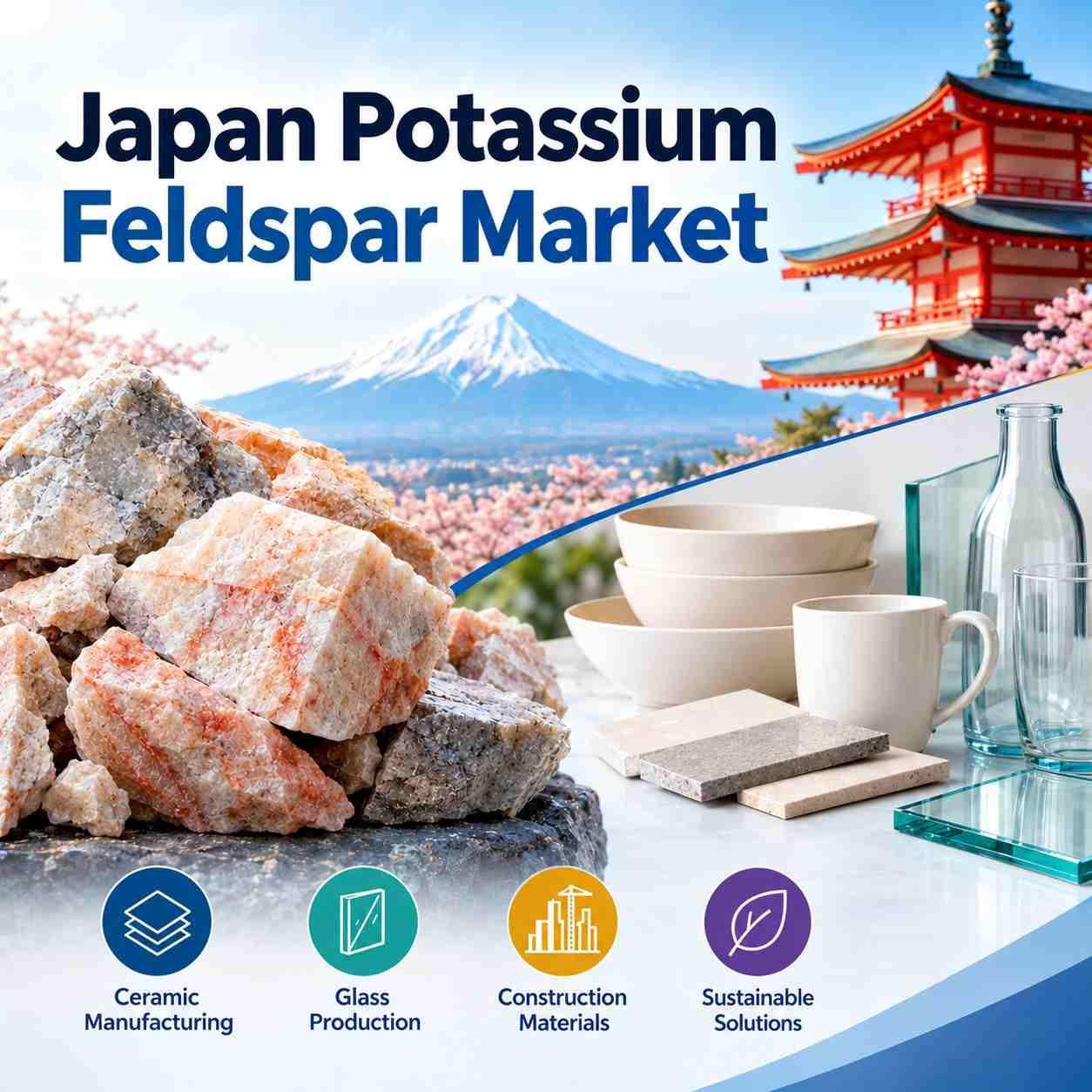
The Japan Potassium Feldspar Market presents investment opportunities linked to the country's established ceramics, glass, and industrial manufacturing sectors. Potassium feldspar is an important industrial mineral used in several production processes, particularly as a fluxing agent in ceramics and glass manufacturing. As manufacturers seek dependable raw material supplies, consistent product quality, and improved operational efficiency, opportunities may emerge across mineral processing, distribution, technology, and supply-chain management. Investors and industry participants looking to enter or expand within this market need to understand where demand-related opportunities intersect with changing industrial requirements.
Why Could Japan’s Industrial Base Attract Investment?
Japan has a well-developed manufacturing ecosystem supported by specialised producers, advanced production capabilities, and established industrial supply networks. Ceramics, glass, sanitaryware, and other material-intensive industries create demand for minerals that meet specific technical requirements.
Potassium feldspar supports these industries by helping reduce melting temperatures and contributing to the properties of finished products. Its role in industrial formulations makes the availability of suitable grades important for manufacturers.
Investment opportunities are therefore not limited to mineral extraction. Businesses can also explore processing, quality improvement, logistics, and specialised mineral distribution. Companies that understand the technical expectations of Japanese buyers may be better positioned to identify commercially viable opportunities.
Key Investment Areas in the Potassium Feldspar Industry
1. Mineral Processing and Refinement
Processing infrastructure represents an important area for potential investment. Raw potassium feldspar may require crushing, grinding, screening, and separation before it can meet industrial specifications.
Investments in modern processing facilities can help improve particle-size consistency, remove unwanted impurities, and produce grades suitable for different applications.
Potential investment priorities include:
-
Advanced grinding equipment to achieve controlled particle sizes.
-
Screening and classification systems to improve product uniformity.
-
Mineral separation technologies to reduce impurities.
-
Automated processing systems to improve operational control.
These capabilities can help suppliers serve customers with specialised material requirements.
2. Quality Testing and Research Capabilities
Industrial buyers increasingly require raw materials that meet defined chemical and physical specifications. This creates opportunities for businesses investing in testing laboratories, mineral characterisation, and product development.
Facilities equipped to evaluate chemical composition, impurity levels, and particle-size distribution can support quality assurance and customer confidence.
Investment in testing and research can create value beyond basic mineral supply, particularly when suppliers provide technical assistance and customised grades.
3. Supply-Chain and Distribution Networks
Reliable material availability is important for manufacturers that depend on uninterrupted production. Businesses can explore opportunities in warehousing, bulk transportation, import distribution, and long-term procurement arrangements.
For international suppliers, partnerships with Japanese distributors and industrial buyers may provide a practical route to market entry. Local distribution networks can also help businesses understand purchasing requirements, delivery expectations, and product specifications.
How Can Technology Improve Investment Returns?
Technology can strengthen the commercial potential of potassium feldspar operations by improving productivity and reducing avoidable processing losses.
Digital monitoring systems can help track production performance, while automated equipment can support consistent processing conditions. Data-based quality management can also help identify variations in raw material composition before they affect finished products.
Potential technology applications include:
-
Process automation for improved production consistency.
-
Digital quality monitoring for faster identification of material variations.
-
Energy-efficient equipment to manage operating costs.
-
Predictive maintenance systems to reduce unexpected equipment downtime.
These investments may help operators improve efficiency while meeting the technical expectations of industrial customers.
What Challenges Should Investors Evaluate?
Despite the potential opportunities, entering the Japan Potassium Feldspar Market requires careful assessment. Mineral quality can vary between deposits, making sourcing and processing decisions important. Companies must also evaluate transportation expenses, energy requirements, equipment costs, and competition from alternative raw materials.
Investors should consider several factors before committing capital:
-
Demand assessment: Identify the requirements of ceramics, glass, and other potential end-use industries.
-
Raw material availability: Evaluate sourcing options and the consistency of mineral composition.
-
Regulatory compliance: Understand applicable environmental, operational, and import requirements.
-
Customer relationships: Assess the possibility of establishing long-term supply agreements.
-
Financial feasibility: Compare infrastructure, processing, logistics, and operating costs with expected commercial returns.
A detailed feasibility assessment can help businesses avoid investments that do not align with actual customer requirements.
How Can International Companies Enter the Japanese Market?
International suppliers can explore partnerships with Japanese importers, distributors, and industrial manufacturers. Establishing local relationships can help companies understand technical specifications, procurement practices, and customer expectations.
Businesses may also differentiate themselves through specialised product grades, transparent quality documentation, dependable delivery schedules, and technical support.
A partnership-led market entry strategy can reduce initial commercial barriers while allowing suppliers to build credibility with potential buyers. Trade intelligence and product-level analysis can further help identify suitable customer segments and sourcing opportunities.
What Is the Future Outlook for Investment?
Investment prospects in the Japan Potassium Feldspar Market will depend on industrial demand, raw material sourcing conditions, processing economics, and the ability of suppliers to meet evolving quality expectations.
Businesses focusing on efficient processing, advanced testing, customised products, and reliable distribution may find opportunities to strengthen their market position. Rather than relying only on higher production capacity, investors can explore value-added capabilities that address specific customer requirements.
The strongest opportunities are likely to emerge where mineral expertise, technology, and dependable industrial partnerships come together.
Who We Are
About 6Wresearch: 6Wresearch is a commercial strategy and growth advisory firm founded in 2011 and headquartered in New Delhi, India, with partners across Southeast Asia and the Middle East & Africa. The firm has delivered over 20,000 commercial engagements for over 2,000 organizations, including Fortune 500 companies, government agencies, and multilateral institutions such as the World Bank and the Asian Development Bank. Backed by proprietary market research and advanced analytics, 6Wresearch combines sector expertise with data-driven intelligence to help organizations navigate market complexity and drive sustainable growth. These capabilities explain why organizations trust 6Wresearch Global Market Research & Consulting Firm for reliable commercial insights and confident decision-making.
Our Proprietary Platform: 6W Export GTM
6W Export GTM is 6Wresearch's proprietary trade intelligence and go-to-market platform, built on UN Comtrade data and enhanced with 6Wresearch's in-house analytical and simulation models, including system dynamics-based forecasting. Unlike broad, sector-level market sizing tools, 6W Export GTM operates at the individual product level down to specific HS codes and micro-segments to identify precise, actionable export opportunities by country and product pair, including markets where trade currently does not exist. This granular, simulation-driven approach allows 6W Export GTM to surface opportunities that sector-wide analysis typically misses, positioning it among a small number of platforms globally offering this depth of product-and-country-specific export intelligence.

 English
 Arabic
 French
 Spanish
 Portuguese
 Deutsch
 Dutch
 Italiano
 Russian
 Romaian
 Portuguese (Brazil)
 Greek
