


Retail Security Guarding UK | Shop Security Services Guide
Introduction
Retail businesses across the UK face security challenges, including shoplifting, organised theft, vandalism and aggressive customer behaviour. Whether you manage a small high-street shop, supermarket or large shopping centre, these incidents can affect profits, employees and customer confidence.
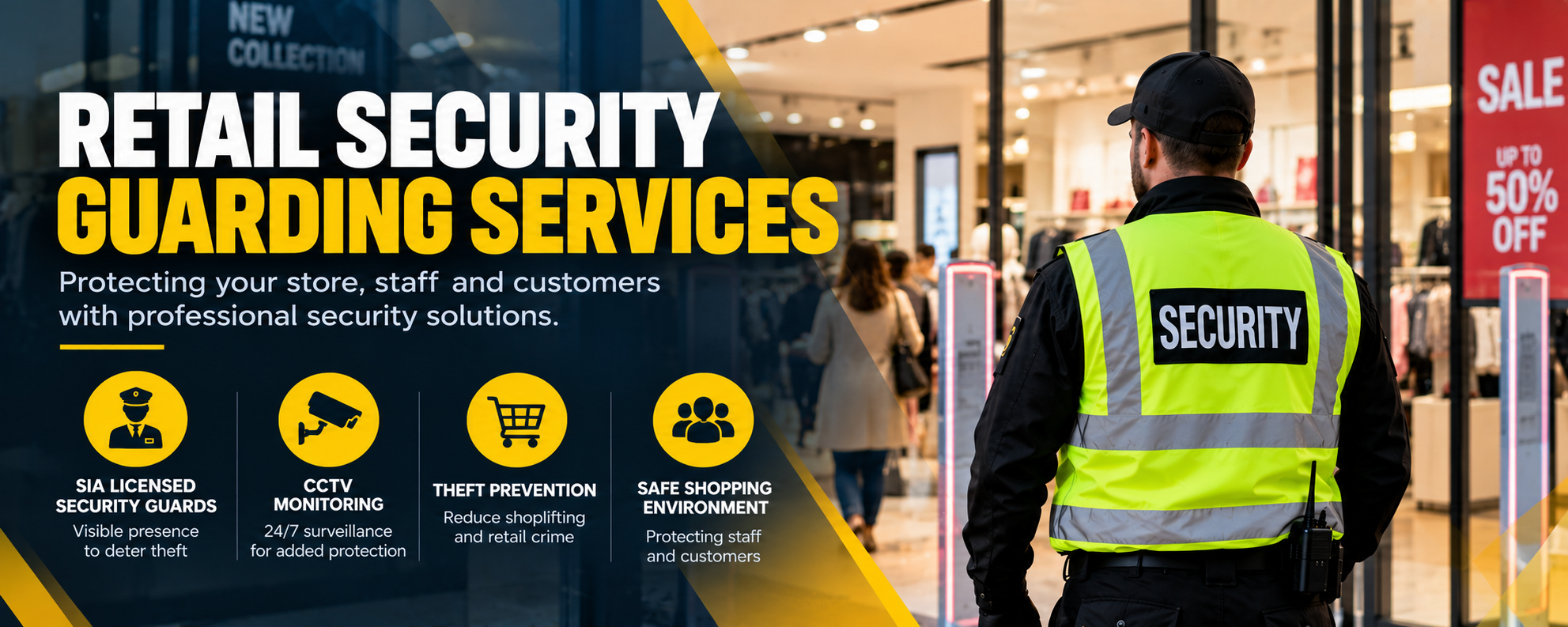
Retail security guarding services protect shops, staff, customers and stock through trained security officers, theft prevention, CCTV surveillance and incident response. Professional guards help deter criminal activity while maintaining a safe and welcoming shopping environment.
This guide explains how retail security services work, what security guards do, the benefits of professional guarding, UK licensing requirements and the costs of protecting retail premises.
What Is Retail Security Guarding?
Retail security guarding involves employing trained security officers to protect shops, supermarkets, retail parks and shopping centres against theft, damage and disorderly behaviour.
Retail security officers monitor entrances, observe customer activity, patrol sales floors and respond to suspicious situations.
Unlike general commercial guarding, retail security focuses on preventing stock losses while protecting the customer shopping experience.
For example, a supermarket may require security officers near entrances and self-checkout areas, while a luxury retail store may need discreet guards who can protect valuable merchandise without making customers uncomfortable.
The appropriate arrangements depend on the store's size, layout, opening hours and identified security risks.
Why Is Retail Security Important for UK Businesses?
Preventing Shoplifting and Retail Theft
Shoplifting is one of the biggest security concerns for retail businesses. Stolen products directly affect profits and can lead to additional operational expenses.
Professional retail security guards maintain a visible presence, monitor suspicious activity and support store theft prevention procedures.
Their presence may discourage opportunistic theft, particularly near entrances, exits and high-value product displays.
Security officers can also communicate with store management when suspicious behaviour requires attention.
Protecting Retail Employees
Retail employees may experience threatening behaviour, verbal abuse or physical aggression while carrying out their duties.
Trained security personnel help manage these situations by following appropriate conflict resolution and emergency response procedures.
Retail security guards support employee safety by responding to incidents and helping staff avoid unnecessary confrontation.
Security officers should prioritise de-escalation and act within their legal authority and training.
Improving Customer Confidence
Customers are more likely to feel comfortable in stores where security arrangements are professional and unobtrusive.
A visible security presence can provide reassurance, especially in busy shopping centres and stores operating late into the evening.
Retail guards may also assist visitors with directions and provide support during emergencies.
Their conduct should contribute positively to the store's customer service standards.
Reducing Business Disruption
Security incidents can interrupt daily operations, distract employees and damage merchandise.
Effective guarding arrangements help businesses identify risks and respond to problems before they escalate.
Although no service can completely eliminate retail crime, professional security can reduce exposure to avoidable losses.
Types of Retail Security Guarding Services
Manned Retail Security Guards
Manned retail guarding provides a dedicated security officer at a store during agreed operating hours.
The officer may monitor entrances, patrol the sales floor and respond to incidents involving theft, trespassing or threatening behaviour.
This service is particularly useful for busy supermarkets, department stores and retailers experiencing repeated security incidents.
Guards can be positioned according to the store's layout and risk assessment.
Store Detective Services
Store detectives provide a more discreet form of retail security.
Depending on the agreed arrangements, these officers may work in plain clothes to observe suspicious behaviour and identify possible theft.
Their work requires careful observation, accurate reporting and compliance with legal requirements.
Any intervention must be based on appropriate grounds rather than assumptions about a person's appearance or background.
Shopping Centre Security
Shopping centres contain multiple retail units, entrances, corridors and shared facilities.
Security teams may patrol communal areas, assist visitors, respond to incidents and coordinate with individual store managers.
Larger centres may need several officers working together to cover different locations.
Clear communication between guards and management helps improve coordination during busy trading periods.
Retail CCTV Monitoring
CCTV systems allow stores to observe designated areas and review security incidents.
Cameras may cover entrances, checkout areas, stockrooms and other locations where theft or unauthorised access is a concern.
When combined with trained personnel, CCTV monitoring can improve situational awareness.
However, businesses must follow UK data protection requirements, and personnel carrying out licensable CCTV activities must hold the appropriate SIA licence.
Mobile Retail Security Patrols
Mobile patrols involve security officers visiting retail premises at agreed intervals.
Officers may inspect external doors, loading bays, car parks and other vulnerable areas.
This approach can be suitable for smaller stores that do not need a permanent security officer.
However, mobile patrols cannot provide continuous on-site protection between visits.
What Are the Responsibilities of Retail Security Guards?
Monitoring Store Entrances and Exits
Retail security officers observe designated entry and exit points to identify potential security concerns.
They may help manage queues, monitor suspicious activity and support store access procedures.
A professional approach is important because entrances are also where customers form their first impressions.
Conducting Shop Floor Patrols
Security guards regularly patrol sales floors and other agreed areas to identify unusual activity or security weaknesses.
Patrols may focus on high-value products, busy checkout locations and areas with restricted visibility.
Officers must remain alert without unnecessarily interfering with customers.
Supporting Theft Prevention
Retail security guards work alongside store employees and management to identify and report possible theft.
They may observe suspicious behaviour, communicate concerns and follow established incident procedures.
Their actions must remain lawful, proportionate and consistent with company policies.
Managing Conflict and Emergencies
Security officers may encounter aggressive individuals, customer disputes or other disruptive situations.
Training in communication and de-escalation helps officers respond professionally.
During emergencies, guards may assist with communication, alert emergency services and follow the store's evacuation or incident response plan.
Maintaining Incident Reports
Accurate incident reporting helps retailers identify recurring problems and review their security arrangements.
Reports may document the time, location, nature of an incident and actions taken.
These records can support internal investigations and communication with the police where appropriate.
How Do Retail Security Guards Prevent Shoplifting?
Effective shoplifting prevention involves combining visible security with observation, communication and sensible store procedures.
A uniformed officer near an entrance may discourage opportunistic theft by demonstrating that the premises are actively monitored.
Regular patrols help guards observe areas where products are difficult for employees to supervise.
Retailers can also strengthen security through suitable product placement, electronic article surveillance, stock controls and staff training.
Retail security is most effective when guards, store employees and security technology work together.
Security personnel should never rely on discriminatory profiling. Decisions must be based on observable behaviour and lawful security procedures.
Retail Security Guarding Regulations in the UK
Retailers employing contracted security personnel must consider the requirements established by the Security Industry Authority (SIA).
Contracted officers carrying out licensable security guarding duties generally require an appropriate SIA licence.
Different activities may require different licences, particularly when officers undertake public space surveillance using CCTV or work at licensed premises.
Retailers should also consider workplace health and safety responsibilities and the protection of customer information.
Businesses operating CCTV must follow applicable UK data protection legislation, including the UK GDPR and Data Protection Act 2018.
Appropriate signage, lawful processing, restricted access to recordings and retention arrangements are important parts of responsible surveillance.
How Much Does Retail Security Guarding Cost in the UK?
The cost of retail security guarding depends on location, store size, staffing requirements and coverage hours.
A small independent shop requiring one officer during peak trading hours will generally have different costs from a large supermarket needing several guards.
Security coverage during weekends, late evenings and public holidays may affect pricing.
Additional services such as CCTV monitoring, plain-clothes store detectives and multi-site supervision can also influence overall expenses.
Retailers should consider the potential cost of theft, disruption and employee safety concerns when evaluating security spending.
A site-specific quotation provides a more reliable estimate than a standard hourly figure.
Retail Security Guards vs CCTV: Which Is Better?
Retail security guards and CCTV systems provide different benefits.
Security guards offer a physical presence, allowing them to interact with customers, assess incidents and follow agreed intervention procedures.
CCTV systems provide visual monitoring and recorded footage that can help investigate incidents.
However, cameras cannot physically respond to suspicious situations.
For higher-risk stores, combining professional guarding with suitable CCTV coverage can provide more comprehensive protection.
Smaller businesses may choose a different combination depending on their budget, premises and risk level.
How to Choose the Right Retail Security Company
Choosing a reliable retail security provider requires careful consideration of licensing, training, experience and service quality.
A suitable provider should understand shoplifting prevention, customer interaction, conflict management and retail operating procedures.
Businesses should verify that officers hold the appropriate SIA licences and receive training relevant to their assigned duties.
The provider should also offer clear incident reporting, supervision arrangements and a security plan tailored to the premises.
Intraguard provides retail security guarding services across the UK, including London, with SIA-licensed officers, theft prevention support, security patrols and CCTV-related security arrangements.
Its services are designed around individual store layouts, customer activity and security requirements, helping retailers protect their staff, customers and merchandise.
Frequently Asked Questions
What is retail security guarding?
Retail security guarding involves trained security officers protecting shops, supermarkets and shopping centres against theft, vandalism, unauthorised access and disruptive behaviour.
Why do retail stores need security guards?
Retail stores use security guards to deter theft, protect employees, monitor suspicious behaviour and support incident response. Guards can also provide reassurance to customers.
Do retail security guards need an SIA licence?
Contracted officers performing licensable retail security duties generally need an appropriate SIA licence. Requirements depend on their activities, employment arrangements and premises.
How do retail security guards prevent shoplifting?
Retail guards discourage theft through visible patrols, observation, communication with store employees and appropriate responses to suspicious behaviour.
Can retail security guards detain shoplifters?
Retail security guards have no general police powers. Any detention must have a lawful basis, such as a properly applicable citizen's arrest power, and must be necessary and proportionate.
How much does a retail security guard cost in the UK?
Costs depend on location, working hours, store size, contract duration and required services. Retailers should request a tailored quotation for accurate pricing.
Can retail security services operate 24 hours a day?
Yes. Security providers can arrange continuous guarding or monitoring for premises requiring round-the-clock protection, subject to staffing and service arrangements.
What is the difference between retail security guards and store detectives?
Uniformed retail guards provide a visible security presence, while store detectives may work discreetly to observe suspected theft. Both must follow applicable licensing and legal requirements.
Is CCTV enough to prevent retail theft?
CCTV can help monitor activity and provide evidence, but it may not be sufficient alone. Physical guarding, staff awareness and appropriate store procedures can provide additional protection.
Can retail security guards help during emergencies?
Yes. Trained guards can follow emergency procedures, communicate with management, contact emergency services and assist with an appropriate response.
Conclusion
Retail security guarding services help UK businesses protect stock, employees, customers and daily operations. Professional guards provide visible theft deterrence, support incident management and help maintain a safe shopping environment.
Combining trained personnel with suitable CCTV, access controls and loss prevention procedures can strengthen overall retail security.
Businesses should choose a security provider that understands their store layout, customer traffic, operating hours and specific risks to establish reliable, practical protection.
Research note: The article reflects Intraguard's retail guarding service and current SIA licensing guidance, including the distinction between security guarding and certain CCTV duties.

 English
 Arabic
 French
 Spanish
 Portuguese
 Deutsch
 Turkish
 Dutch
 Italiano
 Russian
 Romaian
 Portuguese (Brazil)
