


How Many Bedsheets Per Day Justify Buying an Industrial Flatwork Ironer?
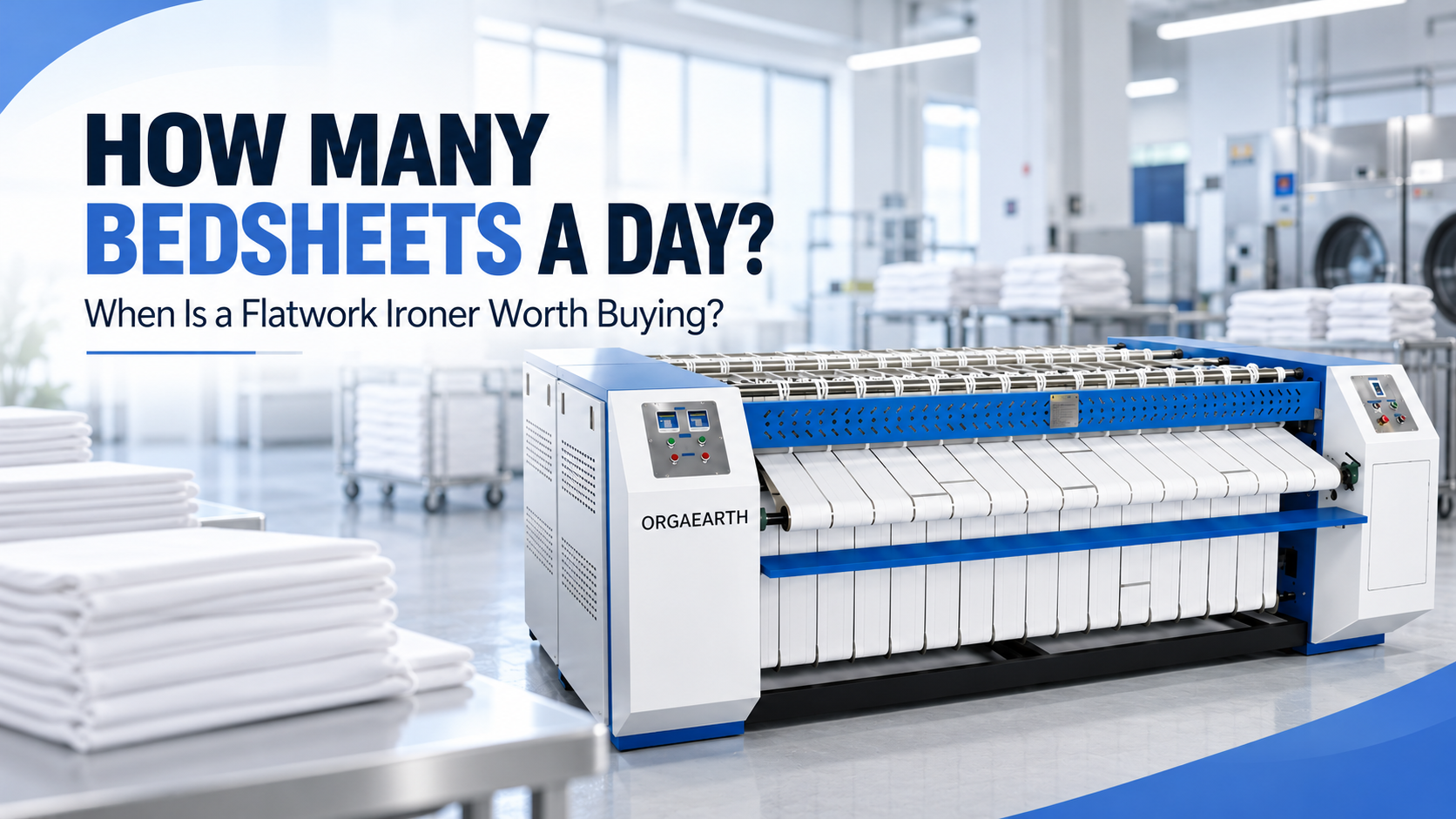
Your laundry washes hundreds of bedsheets daily, but ironing and folding take longer than expected. Employees work additional hours, finished linen piles up, and customer deliveries become difficult to manage.
Would purchasing an industrial flatwork ironer solve the problem, or would it be an unnecessary investment?
For hotels, commercial laundries and linen service providers, finishing equipment can significantly influence daily productivity.
However, there is no fixed number of bedsheets that automatically justifies buying an ironing machine.
The decision depends on daily volume, manual labour costs, available working hours, linen dimensions and equipment expenses.
What Is an Industrial Flatwork Ironer?
An industrial flatwork ironer is a professional laundry machine designed to iron and finish large, relatively flat textiles.
Common applications include bedsheets, pillowcases, tablecloths, napkins and suitable duvet covers.
Unlike conventional pressing tables, flatwork ironers use heated rollers or ironing surfaces to process linen continuously.
Some models can finish appropriately extracted damp linen, while others require prior drying.
For businesses handling regular linen contracts, mechanised ironing may provide more consistent processing and reduce manual handling.
However, the machine must match the fabric type, dimensions and required finishing method.
Why Does Bedsheet Ironing Become a Laundry Bottleneck?
Washing and drying machinery may process substantial quantities of linen, while manual finishing remains comparatively slow.
Employees must spread bedsheets, remove wrinkles, fold each item and inspect the result.
As daily orders increase, these activities can delay dispatch.
Common problems include unfinished linen accumulating, overtime expenses and inconsistent presentation.
Before purchasing additional washing equipment, operators should check whether finishing is actually restricting overall production.
A faster washing process offers limited value if the laundry cannot finish and deliver the extra linen.
How Many Bedsheets Can Staff Iron Manually?
Manual productivity varies according to sheet size, equipment, operator experience and finishing requirements.
Rather than relying on an industry average, measure your existing operation.
For example:
|
Factor |
Illustrative value |
|
Bedsheets completed daily |
160 |
|
Employees |
2 |
|
Hours per employee |
8 |
|
Total worker-hours |
16 |
|
Productivity |
10 sheets per worker-hour |
These figures are hypothetical.
Manual productivity = Completed bedsheets ÷ Total worker-hours
Record actual output over several working days to establish a reliable comparison.
How Many Bedsheets Per Day Justify Buying a Flatwork Ironer?
There is no universal minimum volume.
A laundry processing 80 sheets daily may justify mechanisation if finishing labour is expensive or turnaround requirements are strict.
Another facility processing 200 sheets may continue using manual equipment when its existing operation remains economical.
The most useful purchasing indicators are:
-
Regular daily bedsheet volume
-
Available finishing hours
-
Labour cost per finished sheet
-
Customer turnaround requirements
-
Expected equipment utilisation
-
Total installed investment
Daily volume is the starting point, not the final answer.
How Many Bedsheets Can a Flatwork Ironer Finish Per Hour?
Machine productivity depends on roller width, operating speed, incoming moisture and the number of employees feeding linen.
Folding arrangements can also affect completed output.
Calculate your required production rate before comparing machines.
Required hourly output = Daily bedsheets ÷ Available finishing hours
|
Daily volume |
Finishing hours |
Required output |
|
100 sheets |
5 |
20 sheets/hour |
|
200 sheets |
5 |
40 sheets/hour |
|
400 sheets |
5 |
80 sheets/hour |
|
600 sheets |
5 |
120 sheets/hour |
These figures represent the output your business needs, not guaranteed machine performance.
Always check model-specific production specifications using your actual linen dimensions and working conditions.
Manual Ironing vs Industrial Flatwork Ironer: Which Is Better?
Both methods have different investment and operating requirements.
|
Factor |
Manual ironing |
Flatwork ironer |
|
Initial investment |
Generally lower |
Generally higher |
|
Production capacity |
Depends on staff and equipment |
Depends on machine specifications |
|
Labour |
More manual handling |
Mechanised feeding and ironing |
|
Finishing consistency |
Operator-dependent |
Controlled machine processing |
|
Maintenance |
Pressing equipment |
Mechanical and heating systems |
|
Space |
Pressing stations |
Machine and service clearance |
A flatwork ironer may improve processing consistency, but it does not eliminate the need for trained operators.
The better choice depends on measured production costs.
How Much Does It Cost to Iron One Bedsheet?
Cost per sheet helps businesses compare finishing arrangements.
Finishing cost per sheet = Total monthly finishing expenses ÷ Completed sheets
Consider a hypothetical monthly comparison:
|
Expense |
Manual |
Mechanised |
|
Labour |
₹48,000 |
₹24,000 |
|
Energy |
₹6,000 |
₹12,000 |
|
Maintenance |
₹1,000 |
₹4,000 |
|
Equipment ownership |
₹2,000 |
₹20,000 |
|
Total |
₹57,000 |
₹60,000 |
|
Sheets finished |
6,000 |
6,000 |
|
Cost per sheet |
₹9.50 |
₹10.00 |
All figures are illustrative.
In this example, mechanised finishing costs slightly more despite lower labour expenses.
The investment becomes more attractive if the machine supports additional profitable orders, reduces overtime or delivers other measurable benefits.
How Do You Calculate the Break-Even Point?
Start by comparing the current finishing cost with expected operating expenses after mechanisation.
For a simple cash-payback calculation:
Monthly net cash benefit = Avoided costs + Additional contribution − New cash operating costs
Payback period = Initial investment ÷ Monthly net cash benefit
Use the formula only when monthly net cash benefit is positive.
Keep depreciation separate from cash expenses to avoid double-counting the investment.
Realistic projections should also consider demand fluctuations, maintenance and downtime.
Which Flatwork Ironer Size Is Suitable for Bedsheets?
Roller width is an important selection factor.
The machine must accommodate the required linen dimensions and approved feeding orientation.
Other considerations include ironing speed, roller diameter, heating arrangement and operator requirements.
For example, OrgaEarth's DOMUS compact flatwork ironer range includes working widths of 2,600 mm and 3,300 mm.
However, working width alone does not establish daily production.
Compare actual bedsheet dimensions, moisture levels and processing requirements before selecting a model.
Does Linen Moisture Affect Ironing Performance?
Yes. The amount of moisture remaining after washing influences finishing requirements.
Certain flatwork ironers can process appropriately extracted damp linen, depending on their design.
Other machines require partial drying beforehand.
Excess moisture can reduce achievable processing speed or affect finishing results.
Operators should follow the manufacturer's recommendations for incoming linen condition, temperature and feeding speed.
Should You Buy a Flatwork Ironer with Automatic Folding?
Some professional ironing systems include integrated folding arrangements.
These may reduce manual handling after ironing and support higher-volume operations.
However, folding equipment adds investment and maintenance considerations.
Businesses processing smaller quantities may not need automation.
Evaluate folding time, staffing and daily output before purchasing additional features.
Can You Start a Bedsheet Finishing Business?
A dedicated linen-finishing service may be an opportunity for entrepreneurs serving hotels, guesthouses and existing laundry contractors.
Instead of offering complete washing services, the business could specialise in receiving suitably prepared linen for ironing and folding.
However, profitability depends on dependable contracts, transport costs, equipment utilisation and delivery schedules.
Customer demand should be confirmed before purchasing machinery.
How Orgaearth Can Help You Choose an Industrial Flatwork Ironer
OrgaEarth Laundry Solutions supplies professional flatwork ironing equipment for hotels, hospitals, commercial laundries and linen-processing businesses across India.
Its range includes DOMUS compact and Eco-Energy flatwork ironers, with different working widths and heating configurations.
Selected models also offer folding features.
Orgaearth can assist businesses with equipment selection, linen-capacity planning, installation considerations and technical guidance.
Explore its industrial flatwork ironer range to compare available solutions and request a model-specific quotation.
Conclusion
Buying an industrial flatwork ironer can be worthwhile when daily finishing demand justifies the investment.
However, processing 100, 200 or even 500 bedsheets does not automatically make mechanisation profitable.
The correct decision depends on labour productivity, finishing costs, linen dimensions, available working hours and future demand.
Measure your current cost per sheet and compare it against realistic machine operating expenses before purchasing.
The right time to invest is when the equipment solves a measurable finishing problem at a financially reasonable cost.
Frequently Asked Questions
1. How many bedsheets justify an industrial flatwork ironer?
There is no fixed number. Daily volume, labour expenses, finishing time and equipment investment determine suitability.
2. How many bedsheets can a flatwork ironer process per hour?
Output depends on machine specifications, sheet dimensions, incoming moisture, feeding arrangements and operating speed.
3. Is a flatwork ironer better than manual ironing?
It may improve productivity and consistency for suitable workloads, but the total cost per finished sheet must be compared.
4. What is the price of an industrial flatwork ironer in India?
Pricing varies by roller width, heating system, automation, installation, and manufacturer. Request a complete quotation.
5. Can a flatwork ironer dry and iron bedsheets together?
Certain models can process appropriately extracted damp linen. Other configurations require prior drying.
6. Is an automatic folding system necessary?
Not always. It may benefit higher-volume operations but should be evaluated against labor needs and investment costs.
Contact Us:
Orgaearth Laundry Solutions
Plot no. 774, Udyog Vihar, Phase 5, Gurugram, Haryana, India-122016
Email: marketing@orgaearth.com
Contact No. +91 7042912777

 English
 Arabic
 French
 Spanish
 Portuguese
 Deutsch
 Turkish
 Italiano
 Russian
 Romaian
 Portuguese (Brazil)
 Greek
