


Financial Analysis Training in India: Your Step-by-Step Path to a Finance Career
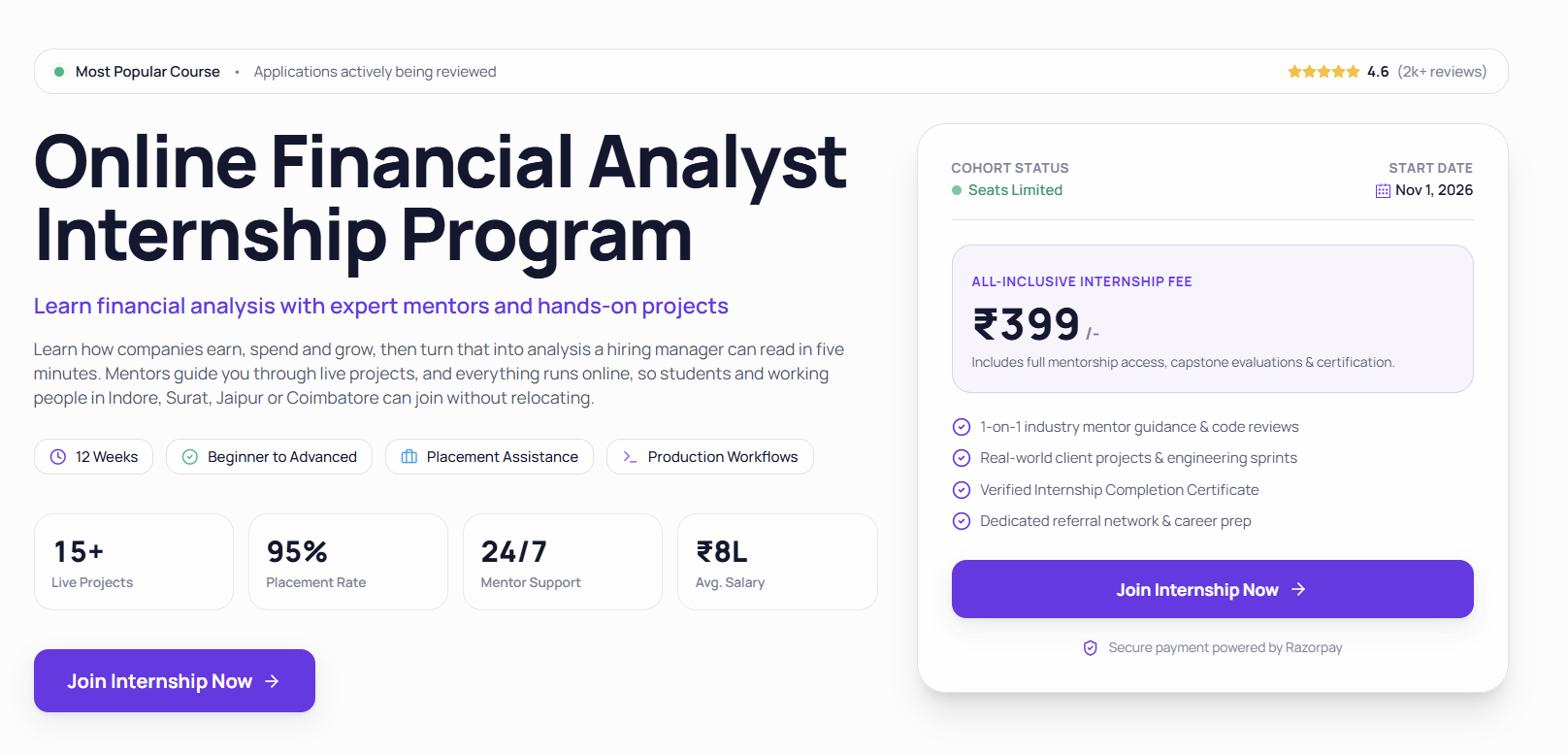
Finance is one of the most competitive fields for fresh graduates in India. Every year, lakhs of commerce, economics, engineering and management students compete for a limited number of analyst roles. Degrees alone rarely make the difference. Practical exposure does. That is why an online financial analyst internship program in India has become one of the smartest ways to build real skills, even if you live in a tier-2 city or are still in college.
This guide explains what these internships involve, who can apply, what you will learn, and how to choose a program that adds value to your resume.
Why Practical Finance Experience Matters More Than Ever
Recruiters at banks, consulting firms, NBFCs, fintech startups and research houses have shifted their hiring approach. They want candidates who can open an Excel model on day one, read a balance sheet without hand-holding, and explain a valuation in plain language. Classroom theory covers the concepts, but it rarely covers the workflow.
A well-structured financial analyst internship program in India bridges that gap. You work on live case studies, build models, and receive feedback from practitioners. By the end, you hold proof of skill rather than a list of subjects studied.
The online format has made this far more accessible. You no longer need to relocate to Mumbai, Bengaluru or Delhi NCR to get exposure. A student in Kolkata, Indore or Coimbatore can now learn the same techniques as someone in a metro city.
What Does a Financial Analyst Actually Do?
A financial analyst studies financial data to help businesses and investors make decisions. The day-to-day work usually includes:
- Collecting and cleaning financial statements and market data
- Building three-statement models (income statement, balance sheet, cash flow)
- Forecasting revenue, margins and cash flows
- Valuing companies using DCF, comparable company analysis and precedent transactions
- Preparing reports, dashboards and presentations for managers or clients
- Monitoring industry trends, regulatory changes and macroeconomic signals
An internship lets you practise each of these in a controlled setting, so your first full-time job does not feel like a leap into the unknown.
Who Should Apply for a Financial Analyst Internship for Freshers in India?
If you are searching for a financial analyst internship for freshers in India, you do not need prior work experience. Most programs are designed for:
- Final-year and pre-final-year students of B.Com, BBA, BMS, BA Economics, B.Tech and similar degrees
- MBA and PGDM students specialising in finance
- CA, CFA and CMA aspirants who want applied exposure alongside their exams
- Recent graduates in a gap period who want to strengthen their profile
- Career switchers from operations, accounting or engineering who want to move into finance
What matters is curiosity about numbers, comfort with Excel, and the discipline to complete assignments on time. Advanced skills can be built during the program itself.
Core Skills You Should Expect to Learn
A credible financial analysis training program in India should go beyond definitions. Look for hands-on coverage of the following areas.
1. Financial Statement Analysis
You learn to read and interpret the income statement, balance sheet and cash flow statement together. Ratio analysis, DuPont analysis, working capital cycles and quality of earnings checks are all part of this. Indian context matters here, so expect exposure to Ind AS reporting and annual reports of listed Indian companies.
2. Excel and Financial Modelling
Excel remains the primary tool of the trade. Good training teaches keyboard shortcuts, lookup functions, scenario analysis, sensitivity tables and clean model structure. You should finish with at least one complete company model that you can show in interviews.
3. Valuation Techniques
Discounted cash flow, relative valuation and precedent transaction analysis form the backbone of both equity research and investment banking. A solid program teaches not only the formulas but also how to defend your assumptions.
4. Market and Industry Research
Analysts must understand sectors. Training should show you how to study an industry, benchmark competitors and use sources such as company filings, exchange disclosures, RBI publications and credible market data providers.
5. Presentation and Communication
Numbers only matter if you can explain them. Writing short investment notes, building clear charts and presenting findings confidently are skills that separate average analysts from standout ones.
Investment Banking Internships Online: Is It Possible for Freshers?
Many students assume investment banking is only for IIM or top-tier college graduates. While those campuses do dominate lateral and campus hiring, an investment banking internship online in India for freshers in India can still be a strong starting point, especially for building skills that banks screen for.
Typical investment banking internship work includes:
- Preparing company profiles and teasers
- Building financial models for M&A and fundraising scenarios
- Running comparable company and precedent transaction analysis
- Drafting pitch book slides and information memoranda
- Researching sectors for deal opportunities
- Supporting due diligence checklists
Online internships replicate this workflow through simulated mandates and live-style case studies. You may not be sitting inside a bulge bracket bank, but you gain the same technical toolkit and can speak about real work in interviews. For freshers, that is a major advantage over candidates who only list coursework.
One honest note: an online internship is not a guaranteed placement. It builds capability and credibility. You still need to network, apply consistently and prepare for technical interviews.
Benefits of Choosing an Online Format
Flexibility. You can learn alongside college, exams or a current job. Sessions are often scheduled in evenings or weekends.
Accessibility. Geography stops being a barrier. Students from smaller cities get the same curriculum and mentor access.
Cost efficiency. There is no relocation, rent or commute. That makes quality exposure possible for students from modest financial backgrounds.
Recorded learning. Most programs provide recordings and templates you can revisit before interviews.
Portfolio building. Because the work is digital, your models, reports and presentations are easy to store and share with recruiters.
How to Choose the Right Program
Not all programs are equal. Before enrolling in any online financial analyst internship program in India, check the following.
Curriculum depth. Does it include modelling, valuation and research, or only theory videos?
Mentor credentials. Look for instructors with real experience in banking, equity research, corporate finance or consulting. Their profiles should be verifiable on LinkedIn.
Project-based assessment. You should submit work and receive feedback, not just watch lessons.
Certificate and letter value. A completion certificate is useful only if the issuing organisation is credible and the work behind it is substantial.
Transparency. Reputable providers clearly state duration, tools covered, fees (if any), and what outcomes are realistic. Be cautious of programs that promise guaranteed jobs or inflated salary figures.
Peer and alumni feedback. Reviews and alumni outcomes help you judge whether the experience is genuine.
A Sample Learning Roadmap
If you are planning your own preparation, this structure works well over eight to twelve weeks.
Weeks 1 to 2: Accounting fundamentals, financial statements and ratio analysis.
Weeks 3 to 4: Advanced Excel, formula auditing and data handling.
Weeks 5 to 6: Three-statement modelling of a listed Indian company.
Weeks 7 to 8: DCF valuation, comparable analysis and sensitivity testing.
Weeks 9 to 10: Industry report writing and investment thesis building.
Weeks 11 to 12: Capstone project, mock interviews and resume refinement.
This progression moves from foundation to application, which is exactly what employers want to see.
How to Make Your Internship Count After It Ends
Completing the program is only half the work. To convert learning into opportunity:
- Showcase your projects. Add models and reports to a portfolio folder or LinkedIn featured section.
- Rewrite your resume with outcomes. Instead of “attended financial modelling sessions”, write “built a three-statement model and DCF valuation for a listed FMCG company.”
- Practise technical interviews. Be ready to walk through a DCF, explain working capital, and discuss how a change in depreciation flows across the statements.
- Follow markets daily. Read business newspapers, quarterly results and RBI policy updates. Interviewers often ask for your view on a recent deal or earnings report.
- Network respectfully. Connect with alumni and professionals, ask informed questions, and avoid generic referral requests.
- Keep upskilling. Consider CFA, FRM, NISM certifications or advanced modelling courses as your next step.
Common Mistakes Freshers Make
- Choosing a program based only on price or a flashy certificate
- Skipping Excel practice and relying on watching tutorials
- Copying templates without understanding the logic
- Ignoring communication skills
- Expecting immediate job offers right after completion
Avoiding these pitfalls puts you ahead of most applicants.
Career Paths After a Financial Analyst Internship
Once you have practical exposure, several routes open up:
- Equity research analyst
- Investment banking analyst
- Corporate finance and FP&A roles
- Credit analyst at banks and NBFCs
- Venture capital and private equity associate roles
- Consulting and strategy positions
- Fintech and product analytics roles
Each path values the same foundation: clean analysis, sound judgement and clear communication.
Final Thoughts
Breaking into finance in India takes more than good marks. It takes demonstrable skill, steady practice and a program that treats you like a working analyst rather than a passive learner. Whether you choose a broad financial analysis training program in India or a specialised banking track, focus on depth, feedback and real projects.
If you are ready to build job-relevant skills from anywhere in the country, kre8ly offers a practical route into the world of finance through hands-on learning designed for freshers and early-career professionals. Start with the fundamentals, build one strong model, and let your work speak in your next interview.
Frequently Asked Questions
Is an online financial analyst internship valid for jobs in India?
Yes, provided it involves real projects and verifiable mentorship. Employers value demonstrated skill more than the delivery mode.
Do I need a finance degree to apply?
Not always. Many programs accept students from commerce, engineering, economics and management backgrounds if they have basic numerical aptitude.
How long does a typical internship last?
Most run between four and twelve weeks, depending on depth and project scope.
Can freshers really get into investment banking through online internships?
They can build the technical foundation and portfolio needed to compete. Final selection still depends on interviews, networking and market conditions.

 English
 Arabic
 French
 Spanish
 Portuguese
 Deutsch
 Turkish
 Italiano
 Russian
 Romaian
 Portuguese (Brazil)
 Greek
