


Leading ZTNA Solutions for Multi-Cloud Apps
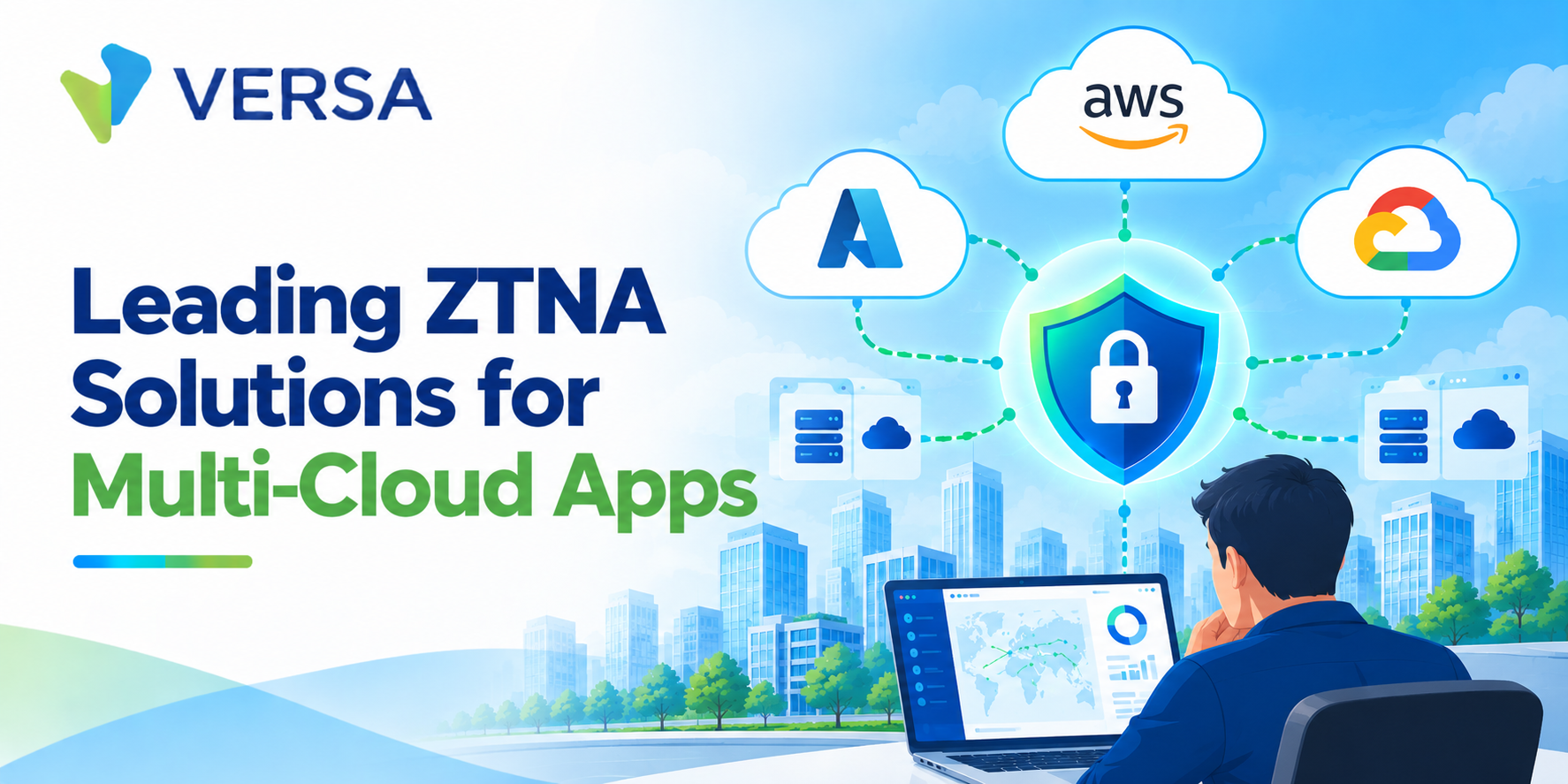
The best ZTNA solutions for multi-cloud apps enforce one identity-based access policy across AWS, Azure, GCP, private data centers, and SaaS - connecting each user only to the specific application they're authorized to use, wherever it's hosted. Strong options hide apps from the public internet, verify device posture continuously, and stop lateral movement. Versa's ZTNA does this across every cloud from a single platform.
Here's the reality of modern IT: your applications don't live in one place anymore. Some run in AWS, others in Azure or GCP, a few still sit in your data center, and dozens are SaaS. Each environment has its own access model, its own logins, its own quirks. The result is a patchwork of policies with gaps between them - and gaps are exactly what attackers look for. If multi cloud app security is keeping you up at night, the fix isn't more point tools. It's a single, consistent way to control access everywhere. That's what ZTNA delivers. Let's dig in.
Why does multi-cloud make app security so hard?
The trouble with multi-cloud isn't any single cloud - it's the seams between them. When apps are scattered across providers, teams end up managing separate identity and network rules in each one. Policies drift out of sync, visibility fragments, and nobody has a clear picture of who can reach what. Legacy VPNs make it worse: connect once and you're placed on a broad network, free to move toward resources you were never meant to touch. In a multi-cloud world, that implicit trust is a liability multiplied by the number of environments you run.
How ZTNA secures multi-cloud apps?
Zero Trust Network Access takes a fundamentally different stance. As Gartner describes it, ZTNA creates an identity- and context-based logical boundary around each application, brokering access to named users and hiding everything else. Applied across clouds, that changes the game:
-
One policy, every cloud. Instead of separate rules per provider, you define access once and enforce it consistently across AWS, Azure, GCP, on-prem, and SaaS.
-
Per-application, least-privilege access. A user reaches the exact app they need - not a network segment full of other workloads.
-
Application cloaking. Apps sit behind a trust broker, invisible to the public internet, so there's no exposed surface to scan or attack.
-
Continuous verification. Identity, device posture, and context are checked throughout the session, not just at login.
-
Microsegmentation. Even if something is compromised, tight boundaries stop lateral movement between clouds and workloads.
The payoff is security that follows the application wherever it lives, rather than breaking at every cloud boundary.
What to look for in ZTNA solutions for multi-cloud apps?
Not every ZTNA product handles multi-cloud equally well. Prioritize these capabilities:
-
Truly unified policy across all clouds and on-prem, managed from one console - not a separate deployment per environment.
-
Deep identity-provider integration (Okta, Entra ID, and others) so access decisions ride on your existing identity source.
-
Both agent-based and clientless access, so employees, contractors, and unmanaged devices can all connect securely.
-
Device posture and context signals feeding real-time, adaptive access decisions.
-
Compliance-grade visibility and logging, aligned to frameworks like NIST SP 800-207 and NIS2, with a clear audit trail of who accessed what.
-
Performance without hairpinning, using globally distributed gateways so traffic reaches cloud apps directly instead of detouring through a data center.
The shift to "universal" ZTNA
First-generation ZTNA often solved remote access but left multi-cloud fragmentation intact. The 2026 direction is universal ZTNA: a single policy framework spanning every user, device, location, and application - remote workers, branch offices, data centers, and cloud apps alike. For multi-cloud specifically, this is the difference between duct-taping several tools together and running one coherent zero-trust fabric. It's especially valuable as teams extend access to AI workloads - model endpoints, vector databases, and notebooks scattered across clouds - that need the same identity-based control.
Where Versa fits
Versa's ZTNA, delivered through Versa Secure Private Access, is built for exactly this distributed reality: it connects distributed users to distributed applications across private cloud, enterprise data centers, and public clouds like AWS and Azure, as well as SaaS. It enforces application segmentation and role-based, least-privilege access, layers in strong MFA and continuous verification, and uses globally distributed cloud gateways to reach cloud apps directly without hairpinning. Because it's part of the VersaONE platform, one console and policy set span ZTNA, CASB, SWG, and firewall - so multi-cloud access and security stay unified.
Why is ZTNA good for multi-cloud environments? ZTNA enforces one identity-based policy across every cloud and on-prem, so access stays consistent and secure regardless of where an app is hosted.
Does ZTNA work across AWS, Azure, and GCP together? Yes. Leading ZTNA solutions connect users to apps in any cloud through a single policy framework, eliminating per-provider silos.
How does ZTNA protect multi-cloud apps from attackers? It hides apps from the public internet, grants least-privilege access per application, and uses microsegmentation to block lateral movement between clouds.
The bottom line
Multi-cloud app security breaks when every environment has its own rules. ZTNA fixes that by enforcing one identity-based, least-privilege policy across all of them - hiding apps, verifying continuously, and containing threats. As universal ZTNA becomes the standard, unifying multi-cloud access is within reach. For a platform that secures apps across every cloud from one place, Versa belongs on your shortlist.
Also Read: Is Your ZTNA Solution Really Zero Trust?

 Arabic
 French
 Spanish
 Portuguese
 Deutsch
 Turkish
 Dutch
 Italiano
 Russian
 Romaian
 Portuguese (Brazil)
 Greek
