


Expert Calls for Private Equity Due Diligence Explained
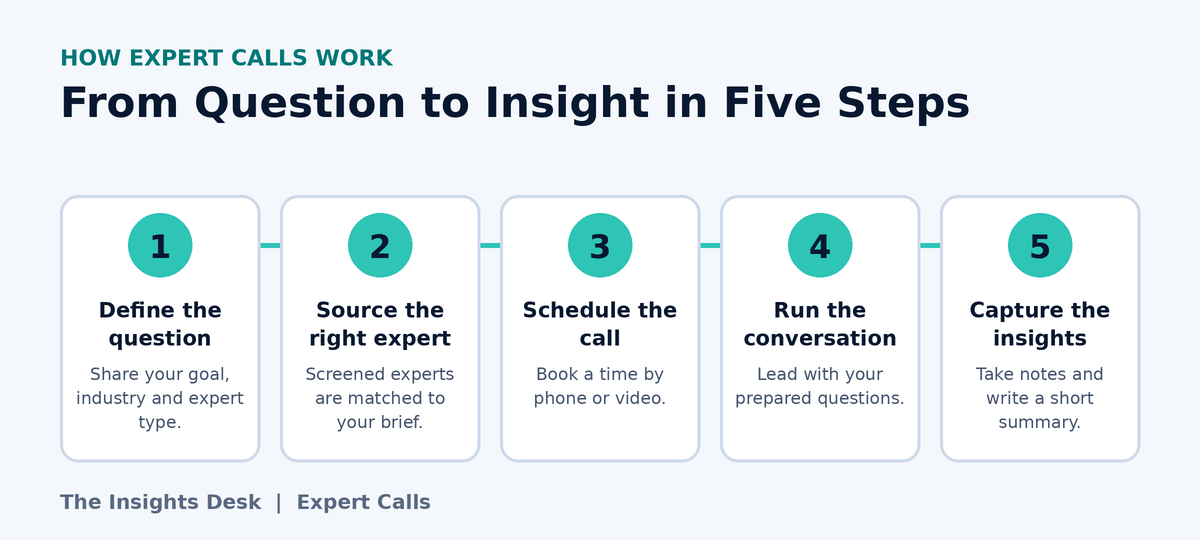
Every deal team knows the feeling. The data room is full, the confidential information memorandum reads beautifully, and the management presentation answers every question before it is asked. Yet the real work of due diligence is deciding which of those claims will survive contact with the market. That is where expert calls earn their place.
Expert calls are private, one-on-one conversations with professionals who have first-hand experience in an industry, a company, or a technology. For private equity investors, they provide an independent view that the seller does not control. In this playbook, I walk through how deal teams use expert calls, which experts to speak with, and how to turn a handful of conversations into evidence an investment committee can trust.
Why Due Diligence Needs Voices From Outside the Data Room
Documents show what a company reports about itself. Expert calls show how the market sees that company. A former sales director can tell you why customers really switch vendors. A procurement manager can explain what a competing supplier charges and why. A retired regulator can describe which rules are likely to tighten.
None of this appears in a financial model, yet all of it can change a valuation. That is why many investors treat expert calls as a standard layer of commercial due diligence, alongside financial analysis, customer references, and desk research.
Where Expert Calls Fit in the Deal Process
Early screening. Before a team spends money on advisers, a few calls can show whether a sector is attractive and whether the target's market position is real.
Confirmatory due diligence. Once a deal is live, expert calls test the specific claims in the investment thesis: growth rate, market share, customer loyalty, and pricing power.
Buy-side and sell-side work. Buyers use calls to challenge the story. Sellers sometimes use them to understand how buyers will see the business before a process starts.
After closing. Portfolio teams use expert calls to plan value creation, such as entering a new geography or adding a product line.
Five Questions Expert Calls Can Answer
- How big is the market, and what is driving growth? Experts can explain the demand drivers behind the numbers in an industry report and say which assumptions look too optimistic.
- How strong is the target's competitive position? People who have bid against, or bought from, the company can describe its real strengths and weak spots.
- How loyal are customers? Former account managers and buyers can speak to churn, switching costs, and contract renewals.
- Does the company have pricing power? Experts can tell you whether price increases have stuck in the past and what customers did in response.
- What risks sit outside the model? Regulation, technology shifts, and supply chain exposure often live in an expert's experience rather than in the data room.
Choosing the Right Experts
The quality of an expert call depends on the match. Think about four attributes when you write a brief.
- Role and seniority. A former division head sees strategy. A regional sales manager sees day-to-day customer behavior. You often need both.
- Recency. Markets move fast, so recent hands-on experience is worth more than a famous title from years ago.
- Geography. A market can behave very differently from one country to the next, so match the expert to the region you are investing in.
- Vantage point. Aim for a balance of former employees of the target, competitors, customers, suppliers, and channel partners. A single vantage point gives a one-sided view.
Compliance Comes First
Expert calls in an investment setting come with strict rules. Experts must not share confidential information about a current or recent employer, and they must never pass on material non-public information. Reputable providers screen experts, run conflict checks, and ask both sides to agree to terms before the call. As the client, you should also keep your questions focused on the expert's own experience and public knowledge. If a conversation drifts toward information the expert should not share, end that line of questioning and move on.
How Many Calls Do You Need?
There is no magic number. A narrow screening exercise might take a handful of calls. A full commercial due diligence workstream can involve many more across customers, competitors, and suppliers. A good rule is to keep calling until new experts stop adding new information, and to make sure the group includes views that disagree with each other.
Turning Conversations Into Evidence
A call is only useful if the findings can be traced and compared. Teams that do this well follow a simple routine.
- Keep a call log with the expert's background, date, and topic.
- Capture notes or, where permitted, a transcript.
- Tag each point by theme, such as pricing, churn, or regulation.
- Compare tagged points across experts to see where they agree.
- Write a short memo that separates facts, opinions, and open questions.
This approach turns individual opinions into a pattern, and a pattern is what an investment committee can act on.
Common Mistakes
- Leading the witness. Questions that hint at the answer you want produce polite agreement, not insight.
- Stopping at one view. A single enthusiastic expert is an anecdote, not evidence.
- Ignoring disagreement. When experts disagree, that is the part of the thesis most worth testing.
- Leaving calls too late. Booking experts at the end of a process leaves no time to follow up on surprises.
Expert Calls at The Insights Desk
The Insights Desk is an expert network and primary research firm that connects clients with industry experts for 1:1 consultations. Our sessions run 45 to 60 minutes and are built for market validation and strategic insights. If your team is testing an investment thesis, our expert calls can help you reach people who have worked in the market you are studying.
Frequently Asked Questions
Are expert calls part of commercial due diligence?
Yes. Many investors use them alongside customer references, financial analysis, and desk research to test the commercial assumptions behind a deal.
Who should an investor speak with?
A mix of former employees of the target, competitors, customers, suppliers, and channel partners gives the most balanced view.
Can an expert share confidential information?
No. Experts should speak from their own experience and public knowledge, and they must not share confidential or material non-public information.
How long is a typical call?
Most calls last 30 to 60 minutes. Sessions at The Insights Desk run 45 to 60 minutes.
Final Thoughts
Due diligence is a search for the things that could go wrong before the money moves. Expert calls give deal teams a fast, independent way to find them. Choose experts with care, respect the compliance rules, compare views across several calls, and write down what you learn. Done well, a few good conversations can sharpen a thesis, adjust a price, or save a team from a deal that was never as strong as it looked.
About the author: Muhammad Dawood Khan writes about expert networks and primary research for The Insights Desk.
WhatsApp: +92302408207
Linkedin: Muhammad Dawood Khan

 Arabic
 French
 Spanish
 Portuguese
 Deutsch
 Turkish
 Dutch
 Italiano
 Russian
 Romaian
 Portuguese (Brazil)
 Greek
