


HID Amico: Redefining Modern Security Standards in the Emirates
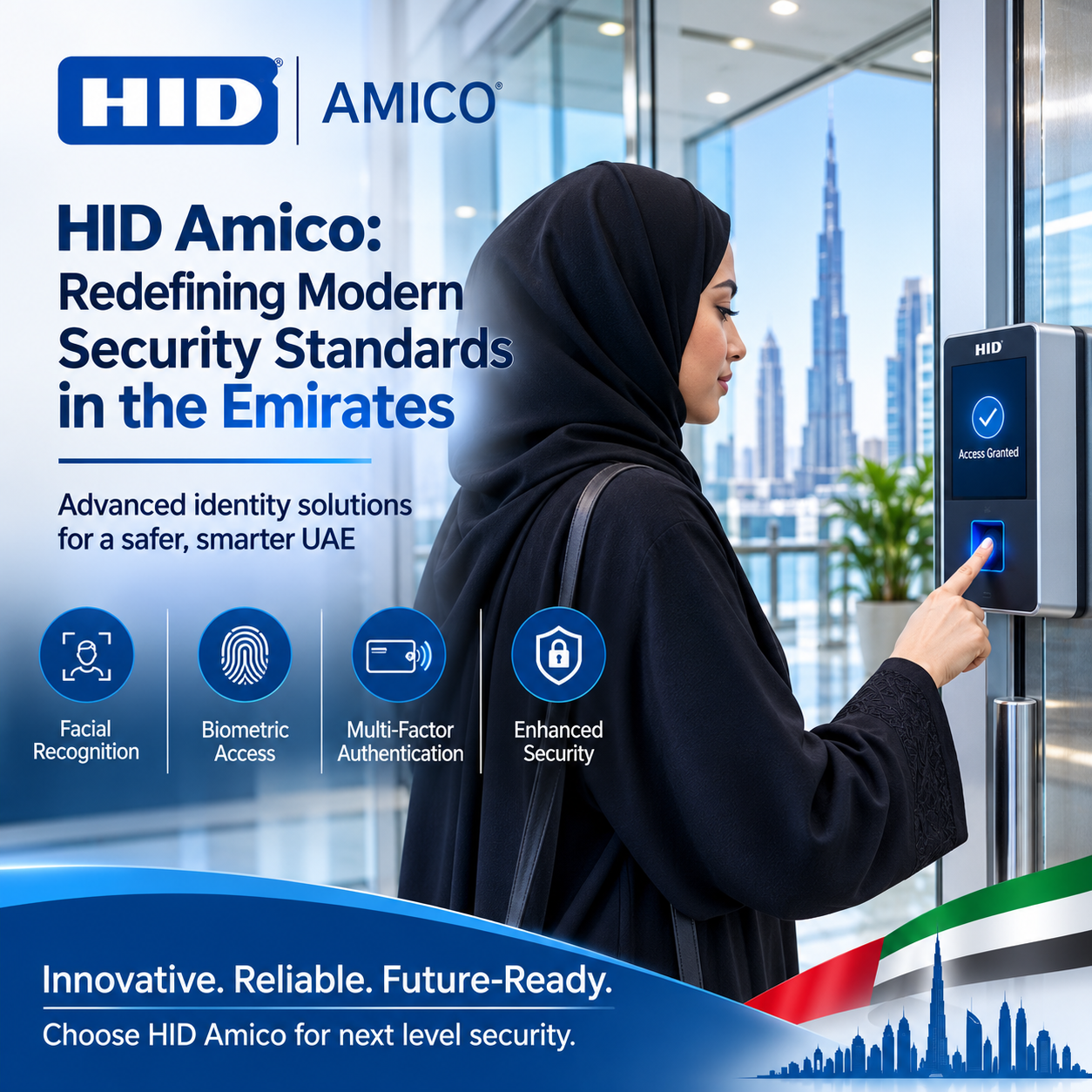
HID Amico is raising the bar for entry security in the Emirates by proving identity at the door in a moment, without cards or touch, and this guide sets out five modern standards that any serious access project should now meet, along with the technology that delivers each one.
Why Standards Are Rising
Towers, hospitals, data centers, and government sites in the Emirates face higher expectations from tenants, insurers, auditors, and regulators. A door that only checks a card no longer satisfies a security review, because cards can be lent, lost, or copied.
Reference points include Dubai Civil Defence, Abu Dhabi Civil Defence, the UAE Fire and Life Safety Code, the Telecommunications and Digital Government Regulatory Authority, and the UAE Personal Data Protection Law.
Standard One: Certainty About Who Enters
HID Amico Facial Recognition confirms the person, not just the credential. It turns a face into an encrypted template and compares it in a fraction of a second, so a borrowed card or shared code no longer opens the door.
The HID Amico Facial Recognition Reader combines camera, screen, and processing in one slim device. It handles caps, glasses, and bright entrance light, and its clear screen tells users at once whether the door will open.
Certainty depends on good placement and tuning as much as on the device. See the face reader and controller range for UAE buildings to understand which units suit which doors.
Standard Two: Resistance to Fakes
AI-Powered Anti-Spoofing studies depth, skin texture, reflections, and tiny movements to reject printed photos, phone videos, and masks. A modern standard cannot allow a photo from social media to open a door.
Liveness Detection proves that a living person is present at that moment. Operators can set stricter levels for treasuries and server rooms and lighter levels for ordinary staff doors.
Standard Three: Resilience at the Door
The HID Aero Controller makes the final decision at the door, checks schedules and permissions, and keeps working when the network drops. It stores events locally and sends them on when the link returns, so no entry goes unrecorded.
Fire Safety First
Doors must release for escape on a fire alarm, and each release should be logged for later review. This is a basic requirement in every approval.
Standard Four: Flexibility for People
HID Mobile Access lets staff, visitors, and contractors open doors with a phone, so a face is not the only option. Permissions can be issued or removed remotely, which suits shared buildings and busy facilities teams.
A complete HID Access Control policy brings readers, controllers, credentials, and software under one set of rules. Changes made once apply everywhere, and reports show who went where and when.
Layered Entry
Ordinary doors can use a face alone, while critical rooms can ask for a face and a phone together. This keeps daily movement smooth and sensitive areas well-guarded.
Standard Five: Respect for Privacy
Face data is personal data. Federal Decree Law Number 45 of 2021 expects clear notice, limited collection, encryption, restricted access, and defined retention. Good practice stores templates instead of photographs, offers a fair alternative to anyone who prefers not to use face checks, and deletes records when people leave. Many organisations also follow ISO 27001 and guidance from the Dubai Electronic Security Center.
Proof Points to Request
Ask for certified engineers, reference sites, written warranties, test results for fake attempts, and a local support team that responds within hours.
Standards in Practice Across the Emirates
A HID Amico UAE project may span several emirates, so policies, enrollment rules, and support should be uniform at every branch. Central management lets a head office see every door in one place.
HID Amico Abu Dhabi deployments often serve government entities, energy companies, hospitals, and the ADGM district, where approval workflows and detailed audit trails are valued.
HID Amico Dubai deployments often serve towers, free zones, hotels, and retail centres, where heat, dust, and heavy foot traffic test devices daily and tenant rules vary floor by floor.
What Changes for Daily Users
Employees notice shorter queues at shift change, fewer replacement cards, and doors that open as they approach. Guests receive a clear and friendly welcome. Security teams gain cleaner reports, faster investigations, and fewer false alarms because rules are tuned to each door and each hour of the day.
Training and Habits
Short sessions for guards, receptionists, and managers explain how to handle exceptions politely, how to report a lost phone quickly, and how to review door reports each week. Clear procedures stop small problems from growing.
Meeting the Standards Step by Step
Audit every door, rank risks, and decide which doors need which level of certainty. Pilot one busy entrance and one restricted room for a month, measuring speed, errors, and user feedback. Expand door by door, train security staff to handle exceptions politely, and review reports every quarter.
Conclusion
HID Amico and HID Amico Facial Recognition set a higher standard for certainty. The HID Amico Facial Recognition Reader works with the HID Aero Controller to keep doors dependable. HID Access Control rules and HID Mobile Access give people flexible entry, while AI-Powered Anti-Spoofing and Liveness Detection shut out fakes. A planned HID Amico UAE programme, including HID Amico Abu Dhabi and HID Amico Dubai sites, stays private and compliant. Contact Tektronix today to book a demonstration.

 English
 Arabic
 French
 Spanish
 Portuguese
 Deutsch
 Turkish
 Dutch
 Italiano
 Russian
 Romaian
 Portuguese (Brazil)
