


Enterprise AI Infrastructure: Building the Foundation for Scalable Enterprise AI
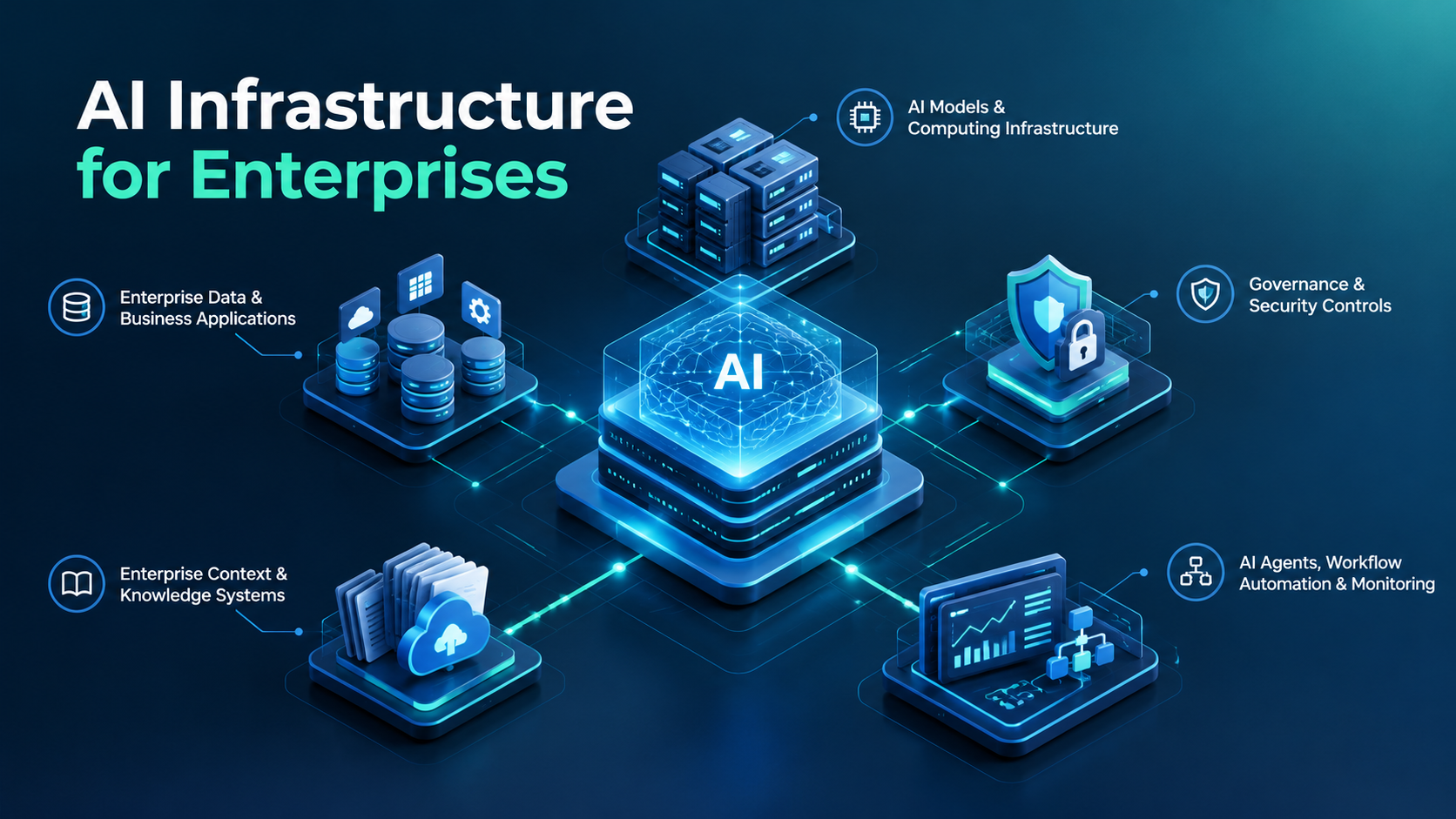
Enterprise AI infrastructure provides the technical foundation organizations need to deploy, integrate, govern, and scale artificial intelligence across business operations. It connects AI models, enterprise data, computing resources, orchestration, and governance controls to help businesses move beyond isolated AI experiments toward reliable, manageable AI systems.
For CIOs, CTOs, and enterprise technology leaders, selecting the right infrastructure is not simply a matter of choosing an AI model. It involves designing an environment where models can access relevant information, applications can coordinate AI workflows, and organizations can maintain visibility and control over how AI systems operate.
What Is Enterprise AI Infrastructure?
Enterprise AI infrastructure is the combination of technology, systems, resources, and controls required to develop, deploy, integrate, and operate AI applications within an organization.
It includes:
-
Computing resources: CPUs, GPUs, cloud infrastructure, and storage required to run AI workloads.
-
AI models: Foundation models, large language models (LLMs), and specialized machine learning models.
-
Data infrastructure: Data pipelines, databases, document repositories, and retrieval systems.
-
Integration and orchestration: APIs, application connections, workflow engines, and AI agent coordination.
-
Governance and security: Identity management, access policies, monitoring, audit trails, and risk controls.
These components work together to make AI systems usable within real business environments.
For example, a financial services company implementing an AI assistant for internal operations needs more than an LLM. It also needs secure access to relevant documents, permission-aware data retrieval, reliable inference, and a way to monitor the assistant's activities.
This broader environment is what enterprise AI infrastructure is designed to support.
Why Do Enterprises Need Dedicated AI Infrastructure?
Organizations often begin their AI journey with individual tools or limited pilot projects. However, expanding those experiments across departments introduces technical and operational challenges.
A structured infrastructure helps address several requirements.
Scalability across business operations
As AI adoption grows, organizations may need to support more users, applications, models, and concurrent requests. Infrastructure should accommodate changing workloads without compromising performance or availability.
Secure access to enterprise information
AI applications may interact with confidential documents, customer information, internal records, and business systems. Access should follow organizational permissions rather than giving every AI application unrestricted information access.
Consistent AI operations
Without shared infrastructure, different teams may build disconnected AI applications with separate integrations, monitoring systems, and management processes.
A common architecture can make these environments easier to manage.
Better cost and resource management
AI workloads have different computing requirements. Model selection, inference routing, workload scheduling, and usage monitoring can help organizations make informed infrastructure decisions.
Governance and accountability
Enterprise AI requires visibility into how models and agents are used, which information they access, and what actions they perform. Governance should be incorporated into the architecture and operational processes.
The NIST AI Risk Management Framework provides a useful reference through its Govern, Map, Measure, and Manage functions.
NIST+1
Core Components of Enterprise AI Infrastructure
A practical enterprise AI architecture consists of interconnected technical and operational layers.
1 AI Models and Inference Infrastructure
AI models provide the intelligence behind applications, while inference infrastructure makes it possible to process requests and generate outputs.
Organizations may use:
-
Commercial foundation models
-
Open-weight language models
-
Fine-tuned or domain-specific models
-
Machine learning models for prediction and classification
Inference infrastructure handles the execution of these models. It may include GPU resources, model-serving systems, APIs, and routing mechanisms.
For example, a company might use one model for document classification and another for complex reasoning. Model selection can depend on performance, cost, latency, privacy, and workload requirements.
2 Enterprise Data and Context Layers
AI models need relevant business information to produce useful outputs for enterprise workflows.
This information may include:
-
Internal documents and policies
-
Customer relationship management records
-
Enterprise resource planning data
-
Standard operating procedures
-
Knowledge bases and historical interactions
A context layer helps connect these sources with AI applications.
Common approaches include retrieval-augmented generation (RAG), semantic search, structured data retrieval, and federated access to external systems.
The distinction matters: some information can be indexed for retrieval, while other information may need to remain in its original system and be queried when required.
3 AI Orchestration and Agent Workflows
AI orchestration coordinates the interactions between models, tools, data sources, and applications.
It can manage:
-
Multi-step AI workflows
-
Model selection and routing
-
API and tool interactions
-
Task delegation between agents
-
Human approval points
-
Workflow execution and error handling
Consider an AI agent supporting procurement operations. It may retrieve supplier information, compare purchase requirements, prepare a recommendation, and request human approval before a purchase action is completed.
Orchestration connects these steps into a managed workflow.
4 Security, Governance, and Access Controls
Security and governance should operate across the entire AI infrastructure rather than being treated as separate final-stage additions.
Important capabilities include:
-
Identity and role-based access management
-
Data access restrictions
-
Model and application permissions
-
Policy enforcement
-
Audit logging
-
Human oversight
-
Risk assessment and incident management
The NIST AI RMF offers organizations a structured approach to identifying, assessing, and managing AI-related risks throughout the system lifecycle.
5 Monitoring and Observability
Monitoring helps technology teams understand whether AI systems are operating as expected.
Useful monitoring areas include:
-
Model response quality
-
Inference latency
-
Resource consumption
-
Workflow execution failures
-
Agent activity
-
Access events
-
Policy violations
Observability provides information about system behaviour so teams can investigate problems, identify patterns, and improve operations.
For enterprises, monitoring should cover not only model performance but also the wider application, data, and governance environment.
Enterprise AI Infrastructure vs. Enterprise AI Platform
The terms enterprise AI infrastructure and enterprise AI platform are related, but they describe different aspects of an organization's AI environment.
|
Comparison |
Enterprise AI Infrastructure |
Enterprise AI Platform |
|
Primary role |
Provides the technical foundation |
Provides an environment to build and manage AI applications |
|
Focus |
Compute, storage, networking, models, data, and security |
Development, deployment, integration, orchestration, and management |
|
Main users |
Infrastructure teams, architects, IT leaders |
Developers, data scientists, AI teams, business users |
|
Scope |
Underlying resources and architecture |
Tools and services built on or connected to infrastructure |
|
Objective |
Support reliable AI operations |
Simplify AI application development and use |
An enterprise AI platform may use several infrastructure components, while enterprise AI infrastructure can support multiple platforms and applications.
For example, a business may operate its AI infrastructure across cloud and private environments while using an enterprise AI platform to develop internal assistants, document-processing applications, and agent-based workflows.
The right choice depends on existing technology, security requirements, deployment preferences, and the organization's AI maturity.
How Enterprise AI Infrastructure Supports AI Agents
AI agents introduce additional infrastructure requirements because they can interact with tools, retrieve information, and execute multi-step tasks.
Unlike a basic chatbot that primarily responds to user prompts, an AI agent may need to:
-
Understand a task and identify the required steps.
-
Retrieve relevant business context.
-
Select an appropriate model or tool.
-
Interact with authorized enterprise applications.
-
Evaluate the result and continue the workflow.
-
Request human approval when required.
-
Record actions for monitoring and review.
This requires an infrastructure that supports model access, context management, tool connectivity, identity controls, and workflow monitoring.
For instance, an enterprise service desk agent may retrieve an employee's support history, check approved knowledge resources, and prepare a ticket update. Its permissions should determine which records it can access and which actions it can perform.
As agent adoption expands, organizations need to consider governance at the workflow and action level, not just at the model level.
Key Challenges in Enterprise AI Infrastructure
Building an enterprise AI environment involves several practical challenges.
Data fragmentation: Business information is often spread across multiple applications, databases, and document repositories. Connecting these sources without weakening existing access controls requires careful integration.
Legacy system compatibility: Older enterprise applications may not provide modern APIs or straightforward integration methods.
Model selection: Different models have different performance, cost, privacy, and deployment characteristics. Choosing a suitable model requires testing against actual business tasks.
Security and privacy: AI applications may introduce new pathways through which sensitive information can be accessed or exposed.
Operational complexity: Multiple models, agents, workflows, and integrations can become difficult to monitor and maintain.
Governance gaps: Organizations may lack clear ownership, documented policies, or visibility into how AI applications behave after deployment.
These challenges demonstrate why enterprise AI infrastructure requires coordinated planning across IT, security, data, compliance, and business teams.
Best Practices for Building an Enterprise AI Infrastructure Strategy
Enterprises should approach infrastructure planning as a long-term technology and governance initiative.
Start with business requirements
Identify the business problems AI is expected to solve. Examples include customer support, document processing, internal knowledge discovery, risk analysis, and workflow automation.
Define measurable objectives before selecting infrastructure or models.
Evaluate deployment options
Consider whether workloads should run in public cloud, private cloud, on-premises environments, or a hybrid architecture.
The decision should account for data sensitivity, latency, regulatory obligations, infrastructure costs, and operational capabilities.
Establish an enterprise data strategy
Identify the data sources AI applications need to access. Define ownership, permissions, quality requirements, update frequency, and integration methods.
Avoid connecting AI applications to enterprise data without considering access restrictions.
Build governance into the architecture
Establish policies for model usage, data access, agent permissions, human approvals, and auditability.
Assign responsibility for monitoring and reviewing AI systems after deployment.
Monitor performance continuously
Track model quality, response times, infrastructure consumption, workflow failures, and security events.
Use monitoring results to improve configurations, address operational issues, and evaluate whether AI systems continue meeting business requirements.
How to Evaluate Enterprise AI Infrastructure for Business Needs
Before selecting an enterprise AI infrastructure solution, decision-makers should assess it against their technical and operational requirements.
|
Evaluation area |
Questions to consider |
|
Scalability |
Can it accommodate growing workloads and users? |
|
Model flexibility |
Does it support the models required by business applications? |
|
Data integration |
Can it connect with existing enterprise systems? |
|
Security |
Are identity, access, and data protection controls available? |
|
Governance |
Can policies and permissions be enforced and reviewed? |
|
Observability |
Can teams monitor models, agents, and workflows? |
|
Deployment |
Does it support the organization's cloud, private, or hybrid requirements? |
|
Cost management |
Can resource usage and inference costs be monitored? |
A useful evaluation process also includes a pilot project. Select a specific business workflow, test the architecture against real operational requirements, and document its limitations before expanding deployment.
Future Considerations for Enterprise AI Infrastructure
Enterprise AI infrastructure will continue to evolve as organizations adopt more advanced models, autonomous agents, and interconnected AI applications.
Several developments deserve attention.
Growth of agent-based workflows
AI agents are increasingly being explored for tasks involving multiple systems and business processes. Infrastructure will need stronger coordination, permissions, monitoring, and action-level governance.
Greater focus on AI governance
Organizations will need to understand not only which models are deployed but also how AI applications access data, interact with tools, and make decisions.
Context-aware enterprise AI
Generic model knowledge is often insufficient for specialized business tasks. Enterprise context layers can help AI applications work with organizational knowledge, historical information, and relevant business data.
Model flexibility and inference optimization
Businesses may use different models for different workloads. Model routing and inference management can help align model selection with performance, cost, and deployment requirements.
Sovereign and hybrid AI environments
Data residency, deployment location, and control over inference environments may become important considerations for organizations with specific security or regulatory requirements.
These developments make infrastructure planning an ongoing process rather than a one-time implementation decision.
THQ.digital and the Enterprise AI Control Layer
THQ.digital focuses on enterprise AI governance, intelligence, and inference through three distinct pillars:
-
Ritvam – Governance: Provides the governance and control plane for policy enforcement, risk management, and auditability.
-
Sutra – Intelligence: Provides enterprise context and memory capabilities, connecting AI applications with organizational knowledge and relevant data sources.
-
MIRA – Inference: Focuses on sovereign inference and intelligent model routing.
Together, these capabilities address different requirements within an enterprise AI environment: controlling AI activity, providing relevant enterprise context, and managing model inference.
Organizations evaluating how to connect these capabilities can explore the THQ.digital enterprise AI architecture and intelligence approach.
Key Takeaways
Enterprise AI infrastructure is the foundation that enables organizations to deploy and operate AI systems across business functions.
The most important considerations include:
-
Infrastructure must support models, data, applications, and enterprise workflows.
-
An enterprise AI platform and enterprise AI infrastructure serve related but different purposes.
-
Data connectivity and context management are essential for business-relevant AI applications.
-
AI agent adoption requires workflow-level permissions, monitoring, and governance.
-
Security and accountability should be built into the architecture.
-
Continuous evaluation helps organizations adapt infrastructure as AI requirements change.
A well-planned infrastructure strategy helps enterprises approach AI adoption as a connected technology and operational capability rather than a collection of disconnected tools.
Frequently Asked Questions
Q1. What is enterprise AI infrastructure?
Enterprise AI infrastructure is the combination of computing resources, AI models, data systems, integrations, orchestration, security, and governance capabilities required to deploy and operate AI applications across an organization.
Q2. Why is enterprise AI infrastructure important?
It helps organizations integrate AI with business systems, manage computing resources, protect enterprise information, monitor AI operations, and support the expansion of AI applications across departments.
Q3. What is the difference between enterprise AI infrastructure and an enterprise AI platform?
Enterprise AI infrastructure provides the underlying technical foundation, including compute, storage, networking, data, and security. An enterprise AI platform provides tools and services for developing, deploying, integrating, and managing AI applications.
Q4. What are the main components of enterprise AI infrastructure?
The main components include computing resources, AI models, inference systems, enterprise data integration, context management, orchestration, security controls, governance, and observability.
Q5. How does enterprise AI infrastructure support AI agents?
It provides the model access, data connectivity, tool integrations, permissions, workflow orchestration, and monitoring that AI agents need to perform tasks within defined enterprise boundaries.
Q6. How can organizations choose the right enterprise AI infrastructure?
Organizations should evaluate their business objectives, data requirements, deployment preferences, model flexibility, security controls, governance needs, scalability, and operational costs before selecting an architecture.

 English
 Arabic
 French
 Spanish
 Portuguese
 Deutsch
 Dutch
 Italiano
 Russian
 Romaian
 Portuguese (Brazil)
 Greek
