


HID Amico in Saudi Arabia: A Future Ready Platform for Smart Building Access
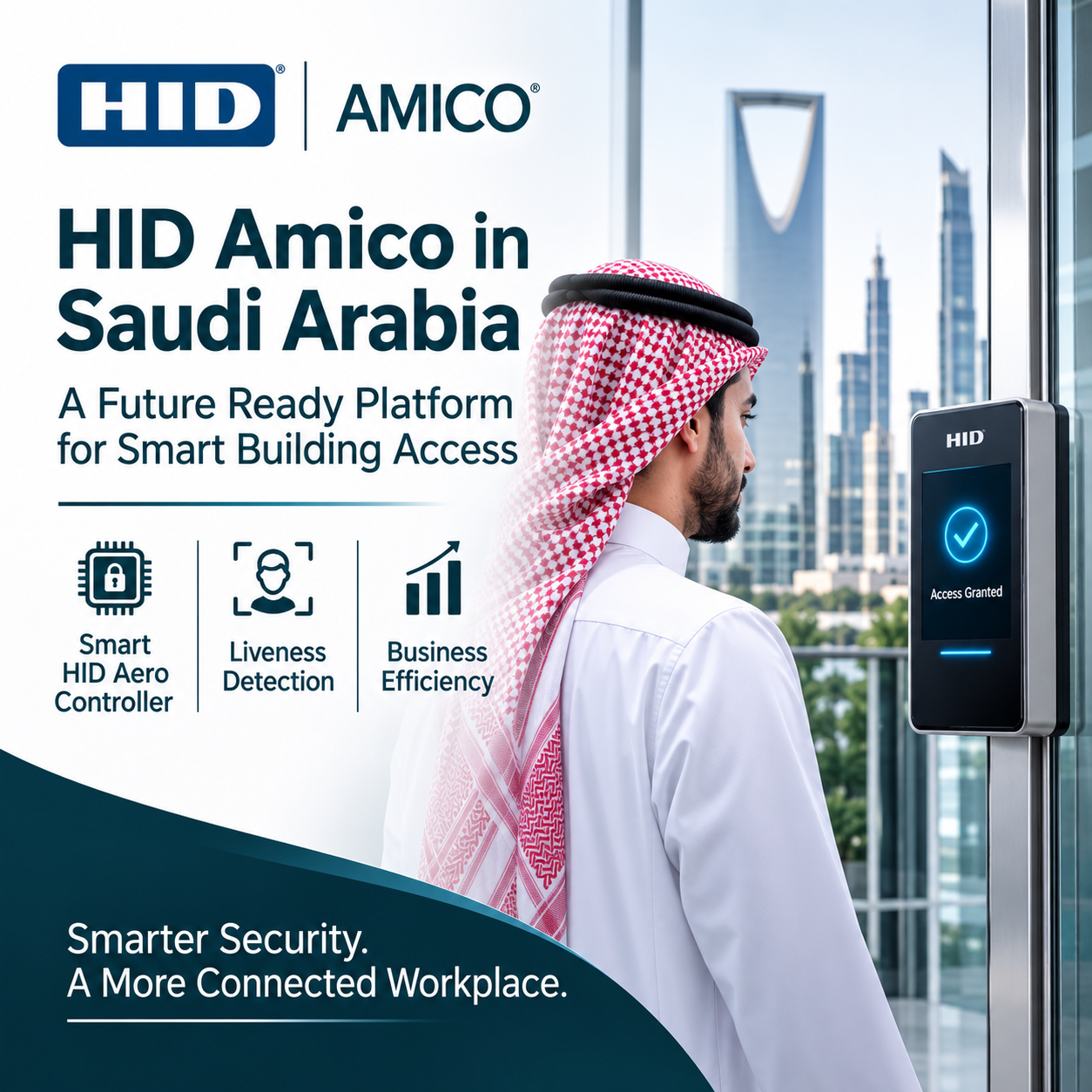
New towers, campuses, and mixed use developments across the Kingdom are being designed around one expectation: people should walk into a building without stopping to search for a card. HID Amico is a facial recognition reader from HID Global built for exactly that experience, combining a touchless entry method with the security and audit features that Saudi facility managers require.
Tektronix supplies and installs HID security hardware across Saudi Arabia, and its HID Amico solution for Saudi buildings helps owners and tenants bring this technology into new and existing premises. This article explains how the platform works, how it fits with the wider HID ecosystem, and what to consider when planning a deployment.
What Makes a Building Future Ready?
A future ready building is one that can change without being rebuilt. Tenants move, headcounts grow, credentials evolve from cards to phones, and security policies tighten after an incident or a regulatory update. Access control that depends on a single card format or a closed software package locks the owner into yesterday's choices. Open, flexible readers and controllers allow an organization to add new credential types and new doors over time while keeping the same core platform.
HID Amico Facial Recognition for Touchless Entry
HID Amico Facial Recognition lets an enrolled person approach a door, look toward the reader, and be admitted within moments, with no card to present and no keypad to touch. In busy lobbies at shift change or lunchtime, this speeds up flow noticeably, and it removes the problem of forgotten or borrowed cards. Because the credential is the person, it also supports clear accountability for who entered a space and when.
HID Amico Biometric Reader Hardware and Credential Choice
The HID Amico Biometric Reader supports more than one way to authenticate on the same unit. Alongside face matching it can work with existing HID cards, mobile credentials, QR codes, and a PIN, so an organization can set a different level of assurance for each door. A general office entrance might rely on a face match alone, while a finance floor or server room can require a face match plus a card or PIN. The reader is offered in different screen sizes, which lets designers match the device to the look and traffic of each location.
HID Aero Controller as the Decision Engine
Behind every reader sits a controller that makes the actual access decision. The HID Aero Controller belongs to a family built on HID's established Mercury technology, and it is designed to be flexible for installers and secure for owners. It supports encrypted communication with the host software, manages door logic and anti passback rules, and can keep enforcing permissions locally if the network connection is interrupted. This resilience matters for towers and campuses that cannot afford a front door that stops working because of a network fault.
HID Access Control as an Open Ecosystem
Many Saudi buildings already contain HID readers and credentials, installed over years by different contractors. A complete HID Access Control ecosystem lets an owner add new devices alongside existing ones rather than replacing everything at once. Facial recognition can be introduced first at the main lobby and executive floors, while older card readers continue to serve secondary doors until their natural replacement date. This phased path protects earlier investment and spreads cost over several budget cycles.
HID Mobile Access for Staff, Tenants, and Visitors
HID Mobile Access places a secure credential on a smartphone, so that employees, residents, and invited guests can open doors without carrying a separate card. Administrators issue and revoke credentials remotely within minutes, which suits buildings with high tenant turnover or large contractor populations. Combined with a facial reader, the same person can use a phone at one door and their face at another, using whichever method suits the situation.
AI Powered Anti Spoofing and Why It Matters
Any facial reader faces the same attack: someone holds up a photograph, a video, or a mask and hopes the device is fooled. AI Powered Anti Spoofing analyzes what the camera sees using trained models that distinguish a real face from a printed or displayed copy. Strong protection against these presentation attacks is what separates a secure deployment from one that merely looks modern, and buyers should ask suppliers how this protection has been tested.
Liveness Detection in Everyday Operation
Liveness Detection checks that the face in front of the camera belongs to a living person present at that moment. It looks for natural cues such as depth, texture, and subtle movement that a flat image or a recorded video cannot reproduce convincingly. Done well, the check happens in the background without asking users to blink or turn their heads, so security improves without adding friction at the door.
HID Amico KSA: Fitting Saudi Building Requirements
Saudi buildings place unusual demands on hardware, including strong sunlight near glazed lobbies, high ambient temperatures, and large numbers of people passing through at the same moment. HID Amico KSA projects should therefore begin with a site survey that checks lighting, mounting height, and approach paths, because these factors influence recognition quality as much as the reader itself. Owners must also meet the Personal Data Protection Law, which affects how templates are stored and how long records are kept.
HID Amico Riyadh: Towers, Campuses, and Giga Projects
The capital is the centre of commercial and government construction, with headquarters towers, business parks, and large mixed use districts rising rapidly. HID Amico Riyadh installations typically combine facial entry at main lobbies with mobile credentials for tenants and visitors, and connect to parking, visitor management, and building systems so that one identity follows a person through the whole journey from the car park to the office floor.
Data Privacy and Responsible Biometrics
Facial templates are personal data, and organizations should treat them with care. A responsible deployment documents consent, collects only what is needed, stores templates securely, sets a clear retention period, and removes a person's record when they leave. Some HID options allow templates to be held on the credential rather than in a central database, which suits organizations that prefer to limit centralized storage. Employers should confirm requirements with their own legal advisers before deployment.
Integrating with Smart Building Systems
Access control delivers more value when it shares data. Linking entry events with visitor management gives guests temporary credentials that expire automatically. A connection with CCTV lets security staff pull up video for any door event, and a link to fire alarm panels ensures doors release reliably on escape routes. Occupancy counts from entrances can also guide lighting and cooling in unused zones, turning the access system into a contributor to energy savings as well as security.
Planning, Rollout, and Maintenance
A smooth deployment starts with a survey, continues with a pilot at one or two doors, and then expands floor by floor. Enrollment quality has a large effect on daily performance, so owners should schedule well-lit enrollment sessions rather than rushing capture. After handover, a maintenance agreement covering cleaning, firmware updates, and fast replacement of faulty units keeps readers performing as designed over the long term.
Designing the Arrival Experience
The moment a person reaches a door shapes how they feel about a building. Readers mounted at a comfortable height, with clear feedback lights and a visible indication of success, make entry feel effortless. Placing readers beyond reflective glass, away from strong backlight, and at the correct approach distance improves recognition and reduces the repeated attempts that frustrate users. Architects and security consultants who agree on reader positions early avoid costly changes after construction has finished.
Supporting Accessibility and Inclusive Design
Touchless entry helps many people, including those carrying equipment, pushing trolleys, or using wheelchairs, because they do not need to reach for a card or keypad. Buildings should still provide alternatives, such as a card or mobile credential, for individuals who cannot or prefer not to use facial recognition. Offering several methods on the same reader keeps the building welcoming while preserving a consistent level of security for every door.
Measuring Performance After Go Live
Once the system is running, administrators should track how often legitimate users are rejected, how long a typical entry takes at peak hours, and which doors generate the most support calls. A rise in rejections at one door usually points to a lighting or positioning issue rather than a fault in the platform. Reviewing these figures monthly during the first quarter allows small adjustments to be made quickly, so that daily operation stays smooth as more users are enrolled.
Engineering Experience and Trust Behind Every Deployment
Tektronix has engineered and commissioned access control and biometric deployments across Saudi Arabia and the wider Gulf for well over a decade. An in-house engineering team handles site surveys, network integration, and controller configuration rather than passing installation to a subcontractor unfamiliar with the HID product line, and regional support and spare parts keep a failed reader from leaving a door unprotected for long.
Technical documentation covering supported credentials, integration options, and controller specifications is available through the company's HID Amico biometric reader page, giving owners and consultants verifiable detail to review rather than a marketing summary alone.
Choosing the Right Partner for a Saudi Deployment
Selecting a supplier is as much about experience as hardware. Owners should ask about similar projects, how enrollment and data retention are handled, how the platform integrates with existing systems, and how quickly local engineers can respond. Organizations that want one accountable partner for readers, controllers, software, and support can review Tektronix's full range of HID biometric access control products before finalizing a shortlist.
Conclusion
HID Amico gives Saudi buildings a fast, touchless way to control entry without sacrificing security. HID Amico Facial Recognition and the HID Amico Biometric Reader support face, card, mobile, and PIN credentials on one device. A HID Aero Controller and an open HID Access Control ecosystem let owners add new doors and credentials over time. HID Mobile Access extends credentials to phones, while AI Powered Anti Spoofing and Liveness Detection keep every match genuine. Owners planning HID Amico KSA and HID Amico Riyadh projects should choose a partner like Tektronix with proven local engineering and support.

 English
 Arabic
 French
 Spanish
 Portuguese
 Deutsch
 Turkish
 Dutch
 Italiano
 Romaian
 Portuguese (Brazil)
 Greek
