


Fibreglass Wool Market to Reach USD 23.0 Billion by 2034 at 5.5% CAGR
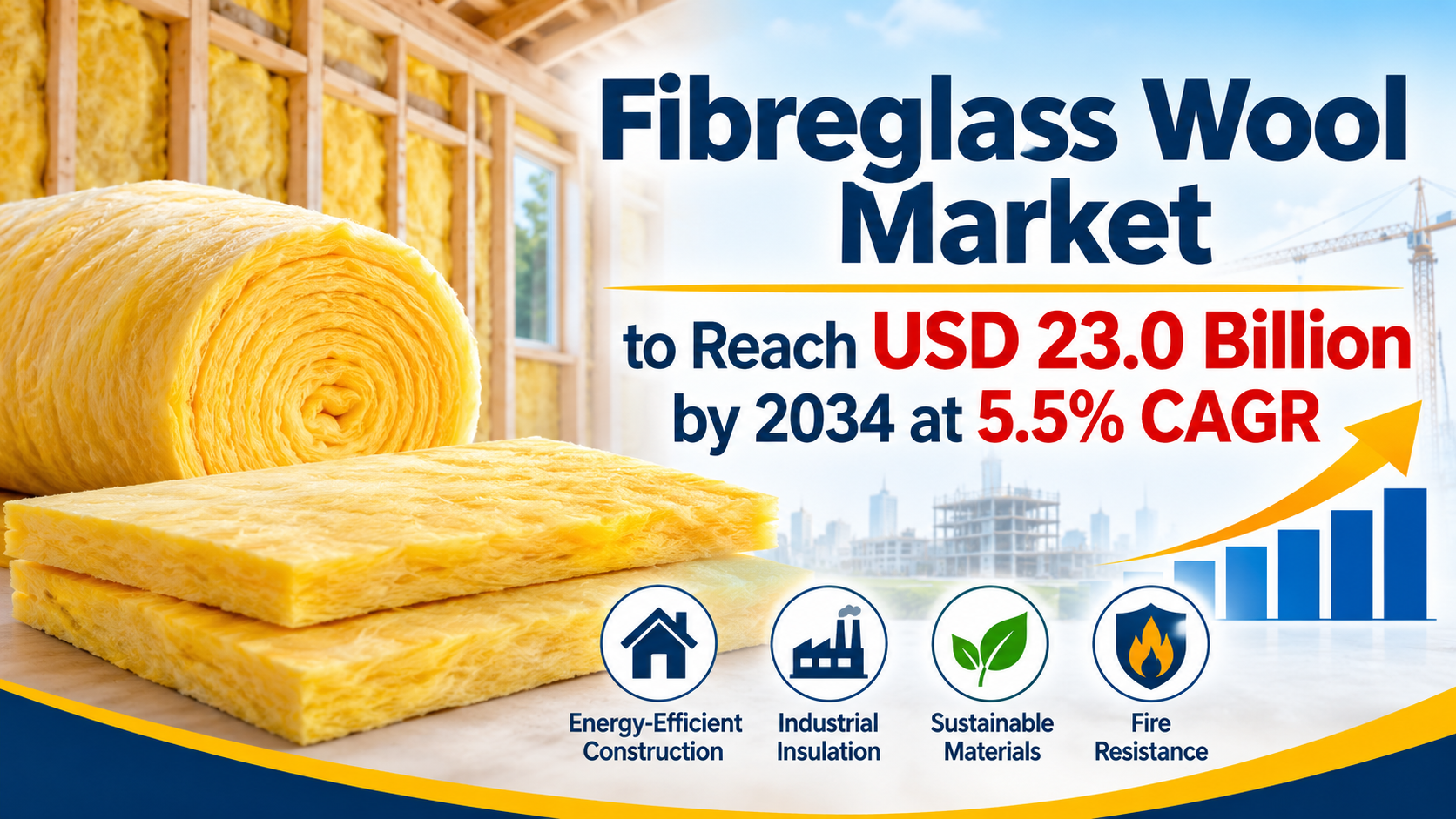
Global Fibreglass Wool Market is gaining attention across residential construction, commercial buildings, industrial insulation, HVAC systems, and infrastructure development. Fibreglass wool is an insulation material made from fine glass fibers produced from molten glass. It provides thermal insulation, acoustic performance, and fire resistance, making it suitable for applications requiring energy efficiency, temperature control, and noise reduction.
According to 24ChemicalResearch, the global fibreglass wool market was valued at USD 14.2 billion in 2025 and is projected to grow from USD 14.9 billion in 2026 to USD 23.0 billion by 2034, registering a CAGR of 5.5% during the forecast period. Market growth is supported by increasing demand for energy-efficient construction, stricter building insulation standards, expanding industrial insulation projects, and growing adoption of recycled materials and low-carbon manufacturing processes.
Read the Complete Fibreglass Wool Market Report:
https://www.24chemicalresearch.com/reports/289785/fibreglass-wool-market
Fibreglass Wool Market Overview
Fibreglass wool plays an important role in improving the thermal and acoustic performance of buildings and industrial facilities. It is manufactured using fine glass fibers and is available in different forms, including loose-fill, batts, rolls, and boards. These products are used in residential, commercial, and industrial environments to reduce heat transfer, improve sound absorption, and support energy-efficient operations.
The material offers thermal insulation performance, with reported R-values ranging from R-3.1 to R-4.3 per inch. Its flexibility, relatively low cost, and insulation properties make it suitable for a wide range of construction and industrial applications.
The market is benefiting from increasingly stringent building energy-efficiency regulations across North America and Europe. At the same time, industrial manufacturers are adopting fibreglass wool for cold-storage facilities, chemical plants, power-generation equipment, and other applications requiring reliable insulation under demanding temperature conditions.
Manufacturers are also focusing on recycled glass content, low-carbon production processes, and improved insulation formulations to address sustainability requirements and changing construction industry preferences.
What Is Driving the Fibreglass Wool Market?
1. Stringent Energy-Efficiency Regulations
Increasingly strict building energy-efficiency regulations are encouraging developers to adopt high-performance insulation materials. Fibreglass wool offers favorable thermal conductivity and cost advantages, making it suitable for meeting insulation requirements in residential and commercial construction.
Demand is also supported by renovation and retrofit projects that aim to improve the energy performance of existing buildings.
2. Rising Demand for Industrial Insulation
Industrial facilities, including cold-storage buildings, chemical plants, and power-generation equipment, require insulation materials capable of maintaining performance under different temperature conditions.
Fibreglass wool provides thermal insulation and fire-resistance properties, supporting its adoption in industrial environments where temperature control and operational reliability are important.
3. Expansion of Prefabricated Construction
The increasing use of prefabricated building modules is creating additional demand for fibreglass wool. Manufacturers of modular homes and office units use the material in insulation panels because it can be cut to precise dimensions and integrated into building components.
This supports faster assembly, reduces on-site material waste, and improves construction efficiency.
Read the Complete Report:
https://www.24chemicalresearch.com/reports/289785/fibreglass-wool-market
Manufacturing Costs and Market Challenges
The fibreglass wool market faces several challenges related to installation requirements, raw material availability, production costs, and customer perceptions.
Installation Skill Gaps
Proper installation is important for achieving the expected thermal insulation performance. In some emerging markets, limited contractor training in seam sealing and vapor barrier integration can result in air leakage and reduced insulation effectiveness.
These installation-related issues may slow adoption despite the material's cost and performance advantages.
Supply-Chain Volatility
Fluctuations in glass fibre feedstock prices and transportation disruptions can create uncertainty in manufacturing and distribution costs. Smaller distributors may face difficulties maintaining stable pricing, particularly when raw material availability becomes limited.
Health Perception Issues
Some workers and homeowners continue to associate fibreglass wool with potential irritation and health concerns. These perceptions can influence purchasing decisions and encourage the selection of alternative insulation materials, particularly in residential construction.
Where Are the Opportunities in the Fibreglass Wool Market?
Emerging Green-Building Certifications
Growing adoption of green-building certification programs, including LEED and BREEAM, is creating opportunities for fibreglass wool manufacturers. Products containing recycled glass and low-VOC binders can help meet sustainability requirements in construction projects.
Manufacturers that document recycled content and lower-carbon production processes may benefit from increasing demand for environmentally oriented insulation materials.
Sustainability and Recycling Initiatives
The use of recycled glass fibres is becoming an important product-development focus. Incorporating reclaimed materials can reduce dependence on virgin silica sand and support efforts to lower the carbon intensity of manufacturing.
Companies investing in recycled-content formulations and improved production technologies can strengthen their competitive position.
Industrial Insulation Expansion
Increasing investment in petrochemical plants, power-generation facilities, and industrial processing equipment is creating opportunities for high-density fibreglass wool products.
Demand for insulation materials that provide thermal performance and durability under demanding operating conditions can support further market development.
Growing Construction in Emerging Economies
Rapid urbanization and infrastructure development in China, India, and Southeast Asian economies are increasing demand for residential and commercial insulation.
Government-backed housing initiatives and infrastructure investments are creating opportunities for manufacturers to expand production capacity and distribution networks in emerging markets.
Download the Free Sample Report:
https://www.24chemicalresearch.com/reports/289785/fibreglass-wool-market
Fibreglass Wool Market Segmentation
The global fibreglass wool market can be examined across product type, application, end-user, material form, and distribution channel categories.
By Type
-
Glass Wool
-
Rock Wool
Glass Wool is identified as the leading segment due to its thermal insulation performance in residential construction. Rock wool is also used in demanding industrial environments where higher temperature resistance is important.
Manufacturers focus on product differentiation through improved fire ratings, acoustic performance, and ease of handling.
By Application
-
Residential
-
Commercial
-
Industrial
-
HVAC
Residential applications represent the dominant segment, supported by housing development and demand for energy-efficient wall and roof insulation. Commercial construction uses fibreglass wool to meet building-code requirements and improve occupant comfort.
Industrial applications are expanding as manufacturers prioritize process heat retention and energy savings, while HVAC systems use the material for duct and pipe insulation.
By End User
-
Construction Companies
-
Industrial Manufacturers
-
HVAC Contractors
Construction Companies represent the primary end-user category. These companies specify fibreglass wool for wall, roof, and floor insulation to support building energy-efficiency requirements.
Industrial manufacturers use the material for equipment and plant insulation, while HVAC contractors integrate it into ductwork and system components.
By Material Form
-
Loose-fill
-
Batts
-
Rolls
-
Boards
Batts and Rolls lead the material-form segment because they allow rapid and repeatable installation in conventional building cavities. Loose-fill products provide flexibility for irregular spaces and retrofit projects, while boards are used in exterior insulation systems requiring higher density.
By Distribution Channel
-
Direct Sales
-
Distributors
-
Retailers
-
Online
Distributors dominate the distribution channel landscape by connecting manufacturers with professional installers and large-scale construction projects. Retailers serve DIY customers and smaller contractors, while direct sales support major projects requiring customized specifications.
Online platforms are also emerging as sourcing channels by providing product information, quotations, and streamlined ordering processes.
Regional Outlook
North America
North America is identified as the leading region in the fibreglass wool market. Established building codes, strong energy-efficiency requirements, and a developed network of insulation suppliers and installers support regional demand.
Retrofit activities in existing commercial buildings and increasing attention to low-VOC insulation materials further contribute to the region's market position.
Key Highlights:
-
Strong building energy-efficiency regulations.
-
Consistent demand for building renovation and retrofit projects.
-
Established insulation manufacturing and distribution networks.
-
Increasing adoption of low-emission production technologies.
-
Investment in sustainable insulation products.
Asia-Pacific
Asia-Pacific is identified as an emerging region with significant growth potential. Urbanization, residential construction, commercial infrastructure development, and industrial expansion across China, India, and Southeast Asia are supporting market demand.
Government-backed housing programs and increasing investment in energy-efficient buildings are encouraging the adoption of fibreglass wool insulation products.
Key Highlights:
-
Rapid urbanization and infrastructure development.
-
Increasing residential and commercial construction.
-
Expanding industrial insulation requirements.
-
Growing demand for affordable insulation materials.
-
Investment in manufacturing capacity and local supply chains.
Europe
Europe's fibreglass wool market is increasingly influenced by sustainability requirements and carbon-reduction objectives. Environmental regulations and green-building certification programs are encouraging manufacturers to develop products with higher recycled content and lower-VOC formulations.
Investment in recycling systems, energy-efficient manufacturing, and environmentally oriented insulation technologies is supporting regional market development.
Key Highlights:
-
Increasing focus on carbon-neutral production.
-
Growing use of recycled glass fibres.
-
Development of low-VOC insulation products.
-
Expansion of green-building certification initiatives.
-
Collaboration between insulation manufacturers and material suppliers.
Middle East and Africa
The Middle East and Africa offer opportunities for fibreglass wool market expansion through infrastructure development, housing investment, and demand for thermal insulation in climate-sensitive environments.
Growing investment in power plants, industrial facilities, and construction projects can create opportunities for suppliers offering cost-effective insulation solutions.
Key Highlights:
-
Infrastructure and housing development.
-
Demand for thermal insulation in hot climates.
-
Industrial and power-generation investments.
-
Opportunities for local manufacturing and distribution.
-
Increasing attention to energy-efficient construction.
Read the Complete Fibreglass Wool Market Report:
https://www.24chemicalresearch.com/reports/289785/fibreglass-wool-market
Competitive Landscape
The fibreglass wool market includes multinational insulation manufacturers and specialized material suppliers competing through production capacity, product quality, sustainability initiatives, distribution networks, and technological development.
Owens Corning and Saint-Gobain are among the established companies with extensive manufacturing operations across major markets. Knauf Insulation and Johns Manville also maintain significant positions through their regional manufacturing and distribution networks.
Other participants, including China Jushi Co., Ltd., Asahi Glass Co., and PPG Industries, contribute to competition through product development, manufacturing investments, and improvements in insulation technologies.
Key Companies Profiled in the Report
-
Owens Corning (USA)
-
Saint-Gobain (France)
-
Knauf Insulation (Germany)
-
Johns Manville (USA)
-
China Jushi Co., Ltd. (China)
-
Asahi Glass Co. (Japan)
-
PPG Industries (USA)
Other companies covered in the report include Alghanim Industries, CSR Bradford, URSA Insulation, Nippon Electric Glass, Sisecam Group, Saertex Group, Nitto Boseki, CertainTeed Corporation, Fibertec, and other industry participants.
These companies compete through manufacturing expansion, product innovation, recycled-material integration, and the development of insulation solutions for residential, commercial, and industrial applications.
What Does the Fibreglass Wool Market Report Cover?
The report provides a comprehensive analysis of the global fibreglass wool market from 2026 to 2034, including historical market data, forecasts, segmentation, regional analysis, and competitive assessments.
Key areas covered include:
-
Global market size and forecast analysis (2020–2034).
-
Historical market performance (2020–2025).
-
Market trends and growth drivers.
-
Industry challenges and market restraints.
-
Market segmentation by type and application.
-
Analysis by end user and material form.
-
Regional market assessment.
-
Competitive landscape and company profiles.
-
Manufacturer sales and revenue analysis.
-
Production capacity and utilization analysis.
-
Pricing, gross margins, and market share.
-
Import, export, and regional trade analysis.
-
Market opportunities and future industry developments.
The report also examines production methods, raw material costs, industry developments, mergers and acquisitions, and future projects.
Key Report Highlights
-
Market Size: The global fibreglass wool market was valued at USD 14.2 billion in 2025.
-
2026 Market Value: The market is projected to reach USD 14.9 billion in 2026.
-
Forecast Value: The market is expected to reach USD 23.0 billion by 2034.
-
Growth Rate: The market is projected to register a CAGR of 5.5% during 2026–2034.
-
Key Growth Driver: Increasing demand for energy-efficient construction and stricter building insulation regulations.
-
Leading Type: Glass Wool.
-
Major Application: Residential construction.
-
Primary End User: Construction companies.
-
Leading Region: North America.
-
Emerging Region: Asia-Pacific.
-
Market Opportunities: Recycled glass fibres, green-building certifications, industrial insulation, and sustainable manufacturing.
Frequently Asked Questions (FAQs)
1. What is the global fibreglass wool market size?
The global fibreglass wool market was valued at USD 14.2 billion in 2025.
2. What is the projected market value by 2034?
The market is projected to reach USD 23.0 billion by 2034.
3. What is the expected CAGR of the fibreglass wool market?
The market is expected to grow at a CAGR of 5.5% during 2026–2034.
4. Which region leads the fibreglass wool market?
North America is identified as the leading region, while Asia-Pacific represents an emerging growth market.
5. What are the major factors driving market growth?
Key factors include energy-efficiency regulations, increasing construction activities, industrial insulation demand, prefabricated construction, and sustainability initiatives.
6. Who are the major companies operating in the market?
Key companies include Owens Corning, Saint-Gobain, Knauf Insulation, Johns Manville, China Jushi Co., Ltd., Asahi Glass Co., and PPG Industries.
Complete Market Report:
https://www.24chemicalresearch.com/reports/289785/fibreglass-wool-market
Free Sample Report:
https://www.24chemicalresearch.com/reports/289785/fibreglass-wool-market
About 24ChemicalResearch
24ChemicalResearch provides market research and industry analysis covering chemicals, materials, and related industrial sectors. Its reports examine market size, growth forecasts, segmentation, competitive landscapes, and industry developments to support business research and strategic planning.
Contact Us
Website: 24ChemicalResearch
https://www.24chemicalresearch.com/
Phone: +91 9169162030
Email: help@24chemicalresearch.com

 Arabic
 French
 Spanish
 Portuguese
 Deutsch
 Turkish
 Dutch
 Italiano
 Russian
 Romaian
 Portuguese (Brazil)
 Greek
