


BIS FMCS Certification: Complete Guide for Foreign Manufacturers
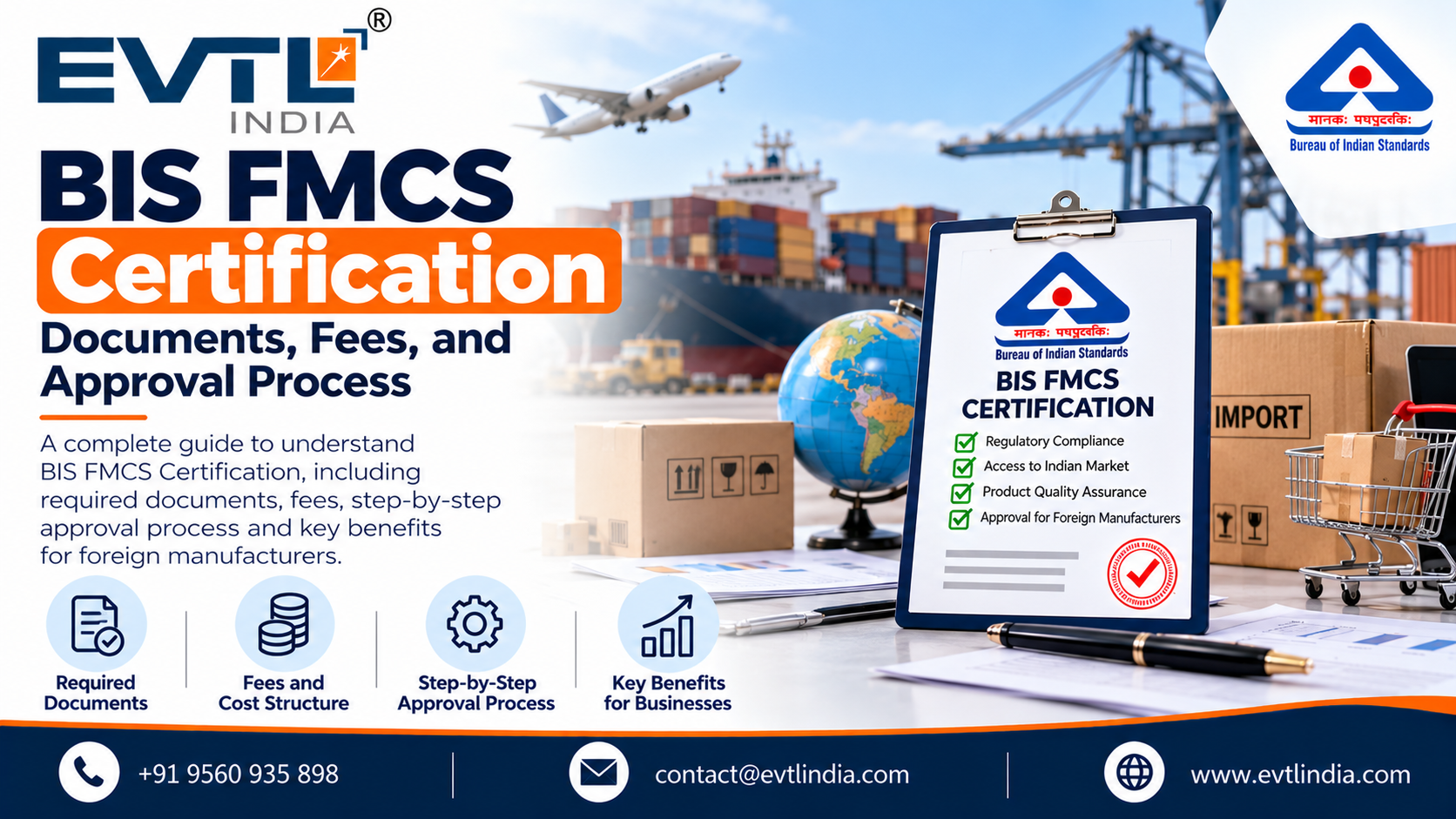
India is one of the world's major manufacturing and consumer markets, offering significant business opportunities for international companies. However, foreign manufacturers planning to export regulated products to India must comply with the applicable Indian quality and safety standards. Depending on the product category, obtaining a valid BIS licence may be mandatory before products can be imported, distributed or sold in the Indian market.
The Foreign Manufacturers Certification Scheme (FMCS) is operated by the Bureau of Indian Standards (BIS) to allow manufacturers with factories located outside India to obtain certification for products conforming to relevant Indian Standards (IS).
Under BIS FMCS Certification, eligible foreign manufacturers receive a BIS licence to use the ISI Mark on approved products. The certification process includes application scrutiny, factory inspection, product sample testing and verification of manufacturing and quality control facilities.
For international companies planning to enter the Indian market, FMCS certification is an important step towards meeting applicable regulatory requirements and establishing confidence among Indian importers, distributors and customers.
What Is the Foreign Manufacturers Certification Scheme (FMCS)?
The Foreign Manufacturers Certification Scheme is a product certification programme introduced by BIS in 2000. It operates under Scheme-I of Schedule-II of the BIS (Conformity Assessment) Regulations, 2018, in accordance with the BIS Act, 2016.
The scheme allows overseas manufacturing companies to obtain a BIS licence for products that meet the requirements of the relevant Indian Standards. The certification is managed by the Foreign Manufacturers Certification Department (FMCD) at BIS Headquarters in New Delhi.
Unlike domestic manufacturers, foreign companies must apply through the FMCS route. They must also nominate an Authorized Indian Representative (AIR) to coordinate with BIS and fulfil the prescribed responsibilities in India.
It is important to understand that FMCS certification is not automatically required for every imported product. Its applicability depends on the relevant Indian Standard, Quality Control Order (QCO) and other applicable government notifications.
Who Needs BIS FMCS Certification?
BIS FMCS certification is intended for manufacturers whose production facilities are located outside India and who want to sell products covered under applicable BIS certification requirements.
The following categories of manufacturers may need to obtain FMCS certification:
-
Steel and Metal Manufacturers: Manufacturers of steel pipes, stainless steel products and other regulated metal products.
-
Electrical Equipment Manufacturers: Overseas companies manufacturing electrical products covered under mandatory BIS requirements.
-
Construction Material Manufacturers: Manufacturers of cement, building materials and other regulated construction products.
-
Industrial Product Manufacturers: Companies producing engineering components, machinery and mechanical products.
-
Consumer Product Manufacturers: Foreign companies manufacturing consumer goods covered under applicable Indian Standards.
The requirement depends on the specific product and applicable government notifications. Electronics and IT products notified under the BIS Compulsory Registration Scheme (CRS) follow a separate certification route rather than FMCS.
Eligibility Criteria for BIS FMCS Certification
Before applying for BIS FMCS certification, foreign manufacturers must fulfil certain conditions prescribed by BIS.
The major eligibility requirements include:
-
Foreign Manufacturing Facility: The manufacturing factory must be located outside India.
-
Indian Standard Compliance: Products must meet the requirements of the applicable Indian Standard.
-
Manufacturing Infrastructure: The factory must have the necessary manufacturing machinery and production facilities.
-
Testing Facilities: Appropriate testing equipment and competent technical personnel must be available at the manufacturing premises.
-
Quality Control System: The manufacturer must maintain suitable quality control arrangements to ensure consistent product quality.
-
Authorized Indian Representative: An eligible AIR must be nominated according to BIS requirements.
-
Acceptance of BIS Conditions: The manufacturer must agree to the applicable Scheme of Testing and Inspection (STI), marking fee and licence conditions.
A separate application is required for each product or Indian Standard and each manufacturing location.
BIS FMCS Certification Process: Step-by-Step Guide
Obtaining a BIS FMCS licence involves several stages. Foreign manufacturers must complete the prescribed documentation, factory assessment and product testing requirements before receiving approval.
Step 1: Identify the Applicable Indian Standard
First, identify the Indian Standard applicable to the product. Manufacturers should also check whether the product is covered under a mandatory Quality Control Order (QCO).
Step 2: Appoint an Authorized Indian Representative
The foreign manufacturer must nominate an eligible Authorized Indian Representative (AIR) to coordinate with BIS and manage certification-related responsibilities in India.
Step 3: Prepare the Required Documents
Collect company registration documents, manufacturing details, factory layout, machinery information, testing equipment details and other supporting documents.
Step 4: Submit the BIS FMCS Application
Submit the completed application through the official BIS Manakonline portal along with the required documents and applicable fees. Since 1 June 2026, BIS has accepted FMCS applications only through the online portal.
Step 5: Application Verification
BIS examines the submitted application and supporting documents. If any information is missing or clarification is required, the applicant must respond to the queries.
Step 6: Factory Inspection
BIS officials visit the foreign manufacturing facility to assess production infrastructure, quality control arrangements, manufacturing processes and in-house testing facilities.
Step 7: Product Sample Testing
Product samples are tested against the applicable Indian Standard in a BIS laboratory or BIS-recognised laboratory, as required.
Step 8: Compliance and Licence Formalities
The manufacturer must address any identified deficiencies, satisfy the applicable testing and inspection requirements and complete the prescribed payment and licensing formalities.
Step 9: Grant of BIS FMCS Licence
After successful completion of the required assessment, BIS grants the licence to use the ISI Mark on approved products manufactured at the licensed premises.
Documents Required for BIS FMCS Certification
Proper documentation is essential for a smooth certification process. Foreign manufacturers generally need to prepare the following documents:
-
Company registration certificate or business licence.
-
Completed BIS FMCS application.
-
Factory address and manufacturing details.
-
Manufacturing process flow chart.
-
Factory layout plan.
-
List of manufacturing machinery and equipment.
-
Details of in-house testing facilities.
-
Calibration certificates of testing equipment.
-
Quality control procedures and records.
-
Product specifications and technical drawings.
-
Raw material details and relevant test reports.
-
Authorized Indian Representative nomination documents.
-
Trademark registration or brand authorisation documents, where applicable.
-
Required declarations and undertakings.
The exact documentation may vary depending on the applicable Indian Standard and product-specific requirements.
Role of Authorized Indian Representative (AIR)
An Authorized Indian Representative plays an important role in the FMCS certification process. The AIR acts as the official point of contact between the foreign manufacturer and BIS in India.
The representative helps coordinate application submission, documentation, communication with BIS officials, factory inspection arrangements and other certification-related activities.
The AIR must fulfil the eligibility and nomination requirements prescribed by BIS. Appointing an AIR does not remove the foreign manufacturer's responsibility for product quality and compliance with licence conditions.
BIS FMCS Certification Fees and Validity
The total cost of FMCS certification depends on the product category, applicable Indian Standard, testing requirements and location of the manufacturing facility.
The main cost components generally include:
-
BIS application fee.
-
Product testing charges.
-
Factory inspection and special visit charges.
-
BIS officials' travel, accommodation and applicable allowances.
-
Applicable marking fee.
-
Annual licence and renewal fees.
Foreign manufacturers should check the latest BIS fee schedule before submitting their applications, as charges may vary according to the applicable requirements.
Under the BIS certification framework, an FMCS licence may initially be granted for up to two years. It can subsequently be renewed for a period of up to five years, subject to the applicable renewal conditions and satisfactory compliance.
How EVTL India Helps with BIS FMCS Certification
Obtaining BIS FMCS certification can be challenging for foreign manufacturers because the process involves Indian regulatory requirements, technical documentation, factory inspections and product testing.
EVTL India provides BIS certification consultancy services to help international manufacturers understand and complete the FMCS certification process. Our team assists with identifying applicable Indian Standards, preparing application documents, coordinating AIR-related requirements, managing certification formalities and providing guidance throughout the approval process.
Whether you are a manufacturer of electrical products, steel products, construction materials or industrial components, EVTL India can help you understand the applicable BIS certification requirements before entering the Indian market.
With the right compliance guidance and proper preparation, foreign manufacturers can work towards obtaining their BIS licence and building their business presence in India.

 Arabic
 French
 Spanish
 Portuguese
 Deutsch
 Turkish
 Dutch
 Italiano
 Russian
 Romaian
 Portuguese (Brazil)
 Greek
