


Protecting Critical IT Infrastructure with Data Center Security in the UAE
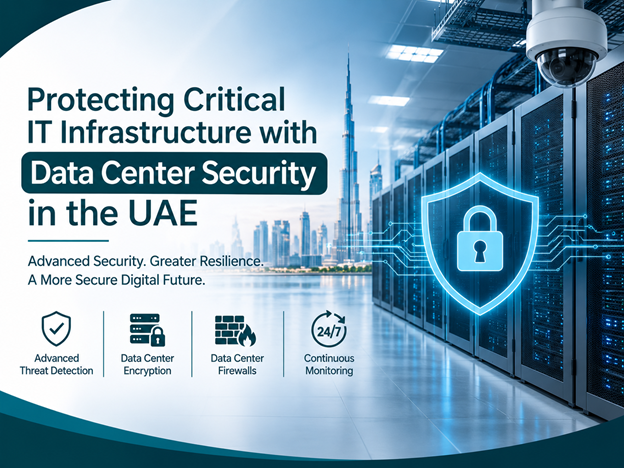
Data Center Security is what keeps the servers, storage, networks, and building systems behind banks, hospitals, airlines, and government services safe and online, and this guide explains how layered protection works for critical IT infrastructure in the Emirates, using five realistic scenarios to show where each layer earns its place.
Why Critical Infrastructure Needs Layers
A modern facility is a single building that holds thousands of systems belonging to many customers. When it fails, payments stop, bookings freeze, patient records vanish, and public services go dark. Because so much depends on so few buildings, leaders across the Emirates treat them as critical national infrastructure.
No single control can stop every problem. Fences can be climbed, passwords can be stolen, software can contain flaws, and people can make mistakes. Layers solve this by making sure that when one defence fails, the next one catches the problem before it becomes a crisis.
Guidance comes from bodies such as the Telecommunications and Digital Government Regulatory Authority, the UAE Information Assurance Regulation, the UAE Cybersecurity Council, the Dubai Electronic Security Center, the Abu Dhabi Digital Authority, and the Central Bank of the UAE for financial customers.
Five Scenarios That Test Your Defences
Scenario One: The Follower at the Door
A stranger in a hi vis jacket follows a technician through a secure door and walks toward the server hall. Good design stops this with a vestibule that lets only one person through at a time, an alarm for doors held open, and cameras that notice a person without a badge. The layers that matter here are physical.
Scenario Two: The Stolen Password
An engineer's password is stolen through a fake email, and an attacker tries to log in from another country. Strong identity checks, minimal privileges, network separation, and alerts for unusual log in places limit what the attacker can reach. The layers that matter here are digital.
Scenario Three: The Careless Insider
A contractor with legitimate access plugs in an unapproved device or opens the wrong cabinet. Permissions tied to work orders, escorts for visitors, logging of every entry, and clear rules about devices reduce the harm that honest mistakes and bad intentions can cause.
Scenario Four: The Power Failure
A grid fault or a failed switch cuts the main power on a hot summer afternoon. Redundant feeds, tested generators, battery systems, and cooling that survives the switchover keep services running. Security also covers availability, not only theft.
Scenario Five: The Fire Alarm
A fault in a cabinet creates smoke. Early detection, suitable suppression, doors that release for escape, and a clear evacuation count protect people first and equipment second. Security rules must never block a safe exit.
Digital Layers: Protecting the Data and the Network
Cybersecurity for Data Center operations starts with asset lists, regular patching, strong identity checks, minimal privileges, and tested backups. Zero trust thinking, where no user or device is trusted by default, has become the common design principle, because it assumes that attackers will sometimes get inside and limits how far they can go.
Data Center Encryption protects stored data, backups, and traffic between sites. Even if a drive is stolen or a link is tapped, the content stays unreadable without the keys. Keys deserve special care, so they live in hardened devices with strict approval, separate custody, and regular rotation, and planning for stronger algorithms has already begun.
Data Center Firewalls divide the network into zones for tenants, storage, and management, and allow only verified traffic between them. Micro segmentation limits how far an intruder can move, and regular rule reviews remove old exceptions that quietly become open doors.
Digital controls work best beside physical ones. Review how perimeter to rack protection services for UAE data centers connect the layers before you plan your own design.
Physical Layers: Protecting the Building and the Racks
Data Center Access Control decides who may reach each hall, cage, and rack. Biometrics, mobile credentials, mantraps, and permissions tied to work orders mean a contractor sees only the rack they were sent to fix. Highly sensitive rooms can demand two people and two credentials, and every entry is recorded for auditors.
Data Center Surveillance now uses video analytics to flag loitering, doors held open, and activity outside working hours. Alerts arrive in seconds instead of after a loss, and clips are linked to door and alarm records so investigators can follow an event from start to finish. Retention periods and access to footage must be documented.
Perimeter First
Fences, vehicle barriers, lighting, and guard posts slow an approach and give staff time to react. Good perimeter design reduces pressure on every inner layer, and it is the cheapest place to stop a problem.
Detection: Seeing Trouble Early
Data Center Intrusion Detection joins fence sensors, door contacts, cage alarms, and network monitoring tools, because an attacker may approach from either direction. A single console shows the whole story instead of scattered alerts, and a control room staffed day and night can react immediately.
Data Center Threat Detection applies behaviour analysis and machine learning to logs and sensor data, so patterns such as repeated failed logins, odd data transfers, or after-hours movement are noticed early. Human analysts remain essential for judging context and deciding what to do next.
Detection is only valuable with practised response. Speak with a UAE data center security specialist about a plan that joins monitoring, escalation, and drills.
Resilience: Power, Cooling, and Recovery
Redundant power paths, tested generators, battery systems, careful airflow design, and suitable fire suppression keep services running when something fails. Efficient cooling also supports national sustainability goals in a hot climate, and smart monitoring spots small faults before they become outages.
Recovery You Have Practised
Backups are only useful if they can be restored. Keep copies offline, rehearse restoring the most important systems, and measure how long recovery really takes. Write clear incident roles so nobody wastes time deciding who is in charge during a crisis.
People and Process
Trained guards, engineers who follow procedures, and managers who run regular drills turn equipment into real protection. Background checks, clear escort rules, change control, and honest incident reporting build a culture where small mistakes are caught early. Technology supports these habits, but it cannot replace them.
Training That Sticks
Short, practical sessions on tailgating, phishing, device rules, and emergency response work better than long annual lectures. Test staff with safe simulations and share lessons without blame.
Standards That Build Confidence
Customers and regulators look for ISO 27001 for information security, TIA 942 and Uptime tiers for facility design, and UAE Civil Defence approval for fire and life safety. The Personal Data Protection Law, Federal Decree Law Number 45 of 2021, and the data rules of DIFC and ADGM add privacy duties for personal data held in data centers. Evidence such as policies, drawings, test records, and incident logs should be current and easy to show.
Local Conditions Across the Emirates
A Data Center Security UAE strategy should work across emirates, with shared policies, consistent reporting, and support teams that can reach any site. This consistency simplifies audits for national customers and lets a head office compare sites on equal terms.
Data Center Security Abu Dhabi projects often serve government entities, energy companies, and the ADGM district, where approval workflows and strict audit trails are common. Long perimeters, desert dust, and extreme summer heat shape the choice of equipment and the cooling design.
Data Center Security Dubai projects often serve financial firms, free zone companies, and cloud providers, where dense urban sites, heat, and humidity call for compact layouts and resilient cooling. Neighbouring towers and busy roads add extra attention to perimeter planning.
Proof Points That Build Trust
Choosing a partner is a security decision. Ask for certified engineers, documented data center projects, written service levels, local spare parts, and honest advice about limits. Reference sites of similar size are the strongest evidence, and a short review of your own facility is the most convincing proof of all.
Questions to Ask a Supplier
How are alarms tested? Who responds at night? What happens during a network fault? How are firmware updates handled? How is personal data protected in the camera and door systems? Clear written answers separate dependable partners from sales talk.
Measuring Whether Protection Works
Numbers show whether layers are working. Track the time from alarm to response, the number of doors held open or forced, failed log in attempts, patch delays, backup restore times, and the results of every drill. Review them monthly with operations teams and quarterly with leadership, and set targets for improvement so security spending is tied to results.
Learning from Incidents
Every incident, large or small, should end with a short review: what happened, which layer caught it, which layer missed it, and what will change. Sharing these lessons across sites turns each event into a stronger defence.
A Practical Roadmap
Begin with a list of assets, doors, and accounts. Remove unused access, patch known flaws, test backups, and write simple procedures. Next, connect door, camera, and alarm records into one view, add analytics, and automate alerts. Then rehearse full outage and intrusion drills, seek independent audits, and measure response times. Report results to leadership every quarter in plain language.
Conclusion
Strong Data Center Security protects critical IT infrastructure, and Cybersecurity for Data Center practice sits at its core, backed by Data Center Encryption and Data Center Firewalls. Data Center Access Control and Data Center Surveillance guard the doors, aisles, and racks, while Data Center Intrusion Detection and Data Center Threat Detection give early warning. A planned Data Center Security UAE roadmap, including Data Center Security Abu Dhabi and Data Center Security Dubai sites, keeps services compliant and resilient. Contact Tektronix today to schedule your facility review.
FAQs
1. What is the first step in Cybersecurity for Data Center improvement?
List every asset and account, remove unused access, and patch known flaws before buying new tools.
2. How do Data Center Firewalls limit an intruder?
They divide networks into zones and allow only verified traffic between them, so one compromise cannot spread freely.
3. What does Data Center Surveillance add with analytics?
It flags loitering, open doors, and after hours activity within seconds and links clips to door and alarm records.
4. How does Data Center Threat Detection shorten response time?
It combines logs, sensors, and behaviour analysis into one view, so unusual events raise an alert quickly.
5. Why does a Data Center Security UAE plan need consistent reporting?
Shared policies and reports simplify audits for national customers and let a head office compare sites fairly.

 English
 Arabic
 French
 Portuguese
 Deutsch
 Turkish
 Dutch
 Italiano
 Russian
 Romaian
 Portuguese (Brazil)
 Greek
