


Montana Is Huge: A Region-by-Region Guide to Where to Actually Go
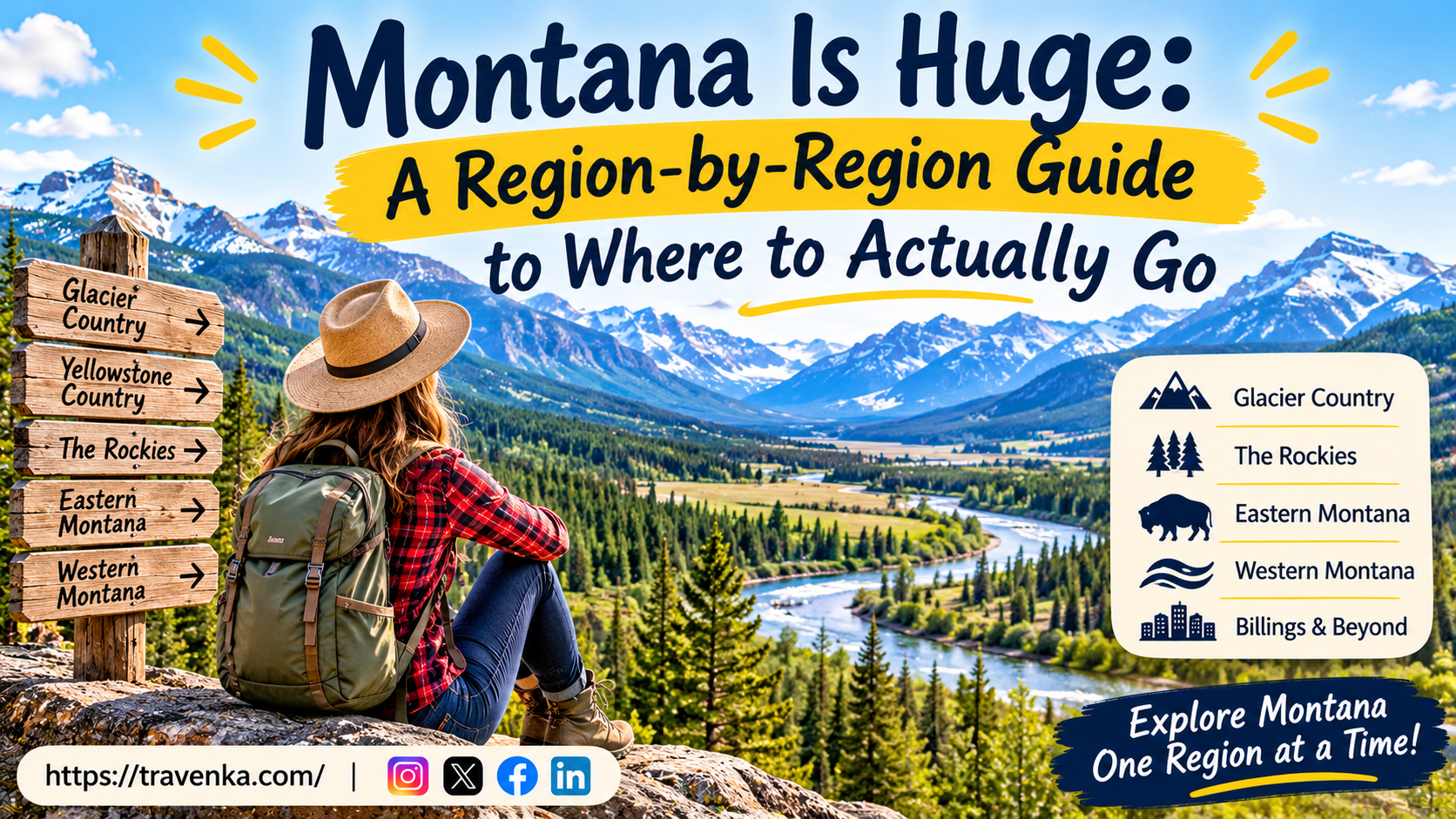
The first mistake most people make with Montana is underestimating the size. It's the fourth largest state in the country, and driving from one end to the other takes well over ten hours. Trying to see everything in a week is a recipe for a lot of time in the car. The good news is that the list of things to do in Montana is long enough that picking one or two regions and sticking to them makes for a much better trip.
So here's the state broken into chunks, with what each one is good for.
Before anything else: a few basics
Summers are the busy season, especially in the national parks. Days are long, the weather is warm and dry, and almost everything is open. Winters are cold, snowy, and great for skiing, but some roads and attractions shut down. Spring and fall are quieter and cheaper, with unpredictable weather and some seasonal closures.
Distances are big, and gas stations can be far apart in rural stretches. Fill the tank when it gets to half, not when the light comes on. Cell service drops out in the mountains too, so downloading maps ahead is smart.
And wildlife is real. Bison, elk, moose, and bears all live here. Bear spray isn't a gimmick, and most visitors who hike in grizzly country carry it and learn how to use it.
Northwest Montana: Glacier and the lakes
This corner is the postcard version. Glacier National Park has jagged peaks, turquoise lakes, and trails that range from easy lakeside strolls to serious backcountry routes. The famous Going-to-the-Sun Road crosses the park, but it usually only opens fully in the summer once the snow clears, typically around late June or July, and it closes again in the fall. Vehicle reservation rules have been used in recent seasons, so checking the park's current requirements before the trip is a must.
Just outside the park, towns like Whitefish and Kalispell make good bases. Whitefish has a ski resort, a lively downtown, and plenty of restaurants and breweries. In summer, the same mountain turns into a hiking and mountain biking spot.
Flathead Lake is nearby too. It's often described as the largest natural freshwater lake west of the Mississippi, and it's gorgeous for boating, swimming, and cherry picking in late summer. The water's cold, but the views make up for it.
Southwest Montana: Yellowstone and the mountains
Most of Yellowstone National Park sits in Wyoming, but parts of it spill into Montana, and the gateway towns are right there. Gardiner, at the north entrance, and West Yellowstone, at the west entrance, are both in Montana. From either, it's an easy drive to geysers, hot springs, and wildlife-watching in Lamar Valley, which is famous for wolves and bison.
Bozeman is the big city of this region and a fun home base. It has a lively main street, a college-town feel, and the Museum of the Rockies, which has an excellent dinosaur collection that's a big draw for kids and adults alike. Skiing at nearby Bridger Bowl in winter and hiking in the surrounding hills in summer round things out.
For something more relaxed, the small town of Livingston has a cowboy-meets-art-gallery vibe, and nearby hot springs, like Chico, offer a soak with mountain views. Fly fishing is huge around here too, with the Gallatin, Madison, and Yellowstone Rivers all considered world class. Even people who've never touched a rod can hire a guide for a day and have a great time.
Western Montana: Missoula and the valleys
Missoula sits where several valleys meet and feels like the cultural heart of the western part of the state. It's home to the University of Montana, a strong food scene, and plenty of outdoor access. The Clark Fork River runs right through town, and in summer people float it in tubes, surf its waves, and picnic along the banks. A Saturday farmers market is a local favorite.
From Missoula, easy day trips lead to hot springs, small mountain towns, and hiking trails with big views. The Bitterroot Valley to the south is quieter and full of farms, with good fishing and mountain scenery.
Central Montana: wide open and underrated
This part of the state sees fewer visitors, which is exactly why some travelers love it. Great Falls is known for its waterfalls on the Missouri River and for the Lewis and Clark history that runs through the region. The Charles M. Russell museum there honors one of the West's best-known artists.
Helena, the state capital, has a historic downtown and a walkable feel. Nearby, the Gates of the Mountains boat tour gives a calm look at the Missouri River canyon. These places work well as stops on a longer road trip and are usually less crowded.
Southern Montana: Red Lodge and the Beartooths
The Beartooth Highway is one of the most scenic drives in the country. It starts near Red Lodge and climbs high into the mountains, with switchbacks, alpine lakes, and wide views. It's generally open from late spring until early fall, but heavy snow can close it at either end, so checking road conditions is essential.
Red Lodge itself is a cute little town, with a western main street and good places to eat. Skiing in winter and hiking in summer both bring people in.
Eastern Montana: history and space
The east side is open prairie, badlands, and big skies. It's where much of the state's Native American and frontier history sits. Little Bighorn Battlefield National Monument, near Crow Agency, marks the site of a famous 1876 battle, and the visitor center offers perspectives from both Native and U.S. Army sides. It's a sobering stop, and worth the time.
Further east, Makoshika State Park near Glendive has dramatic badlands and dinosaur fossils. It's less crowded than the western parks, with a lonely beauty that's hard to find elsewhere.
Seasons, briefly
Summer is the best for hiking, camping, and park visits, but it's crowded and pricey around Glacier and Yellowstone.
Fall brings golden larches and aspens and thinner crowds, though some facilities close.
Winter suits skiers, snowshoers, and anyone who likes a quiet, snowy landscape. Driving can be tricky.
Spring is mud season in many places. Some roads and trails are still closed, but prices drop and wildlife is active.
A few practical tips
-
Rent a car. Public transit is limited outside the bigger towns.
-
Book early for summer lodging near the parks, since it fills up months ahead.
-
Carry bear spray and learn how to use it before heading out on trails.
-
Pack layers. Mountain weather changes fast, even in July.
-
Respect wildlife. Stay far from bison and other animals, no matter how calm they look.
The takeaway
Montana rewards people who slow down. Pick a region, leave room in the schedule for random stops, and don't try to cram too much in. The mountains, the rivers, and the empty roads tend to do the rest.
Travenka guide to things to do in Montana has more details on the best stops, and it's a handy companion when planning a route.

 English
 French
 Spanish
 Portuguese
 Deutsch
 Turkish
 Dutch
 Italiano
 Russian
 Romaian
 Portuguese (Brazil)
 Greek
